115195
论文已发表
注册即可获取德孚的最新动态
IF 收录期刊
- 3.6 Breast Cancer (Dove Med Press)
- 4.3 Clin Epidemiol
- 2.6 Cancer Manag Res
- 3.2 Infect Drug Resist
- 4.1 Clin Interv Aging
- 6.1 Drug Des Dev Ther
- 4.1 Int J Chronic Obstr
- 8.7 Int J Nanomed
- 2.5 Int J Women's Health
- 3.2 Neuropsych Dis Treat
- 2.4 OncoTargets Ther
- 2.6 Patient Prefer Adher
- 2.6 Ther Clin Risk Manag
- 3.1 J Pain Res
- 3.5 Diabet Metab Synd Ob
- 4.5 Psychol Res Behav Ma
- 3.4 Nat Sci Sleep
- 2.4 Pharmgenomics Pers Med
- 2.6 Risk Manag Healthc Policy
- 4.6 J Inflamm Res
- 2.3 Int J Gen Med
- 3.9 J Hepatocell Carcinoma
- 3.3 J Asthma Allergy
- 2.5 Clin Cosmet Investig Dermatol
- 3.0 J Multidiscip Healthc

手术后阴性淋巴结数量与胆囊癌病因特异性存活时间呈正相关
Authors Lin JY, Bai DS, Zhou BH, Chen P, Qian JJ, Jin SJ, Jiang GQ
Received 17 September 2018
Accepted for publication 14 November 2018
Published 13 December 2018 Volume 2018:10 Pages 6961—6969
DOI https://doi.org/10.2147/CMAR.S187857
Checked for plagiarism Yes
Review by Single-blind
Peer reviewers approved by Dr Colin Mak
Peer reviewer comments 3
Editor who approved publication: Dr Chien-Feng Li
Background: Although
the prognostic implications of negative lymph nodes (NLNs) has been reported
for a variety of tumors, little information has been published about the NLNs
in gallbladder cancer (GBC).
Patients and methods: In this study,
clinicopathological characteristics and survival times of patients who had
undergone surgery for GBC were collected from the Surveillance, Epidemiology,
and End Results Program-registered TNM stage database and analyzed. Univariate
and multivariate Cox proportional hazards models were used to identify the
predictors of survival.
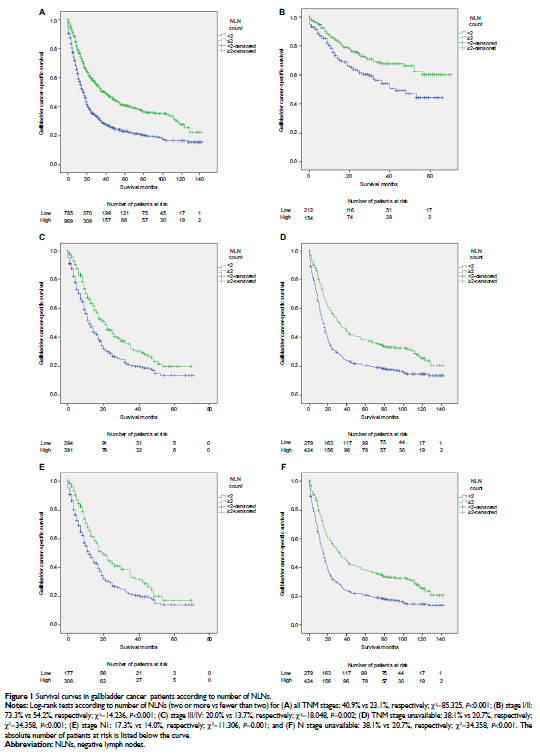
Results: It was found
that a cutoff of one to two NLNs is optimal when assessing the association with
survival, survival rates being consistently better with two or more NLNs than
with fewer than two. This optimal cutoff value of 2 was identified as an
independent prognostic factor by univariate and multivariate analyses
(all P <0.001).
Specifically, patients with two or more NLNs had better 5-year gallbladder
cancer cause-specific survival than those with fewer than NLNs examined for
stage I/II, stage III/IV, and all TNM stages (all P <0.001).
Conclusion: Our
findings indicate that the number of NLNs is an independent prognostic factor
after GBC surgery, and, together with the number of positive lymph nodes, this
will provide better prognostic information than the number of positive lymph
nodes alone.
Keywords: gallbladder
cancer, SEER, surgery, survival analysis, negative lymph nodes