115195
论文已发表
注册即可获取德孚的最新动态
IF 收录期刊
- 3.6 Breast Cancer (Dove Med Press)
- 4.3 Clin Epidemiol
- 2.6 Cancer Manag Res
- 3.2 Infect Drug Resist
- 4.1 Clin Interv Aging
- 6.1 Drug Des Dev Ther
- 4.1 Int J Chronic Obstr
- 8.7 Int J Nanomed
- 2.5 Int J Women's Health
- 3.2 Neuropsych Dis Treat
- 2.4 OncoTargets Ther
- 2.6 Patient Prefer Adher
- 2.6 Ther Clin Risk Manag
- 3.1 J Pain Res
- 3.5 Diabet Metab Synd Ob
- 4.5 Psychol Res Behav Ma
- 3.4 Nat Sci Sleep
- 2.4 Pharmgenomics Pers Med
- 2.6 Risk Manag Healthc Policy
- 4.6 J Inflamm Res
- 2.3 Int J Gen Med
- 3.9 J Hepatocell Carcinoma
- 3.3 J Asthma Allergy
- 2.5 Clin Cosmet Investig Dermatol
- 3.0 J Multidiscip Healthc

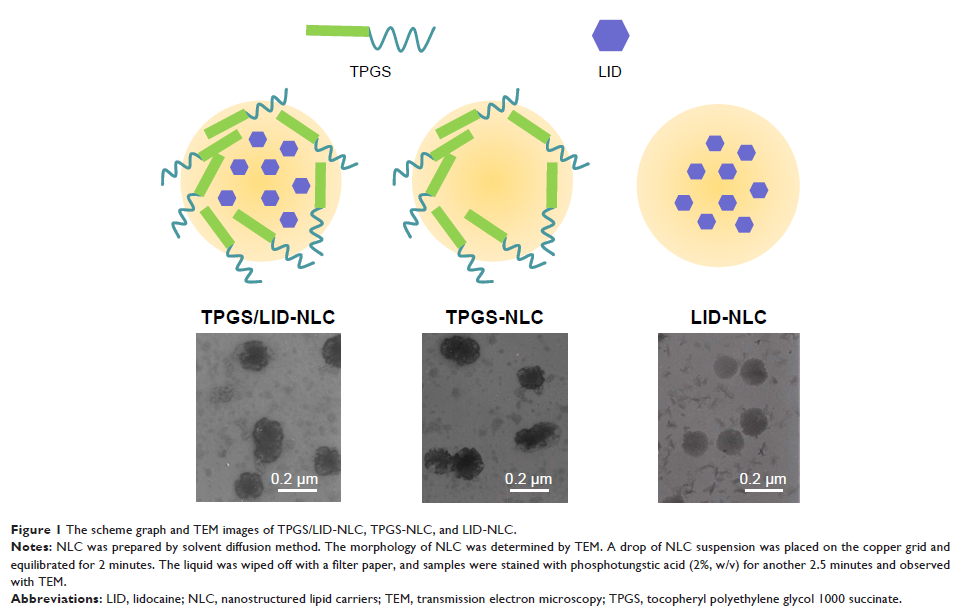
使用负载利多卡因的纳米结构脂质载体的局部麻醉治疗:生育酚聚乙二醇 1000 琥珀酸酯修饰的透皮递送系统
Authors Zhao X, Sun Y, Li Z
Received 11 September 2018
Accepted for publication 21 November 2018
Published 13 December 2018 Volume 2018:12 Pages 4231—4240
DOI https://doi.org/10.2147/DDDT.S187177
Checked for plagiarism Yes
Review by Single-blind
Peer reviewers approved by Dr Colin Mak
Peer reviewer comments 3
Editor who approved publication: Dr Tuo Deng
Purpose: Transdermal
drug delivery of local anesthetics using lipid nanoparticles could enhance
lipophilic drugs permeation through the stratum corneum, improve drug diffusion
to deeper skin, and exert good therapeutic effects. The purpose of this study
was to engineer a Tocopheryl Polyethylene Glycol 1000 Succinate (TPGS)-modified
cationic nanostructured lipid carriers (NLC) for the delivery of lidocaine
(LID; TPGS/LID-NLC).
Materials and methods: TPGS/LID-NLC
was prepared by solvent diffusion method. The particle size, polydispersity
index, zeta potential, drug entrapment efficiency, drug loading, stability,
drug release, and cytotoxicity were tested to evaluate the basic characters of
NLC. In vitro skin permeation and in vivo anesthesia effect in an animal model
were further investigated to determine the therapeutic efficiency of the
system.
Results: TPGS/LID-NLC
had a particle size of 167.6±4.3 nm, a zeta potential of +21.2±2.3 mV, an
entrapment efficiency of 85.9%±3.1%, and a drug loading of 11.5%±0.9%. A
sustained release pattern was achieved by TPGS/LID-NLC, with 81.2% of LID
released at 72 hours. In vitro permeation study showed that the steady-state
fluxes (Jss), permeability coefficient (Kp), and
cumulative drug permeation Qn at 72 hours (Q72) of
TPGS/LID-NLC were 15.6±1.8 µg/cm2/hour, 10.3±0.9 cm/hour (×10-3), and
547.5±23.6 µg/cm2, respectively, which were significantly higher
than the nonmodified NLC and free drug groups. In vivo anesthesia effect of
TPGS/LID-NLC was the most remarkable and long acting among the formulations
tested, which could be concluded by the most considerable maximum possible
effect from 10 to 120 minutes during the whole research.
Conclusion: The most
prominent in vitro permeation efficiency and in vivo anesthetic effect of
TPGS/LID-NLC could be the evidence that TPGS-modified NLC could function as a
promising drug delivery system for prolonged and efficient local anesthetic
therapy.
Keywords: local
anesthetics, transdermal delivery, tocopheryl succinate, nanostructured lipid
carriers, lidocaine