115195
论文已发表
注册即可获取德孚的最新动态
IF 收录期刊
- 3.6 Breast Cancer (Dove Med Press)
- 4.3 Clin Epidemiol
- 2.6 Cancer Manag Res
- 3.2 Infect Drug Resist
- 4.1 Clin Interv Aging
- 6.1 Drug Des Dev Ther
- 4.1 Int J Chronic Obstr
- 8.7 Int J Nanomed
- 2.5 Int J Women's Health
- 3.2 Neuropsych Dis Treat
- 2.4 OncoTargets Ther
- 2.6 Patient Prefer Adher
- 2.6 Ther Clin Risk Manag
- 3.1 J Pain Res
- 3.5 Diabet Metab Synd Ob
- 4.5 Psychol Res Behav Ma
- 3.4 Nat Sci Sleep
- 2.4 Pharmgenomics Pers Med
- 2.6 Risk Manag Healthc Policy
- 4.6 J Inflamm Res
- 2.3 Int J Gen Med
- 3.9 J Hepatocell Carcinoma
- 3.3 J Asthma Allergy
- 2.5 Clin Cosmet Investig Dermatol
- 3.0 J Multidiscip Healthc

奥氮平对女性精神分裂症患者血清催乳素水平和 BMI 的影响
Authors Yang F, Chen L, Fang X, Zheng K, Zhu C, Xu C, Zhang C, Tang W
Received 15 July 2018
Accepted for publication 25 September 2018
Published 13 December 2018 Volume 2018:14 Pages 3373—3379
DOI https://doi.org/10.2147/NDT.S180303
Checked for plagiarism Yes
Review by Single-blind
Peer reviewers approved by Dr Andrew Yee
Peer reviewer comments 3
Editor who approved publication: Dr Yu-Ping Ning
Objectives: It has
been well documented that elevation of serum prolactin (PRL) level and weight
gain are common in patients receiving treatment with atypical antipsychotics.
The existing evidences show that serum PRL is elevated in schizophrenic
patients treated with olanzapine. However, little is known about the long-term
effects of olanzapine on PRL levels and weight gain in female patients with
schizophrenia.
Materials and methods: This
study addressed this issue by investigating the relationship between serum PRL
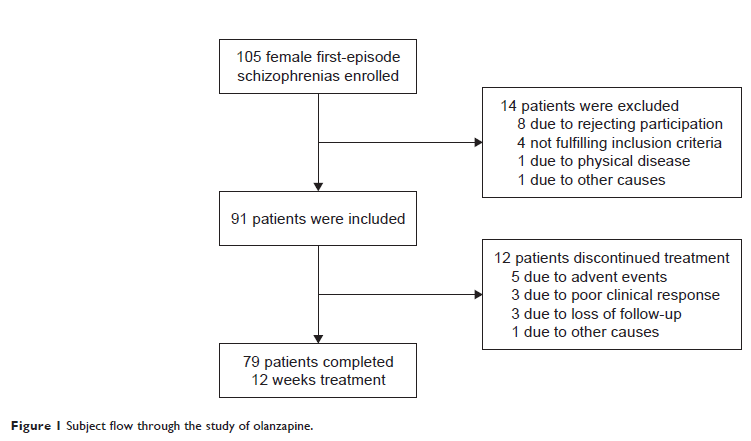
level and body mass index (BMI). Seventy-nine female patients with first-episode
schizophrenia were recruited and received olanzapine monotherapy for 12 weeks.
Serum PRL level and BMI were measured at baseline and at 4, 8, 12 weeks.
Thirty-five age-matched healthy female individuals were recruited as controls.
The severity of psychiatric symptoms was evaluated using the Positive and
Negative Syndrome Scale.
Results: The
olanzapine treatment for 12 weeks significantly increased serum PRL (P <0.01) level
and BMI (P <0.01).
A positive correlation between the pre- and posttreatment changes in serum PRL
level and BMI was observed (r =0.247, P =0.028).
Conclusion: Our
findings suggest that PRL might conceivably modulate weight gain in female
patients with schizophrenia receiving olanzapine treatment; however, the exact
mechanism remains unclear.
Keywords: schizophrenia,
prolactin, BMI, olanzapine