115195
论文已发表
注册即可获取德孚的最新动态
IF 收录期刊
- 3.6 Breast Cancer (Dove Med Press)
- 4.3 Clin Epidemiol
- 2.6 Cancer Manag Res
- 3.2 Infect Drug Resist
- 4.1 Clin Interv Aging
- 6.1 Drug Des Dev Ther
- 4.1 Int J Chronic Obstr
- 8.7 Int J Nanomed
- 2.5 Int J Women's Health
- 3.2 Neuropsych Dis Treat
- 2.4 OncoTargets Ther
- 2.6 Patient Prefer Adher
- 2.6 Ther Clin Risk Manag
- 3.1 J Pain Res
- 3.5 Diabet Metab Synd Ob
- 4.5 Psychol Res Behav Ma
- 3.4 Nat Sci Sleep
- 2.4 Pharmgenomics Pers Med
- 2.6 Risk Manag Healthc Policy
- 4.6 J Inflamm Res
- 2.3 Int J Gen Med
- 3.9 J Hepatocell Carcinoma
- 3.3 J Asthma Allergy
- 2.5 Clin Cosmet Investig Dermatol
- 3.0 J Multidiscip Healthc

miRNA-30c 可用作骨肉瘤诊断和治疗的靶标
Authors Sun R, Muheremu A, Hu Y
Received 23 July 2018
Accepted for publication 25 November 2018
Published 14 December 2018 Volume 2018:11 Pages 9091—9099
DOI https://doi.org/10.2147/OTT.S181177
Checked for plagiarism Yes
Review by Single-blind
Peer reviewers approved by Dr Justinn Cochran
Peer reviewer comments 3
Editor who approved publication: Dr Jianmin Xu
Objective: Osteosarcoma is
a highly malignant osseous sarcoma with poor prognosis. Previous studies indicated
that miRNA-30c may play an important role in the development of osteosarcoma,
but its mechanism is not yet clear. The current research was carried out to
explore the potential applications of miR-30c in the diagnosis and treatment of
osteosarcoma.
Materials and methods: Real-time
PCR and in situ hybridization were used to test the correlation between miR-30c
and the onset of osteosarcoma. In vitro transfection of miR-30 mimic was used
to test the effect of miR-30c on the development of osteosarcoma. Cell Counting
Kit-8, formation of Petri dish clones, in vivo formation of tumor, flow
cytometry tests and Transwell analysis were used to assess the effect of
miR-330c on the metastatic potential and invasiveness of osteosarcoma.
Results: Reverse
transcriptase-PCR analysis and in situ hybridization tests revealed that the
expression of miR-30c was lower in the osteosarcoma tissue than in normal bone
tissue (P <0.05).
Low expression of miR-30c was associated with advanced osteosarcoma staging and
low cellular differentiation. Multivariate analysis revealed that lower
expression of miR-30c was associated with shorter survival of patients (P <0.01). U2OS
cell growth was significantly inhibited when transfected with miR-30c mimic.
Flow cytometry analysis revealed that overexpression of miR-30c could induce
apoptosis of osteosarcoma cells. In vitro Petri dish cloning experiment showed
that overexpression of miR-30c reduced the cloning ratio of U2OS cells from 21%
to 7%. At the same time, overexpression of miR-30c inhibited the formation of
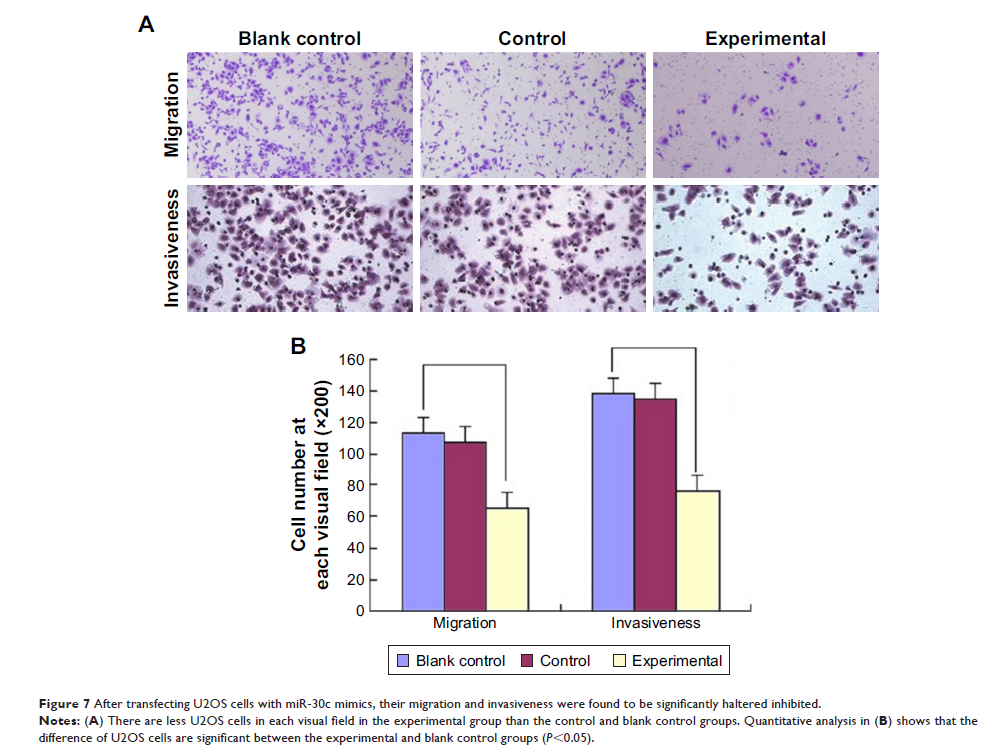
sarcoma in nude mice. Transwell experiments indicated that overexpression of
miR-30c could reduce the invasiveness of U2OS cells.
Conclusion: Low expression
of miR-30c was associated with high probability of onset and aggressiveness of
osteosarcoma and shorter patient survival. Upregulation of miR-30c could
downregulate the invasiveness of osteosarcoma. Therefore, miR-30 can be used in
the development of future diagnostic and therapeutic techniques.
Keywords: miRNA-30c,
osteosarcoma, diagnosis, invasiveness, treatment