115195
论文已发表
注册即可获取德孚的最新动态
IF 收录期刊
- 3.6 Breast Cancer (Dove Med Press)
- 4.3 Clin Epidemiol
- 2.6 Cancer Manag Res
- 3.2 Infect Drug Resist
- 4.1 Clin Interv Aging
- 6.1 Drug Des Dev Ther
- 4.1 Int J Chronic Obstr
- 8.7 Int J Nanomed
- 2.5 Int J Women's Health
- 3.2 Neuropsych Dis Treat
- 2.4 OncoTargets Ther
- 2.6 Patient Prefer Adher
- 2.6 Ther Clin Risk Manag
- 3.1 J Pain Res
- 3.5 Diabet Metab Synd Ob
- 4.5 Psychol Res Behav Ma
- 3.4 Nat Sci Sleep
- 2.4 Pharmgenomics Pers Med
- 2.6 Risk Manag Healthc Policy
- 4.6 J Inflamm Res
- 2.3 Int J Gen Med
- 3.9 J Hepatocell Carcinoma
- 3.3 J Asthma Allergy
- 2.5 Clin Cosmet Investig Dermatol
- 3.0 J Multidiscip Healthc

缺氧诱导因子 1 的天然反义转录物可调节上皮性卵巢癌中的缺氧细胞凋亡
Authors Qiu J, Lin X, Zheng T, Tang X, Hua K
Received 11 May 2018
Accepted for publication 27 August 2018
Published 14 December 2018 Volume 2018:11 Pages 9101—9110
DOI https://doi.org/10.2147/OTT.S173816
Checked for plagiarism Yes
Review by Single-blind
Peer reviewers approved by Dr Colin Mak
Peer reviewer comments 3
Editor who approved publication: Dr Federico Perche
Purpose: Hypoxia
is a key stress that triggers apoptosis in various tumors, including epithelial
ovarian cancer (EOC). Previous researches identified a hypoxia-upregulated
lncRNA named “a natural antisense transcript of hypoxia-inducible factor 1
(aHIF)” in some tumors. However, the contribution of aHIF to EOC remains
unclear. Here, we aimed to investigate the expression, function, and underlying
mechanisms of aHIF in EOC progression under hypoxia.
Materials and methods: Expression
levels of aHIF in EOC tissues were tested. In vitro and in vivo assays were
conducted to explore the function and mechanism of aHIF in hypoxia-induced EOC
progression.
Results: aHIF
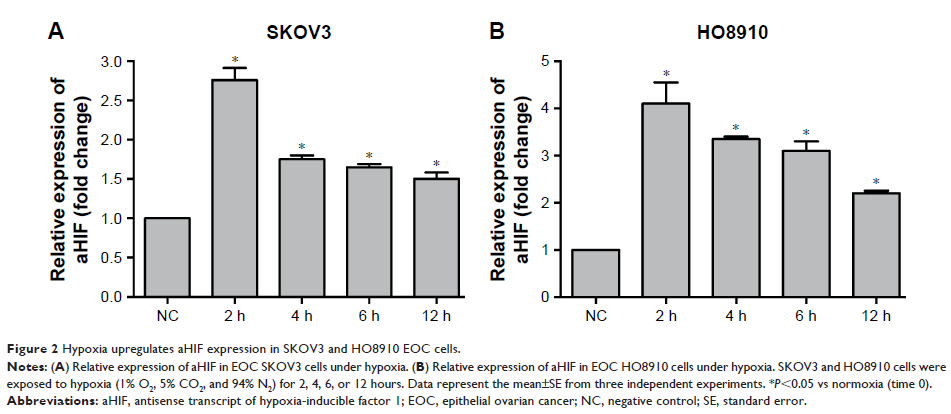
levels were increased in EOC tissues and were upregulated by hypoxia in EOC
cells. Functional data revealed that aHIF knockdown accelerated cell apoptosis
under hypoxia and inhibited EOC tumorigenesis and tumor growth in vivo.
Additionally, aHIF overexpression inhibited cell apoptosis and enhanced cell
proliferation under hypoxia in EOC. Mechanistically, the dysregulation of
certain key mitochondrial apoptosis pathway-related genes, including Bcl-2,
Bax, Caspase-7, and Caspase-9, may partially explain aHIF-regulated EOC
apoptosis and growth under hypoxia.
Conclusion: These data
provide the first convincing evidence that aHIF may inhibit EOC apoptosis and
thereby promote tumor growth through activation of the mitochondrial apoptosis
pathway under hypoxia. Our findings help clarify the role of lncRNA in
hypoxia-induced EOC progression.
Keywords: lncRNA,
hypoxia, microenvironment, tumor growth