115195
论文已发表
注册即可获取德孚的最新动态
IF 收录期刊
- 3.6 Breast Cancer (Dove Med Press)
- 4.3 Clin Epidemiol
- 2.6 Cancer Manag Res
- 3.2 Infect Drug Resist
- 4.1 Clin Interv Aging
- 6.1 Drug Des Dev Ther
- 4.1 Int J Chronic Obstr
- 8.7 Int J Nanomed
- 2.5 Int J Women's Health
- 3.2 Neuropsych Dis Treat
- 2.4 OncoTargets Ther
- 2.6 Patient Prefer Adher
- 2.6 Ther Clin Risk Manag
- 3.1 J Pain Res
- 3.5 Diabet Metab Synd Ob
- 4.5 Psychol Res Behav Ma
- 3.4 Nat Sci Sleep
- 2.4 Pharmgenomics Pers Med
- 2.6 Risk Manag Healthc Policy
- 4.6 J Inflamm Res
- 2.3 Int J Gen Med
- 3.9 J Hepatocell Carcinoma
- 3.3 J Asthma Allergy
- 2.5 Clin Cosmet Investig Dermatol
- 3.0 J Multidiscip Healthc

Syncytin-1 的上调通过激活与子宫内膜癌的上皮 - 间质转化相关的通路促进侵袭和转移
Authors Liu C, Xu J, Wen F, Yang F, Li X, Geng D, Li L, Chen J, Zheng J
Received 16 October 2018
Accepted for publication 21 November 2018
Published 17 December 2018 Volume 2019:12 Pages 31—40
DOI https://doi.org/10.2147/OTT.S191041
Checked for plagiarism Yes
Review by Single-blind
Peer reviewers approved by Dr Justinn Cochran
Peer reviewer comments 2
Editor who approved publication: Dr Leo Jen-Liang Su
Background: Endometrial
carcinoma (EC) is the most common and lethal malignancy worldwide. Syncytin-1
is expressed in multiple types of cancer. However, the expression pattern and
potential mechanism of syncytin-1 and its clinical significance in EC remain
unclear.
Materials and methods: We analyzed 130
primary EC specimens from Binzhou Medical University to investigate the
clinical role of syncytin-1 in EC by using different advanced pathological
stages of EC tissues. Kaplan–Meier analysis was used to measure the overall survival
of EC patients. Syncytin-1 expression was analyzed by Western blot assays in
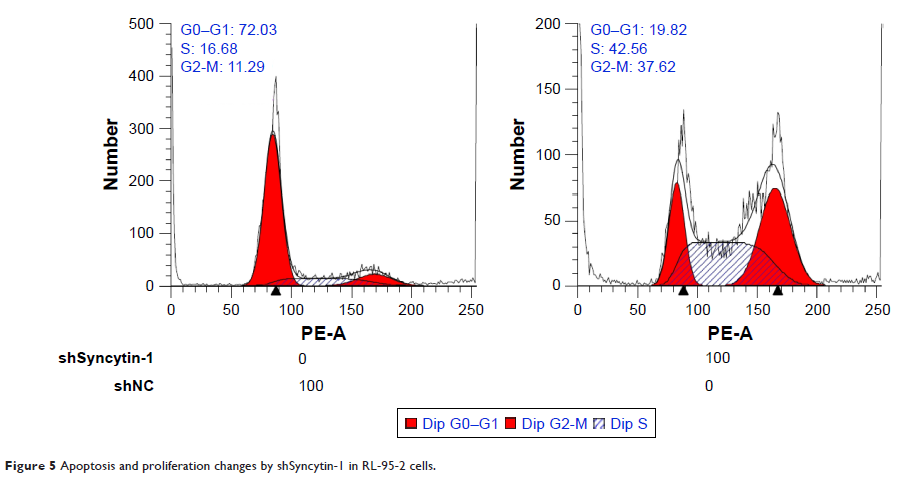
HECCL-1 and RL-95-2 cells. Cell proliferation, cycle, migration, and invasion
abilities were detected by cell counting kit-8, flow cytometry, and transwell
assays. AKT and epithelial-mesenchymal transition (EMT)-related genes were
assessed by Western blot assays in HECCL-1 and RL-95-2 cells.
Results: Syncytin-1 was
upregulated in EC tissues and cells and was related to clinical stages,
expression of ER, Ki-67, and overall survival of EC. Functional research
revealed that overexpression of syncytin-1 can promote cell proliferation, cell
cycle progression, and the migration and invasion of EC cells. Suppression of
syncytin-1 expression also inhibited cell proliferation and apoptosis
in vitro. The expression of syncytin-1 substantially improved the
expression levels of EMT-related genes (vimentin, E-cadherin, slug, and ZEB1)
but significantly decreased those of epithelial markers (N-cadherin and snail).
In addition, we found that syncytin-1 was not correlated with AKT-related genes
(total-AKT, p-AKT, and vinculin).
Conclusion: Our
results suggested that syncytin-1 may promote aggressive behavior and can serve
as a novel prognostic biomarker for EC. Our study provides new insights into
the regulatory mechanism of EMT signaling.
Keywords: syncytin-1,
epithelial-mesenchymal transition, endometrial carcinoma