115195
论文已发表
注册即可获取德孚的最新动态
IF 收录期刊
- 3.6 Breast Cancer (Dove Med Press)
- 4.3 Clin Epidemiol
- 2.6 Cancer Manag Res
- 3.2 Infect Drug Resist
- 4.1 Clin Interv Aging
- 6.1 Drug Des Dev Ther
- 4.1 Int J Chronic Obstr
- 8.7 Int J Nanomed
- 2.5 Int J Women's Health
- 3.2 Neuropsych Dis Treat
- 2.4 OncoTargets Ther
- 2.6 Patient Prefer Adher
- 2.6 Ther Clin Risk Manag
- 3.1 J Pain Res
- 3.5 Diabet Metab Synd Ob
- 4.5 Psychol Res Behav Ma
- 3.4 Nat Sci Sleep
- 2.4 Pharmgenomics Pers Med
- 2.6 Risk Manag Healthc Policy
- 4.6 J Inflamm Res
- 2.3 Int J Gen Med
- 3.9 J Hepatocell Carcinoma
- 3.3 J Asthma Allergy
- 2.5 Clin Cosmet Investig Dermatol
- 3.0 J Multidiscip Healthc

在带状疱疹后神经痛患者的大脑中,5 和 4 慢频率的 ALFF 双向改变
Authors Gu L, Hong S, Jiang J, Liu J, Cao X, Huang Q, Zeng X, Zhou F, Zhang D
Received 4 July 2018
Accepted for publication 9 November 2018
Published 18 December 2018 Volume 2019:12 Pages 39—47
DOI https://doi.org/10.2147/JPR.S179077
Checked for plagiarism Yes
Review by Single-blind
Peer reviewers approved by Dr Cristina Weinberg
Peer reviewer comments 2
Editor who approved publication: Dr E Alfonso Romero-Sandoval
Purpose: Postherpetic
neuralgia (PHN) detrimentally affects brain function. Recent studies have
suggested that frequency-dependent changes in electroencephalography in chronic
pain patients and blood oxygenation level dependent (BOLD) fluctuations can
reflect neuronal activity in different frequencies. The current study aimed to
investigate PHN-related brain oscillatory activity in a specific frequency band
by using the amplitude of low-frequency fluctuation (ALFF) method.
Materials and methods: ALFF changes
were analyzed across different frequencies (slow-4 band: 0.027–0.073 Hz; slow-5
band: 0.01–0.027 Hz; and typical band: 0.01–0.08 Hz) in the brains of PHN
patients and compared with those in the brains of healthy controls (HCs) during
resting-state fMRI. Eighteen HCs and PHN patients underwent fMRI scanning.
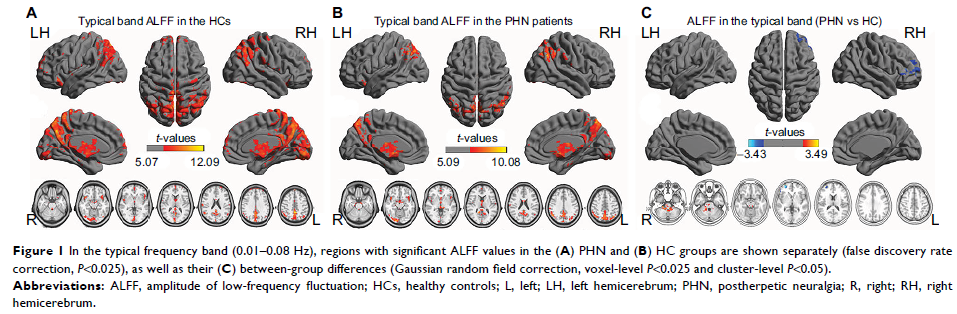
Results: In the
typical band, compared with HCs, PHN patients showed prominently decreased ALFF
in the right prefrontal cortex (Brodmann area 10/46) and increased ALFF in the
bilateral brain stem/cerebellum anterior lobe (BS/CAL). In the slow-4 band, PHN
patients exhibited significantly decreased ALFF in the bilateral cuneus/lingual
gyrus and the right prefrontal cortex. In the slow-5 band, PHN patients
presented significantly increased ALFF in the bilateral BS/CAL and left
parieto-occipital cortex. Moreover, the increased ALFF in the left
parieto-occipital cortex in the slow-5 band was positively correlated with VAS
scores (P =0.022),
and the increased ALFF in the bilateral BS/CAL in the slow-5 band was
positively correlated with disease duration (P =0.020).
Conclusion: Our
results suggested that the intrinsic brain activity of PHN patients was
abnormal and frequency dependent, especially the bidirectional alteration in
ALFF across the slow-4 and slow-5 frequencies in the brains of PHN patients.
Keywords: amplitude of
low-frequency fluctuation, postherpetic neuralgia, functional magnetic
resonance imaging, resting state, pain