115195
论文已发表
注册即可获取德孚的最新动态
IF 收录期刊
- 3.6 Breast Cancer (Dove Med Press)
- 4.3 Clin Epidemiol
- 2.6 Cancer Manag Res
- 3.2 Infect Drug Resist
- 4.1 Clin Interv Aging
- 6.1 Drug Des Dev Ther
- 4.1 Int J Chronic Obstr
- 8.7 Int J Nanomed
- 2.5 Int J Women's Health
- 3.2 Neuropsych Dis Treat
- 2.4 OncoTargets Ther
- 2.6 Patient Prefer Adher
- 2.6 Ther Clin Risk Manag
- 3.1 J Pain Res
- 3.5 Diabet Metab Synd Ob
- 4.5 Psychol Res Behav Ma
- 3.4 Nat Sci Sleep
- 2.4 Pharmgenomics Pers Med
- 2.6 Risk Manag Healthc Policy
- 4.6 J Inflamm Res
- 2.3 Int J Gen Med
- 3.9 J Hepatocell Carcinoma
- 3.3 J Asthma Allergy
- 2.5 Clin Cosmet Investig Dermatol
- 3.0 J Multidiscip Healthc

逍遥散调节海马色氨酸代谢对慢性应激抑郁大鼠抑郁样行为的影响
Authors Jiao H, Yan Z, Ma Q, Li X, Jiang Y, Liu Y, Chen J
Received 25 August 2018
Accepted for publication 12 November 2018
Published 18 December 2018 Volume 2019:15 Pages 21—31
DOI https://doi.org/10.2147/NDT.S185295
Checked for plagiarism Yes
Review by Single-blind
Peer reviewers approved by Dr Andrew Yee
Peer reviewer comments 3
Editor who approved publication: Dr Yu-Ping Ning
Background: Tryptophan
metabolism has always been considered to play a vital role in mental disorder
diseases, and how traditional Chinese formula Xiaoyaosan regulates the
tryptophan metabolism is a complement to the pathogenesis of depression. This
study established a depression rat model by the chronic immobilization stress
(CIS) method and observed the change in tryptophan metabolism in hippocampus
and the effects of Xiaoyaosan.
Methods: Forty-eight
male Sprague Dawley (SD) rats were randomly divided into the following four
groups: control group, CIS group, Xiaoyaosan group, and fluoxetine group. The
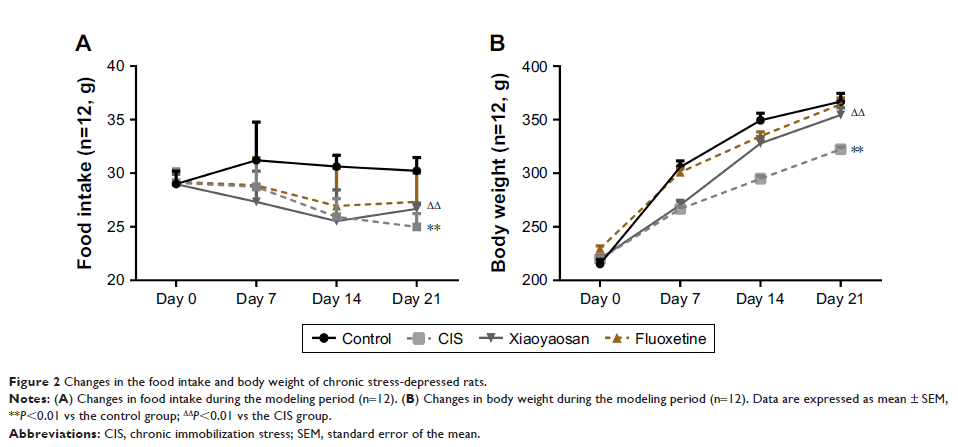
depression model was established by the 21-day CIS. The food intake and body
weight were recorded, and the sucrose preference test (SPT), novelty suppressed
feeding (NSF) test and open field test (OFT) were also used to evaluate the
model. Then, the contents of tryptophan and 5-hydroxytryptamine (5-HT) in
hippocampus were detected by the ELISA method, and the expression levels of
tryptophan hydrogenase 2 (TPH2) and indoleamine 2,3-dioxygenase 1 (IDO1)
in hippocampus were determined by quantitative reverse transcriptase polymerase
chain reaction reaction (qRT-PCR) and Western blot methods.
Results: The behavioral
data showed a significant difference between the model group and the normal
group. The 5-HT content in the hippocampi of CIS rats was significantly
reduced, whereas the tryptophan content in the hippocampi of model rats was
significantly increased. The TPH2 level in hippocampus of the model group was
significantly decreased, and the IDO1 level was significantly increased.
Xiaoyaosan and fluoxetine could significantly reverse these changes and had
obvious curative effects.
Conclusion: The abnormal
tryptophan metabolism existed in the hippocampi of chronic stress-depressed
rats, which was closely related to the pathogenesis of depression. Xiaoyaosan
could improve the tryptophan metabolism by regulating the expression levels of
TPH2 and IDO1, thus exerting an antidepressant-like effect.
Keywords: Xiaoyaosan,
depression, chronic immobilization stress, tryptophan, TPH2, IDO1, traditional
Chinese formula, traditional Chinese medicine