115195
论文已发表
注册即可获取德孚的最新动态
IF 收录期刊
- 3.6 Breast Cancer (Dove Med Press)
- 4.3 Clin Epidemiol
- 2.6 Cancer Manag Res
- 3.2 Infect Drug Resist
- 4.1 Clin Interv Aging
- 6.1 Drug Des Dev Ther
- 4.1 Int J Chronic Obstr
- 8.7 Int J Nanomed
- 2.5 Int J Women's Health
- 3.2 Neuropsych Dis Treat
- 2.4 OncoTargets Ther
- 2.6 Patient Prefer Adher
- 2.6 Ther Clin Risk Manag
- 3.1 J Pain Res
- 3.5 Diabet Metab Synd Ob
- 4.5 Psychol Res Behav Ma
- 3.4 Nat Sci Sleep
- 2.4 Pharmgenomics Pers Med
- 2.6 Risk Manag Healthc Policy
- 4.6 J Inflamm Res
- 2.3 Int J Gen Med
- 3.9 J Hepatocell Carcinoma
- 3.3 J Asthma Allergy
- 2.5 Clin Cosmet Investig Dermatol
- 3.0 J Multidiscip Healthc

美托洛尔对中国 CHF 患者心脏和运动功能、生活质量和心理状态的剂量依赖性影响
Authors Zhang Q, Shu Q, Wu L, Zhang R, Meng Y
Received 19 September 2018
Accepted for publication 23 November 2018
Published 18 December 2018 Volume 2019:15 Pages 23—31
DOI https://doi.org/10.2147/TCRM.S188123
Checked for plagiarism Yes
Review by Single-blind
Peer reviewers approved by Dr Colin Mak
Peer reviewer comments 2
Editor who approved publication: Professor Deyun Wang
Objective: The
objective of the study was to evaluate the dose-related influence of metoprolol
on cardiac performance, motor function, quality of life (QoL), and mental
status in Chinese patients with chronic heart failure (CHF).
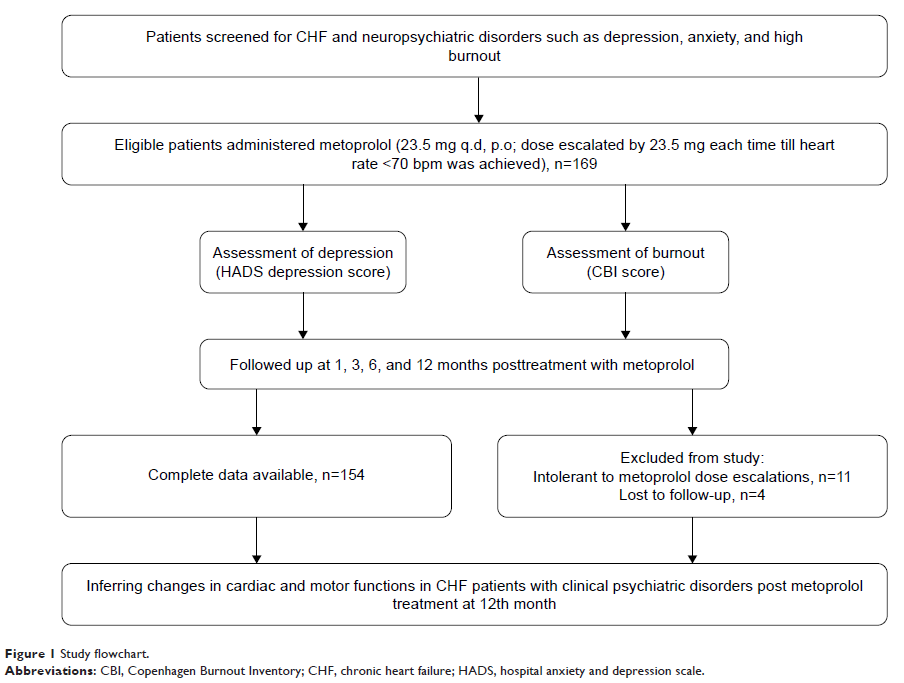
Patients and methods: This was
a prospectively designed single-center study which enrolled CHF patients with
resting heart rate (HR) >80 bpm belonging to the New York Heart Association
(NYHA) III/IV functional classification. Patients were initiated with 12.5 mg
of metoprolol, and every second week, the dose was escalated until the target
HR level (60–70 bpm) was achieved during the follow-up at 1st, 3rd, 6th, and
12th months. Patients were divided into two groups depending on the doses
administered: 47.5 mg (n=37) and 118.75 mg (n=74), respectively, for comparison
in terms of change in cardiac function, motor function, QoL, and mental status.
Results: Among the
111 patients with CHF, no significant difference was shown between the two
doses administered. Irrespective of the dose, the cardiac performance, motor
function, QoL, and anxiety improved and there was an increase in depression,
whereas the effect on burnout, calculated as Copenhagen Burnout Inventory
(CBI), equally was insignificant throughout the 1-year follow-up period in both
the CHF patient groups.
Conclusion: Lower
dose of metoprolol (47.5 mg) is as effective as higher dose (118.75 mg) in
Chinese population with CHF to improve the cardiac function, motor function,
QoL, and mental status.
Keywords: metoprolol,
heart rate, motor function, quality of life, mental status, ejection fraction