115195
论文已发表
注册即可获取德孚的最新动态
IF 收录期刊
- 3.6 Breast Cancer (Dove Med Press)
- 4.3 Clin Epidemiol
- 2.6 Cancer Manag Res
- 3.2 Infect Drug Resist
- 4.1 Clin Interv Aging
- 6.1 Drug Des Dev Ther
- 4.1 Int J Chronic Obstr
- 8.7 Int J Nanomed
- 2.5 Int J Women's Health
- 3.2 Neuropsych Dis Treat
- 2.4 OncoTargets Ther
- 2.6 Patient Prefer Adher
- 2.6 Ther Clin Risk Manag
- 3.1 J Pain Res
- 3.5 Diabet Metab Synd Ob
- 4.5 Psychol Res Behav Ma
- 3.4 Nat Sci Sleep
- 2.4 Pharmgenomics Pers Med
- 2.6 Risk Manag Healthc Policy
- 4.6 J Inflamm Res
- 2.3 Int J Gen Med
- 3.9 J Hepatocell Carcinoma
- 3.3 J Asthma Allergy
- 2.5 Clin Cosmet Investig Dermatol
- 3.0 J Multidiscip Healthc

单节段颈椎前路融合手术是否需要矫正节段性脊柱后凸?一个观察性研究
Authors Lu J, Sun C, Bai J, Tian S, Zhang B, Tian D, Kong L
Received 17 June 2018
Accepted for publication 13 November 2018
Published 19 December 2018 Volume 2019:15 Pages 39—44
DOI https://doi.org/10.2147/TCRM.S177513
Checked for plagiarism Yes
Review by Single-blind
Peer reviewers approved by Dr Andrew Yee
Peer reviewer comments 4
Editor who approved publication: Professor Deyun Wang
Background: This
study was conducted to determine whether sagittal lordotic alignment and
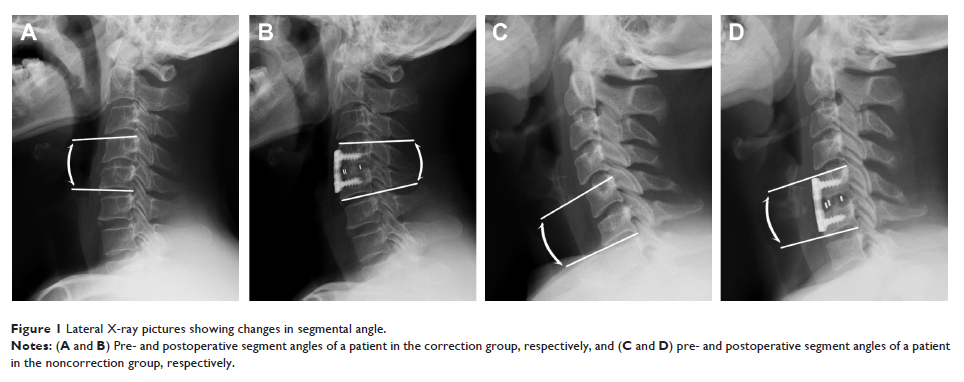
clinical outcomes could be improved by the correction of segmental kyphosis
after single-level anterior cervical discectomy and fusion (ACDF) surgery.
Patients and methods: We
retrospectively reviewed patients who underwent single-level ACDF surgery in
our hospital between January 2014 and February 2017. Basic characteristics of
patients included age at surgery, gender, diagnosis, duration of symptoms, and
location of target level. Pre- and postoperative radiographs at the 6-month
follow-up were used to evaluate the following parameters, such as segmental
angle, C2–C7 angle, T1 slope, and C2–C7 sagittal vertical axis (SVA).
Postoperative clinical outcomes were assessed by the Neck Disability Index and
VAS. According to the segmental angle of postoperative radiographs, patients
were divided into noncorrection group and correction group.
Results: A total
of 181 patients (99 males and 82 females) were analyzed in our study. There
were 32 patients in the noncorrection group and 149 patients in the correction
group. There was no significant difference in demographic and clinical data
between the two groups before surgery. However, patients in the correction
group showed larger C2–C7 angle and lower C2–C7 SVA after surgery in comparison
with those in the noncorrection group. Besides, changes in the segmental angle
were positively correlated with changes in C2–C7 angle and negatively
correlated with changes in C2–C7 SVA.
Conclusion: Surgical
correction of segmental kyphosis in single-level cervical surgery contributed
to balanced cervical alignment in comparison with those without satisfactory
correction. However, we could not demonstrate that the correction of segmental
alignment is associated with a better recovery in clinical outcomes.
Keywords: segmental
kyphosis, sagittal alignment, single level, cervical spine, anterior cervical
discectomy and fusion