115195
论文已发表
注册即可获取德孚的最新动态
IF 收录期刊
- 3.6 Breast Cancer (Dove Med Press)
- 4.3 Clin Epidemiol
- 2.6 Cancer Manag Res
- 3.2 Infect Drug Resist
- 4.1 Clin Interv Aging
- 6.1 Drug Des Dev Ther
- 4.1 Int J Chronic Obstr
- 8.7 Int J Nanomed
- 2.5 Int J Women's Health
- 3.2 Neuropsych Dis Treat
- 2.4 OncoTargets Ther
- 2.6 Patient Prefer Adher
- 2.6 Ther Clin Risk Manag
- 3.1 J Pain Res
- 3.5 Diabet Metab Synd Ob
- 4.5 Psychol Res Behav Ma
- 3.4 Nat Sci Sleep
- 2.4 Pharmgenomics Pers Med
- 2.6 Risk Manag Healthc Policy
- 4.6 J Inflamm Res
- 2.3 Int J Gen Med
- 3.9 J Hepatocell Carcinoma
- 3.3 J Asthma Allergy
- 2.5 Clin Cosmet Investig Dermatol
- 3.0 J Multidiscip Healthc

Development of an e-health app to support women prescribed adjuvant endocrine therapy after treatment for breast cancer
Authors Brett J, Boulton M, Watson E
Received 15 September 2018
Accepted for publication 25 October 2018
Published 11 December 2018 Volume 2018:12 Pages 2639—2647
DOI https://doi.org/10.2147/PPA.S187692
Checked for plagiarism Yes
Review by Single-blind
Peer reviewers approved by Dr Andrew Yee
Peer reviewer comments 2
Editor who approved publication: Dr Johnny Chen
Background: Adjuvant
endocrine therapy (AET) is prescribed to women for 5–10 years after treatment
for estrogen receptor positive (ER+ve), early-stage breast cancer. AET has
proven effectiveness in reducing the risk of recurrence of breast cancer and
mortality. However, adherence is known to be suboptimal with around 20%
discontinuing by 2 years and up to 50% discontinuing by 5 years. Interventions
are needed to support women taking AET after breast cancer. The aim of this
study was to develop and pilot test an e-health app for this population.
Methods: Two focus
groups (n=15) and five interviews were conducted with women following treatment
for early-stage breast cancer to assess the likely acceptability of an e-health
app and to inform the content (Phase I). Following development of a prototype
e-health app, a simple heuristic usability test was completed by five women in
order to identify any design usability problems (Phase II). A further 18 women
used the app for 1 month between July and August 2016, after which they were
interviewed by telephone to collect their experiences and views of the app
(Phase III).
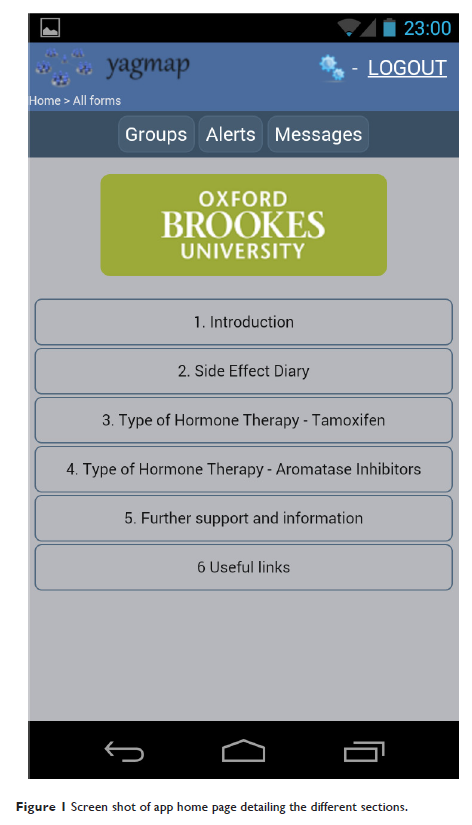
Results: The
prototype e-health app included evidence-based information on effectiveness of
AET, an electronic side-effects diary, a peer support forum, a repeat
prescription reminder, suggested strategies for facilitating adherence and
managing any side effects that occur, and a link to further evidence and useful
organizations for further information and support. The app was received
positively by women. Women found the app useful as it emphasized the importance
of taking AET, helped them manage their side effects and provided details of
support organizations, while offering empathy and exchange of suggestions for
self-management strategies through the peer support forum.
Conclusion: Overall,
findings suggest that this novel e-health app has potential as a feasible
medium for promoting adherence to AET. Future research should evaluate the
efficacy of the app in supporting women and promoting adherence.
Keywords: adjuvant
endocrine therapy, breast cancer, e-health app, support