115195
论文已发表
注册即可获取德孚的最新动态
IF 收录期刊
- 3.6 Breast Cancer (Dove Med Press)
- 4.3 Clin Epidemiol
- 2.6 Cancer Manag Res
- 3.2 Infect Drug Resist
- 4.1 Clin Interv Aging
- 6.1 Drug Des Dev Ther
- 4.1 Int J Chronic Obstr
- 8.7 Int J Nanomed
- 2.5 Int J Women's Health
- 3.2 Neuropsych Dis Treat
- 2.4 OncoTargets Ther
- 2.6 Patient Prefer Adher
- 2.6 Ther Clin Risk Manag
- 3.1 J Pain Res
- 3.5 Diabet Metab Synd Ob
- 4.5 Psychol Res Behav Ma
- 3.4 Nat Sci Sleep
- 2.4 Pharmgenomics Pers Med
- 2.6 Risk Manag Healthc Policy
- 4.6 J Inflamm Res
- 2.3 Int J Gen Med
- 3.9 J Hepatocell Carcinoma
- 3.3 J Asthma Allergy
- 2.5 Clin Cosmet Investig Dermatol
- 3.0 J Multidiscip Healthc

Evaluating associations between the benefits and risks of drug therapy in type 2 diabetes: a joint modeling approach
Authors Dennis JM, Shields BM, Jones AG, Pearson ER, Hattersley AT, Henley WE
Received 16 July 2018
Accepted for publication 24 October 2018
Published 14 December 2018 Volume 2018:10 Pages 1869—1877
DOI https://doi.org/10.2147/CLEP.S179555
Checked for plagiarism Yes
Review by Single-blind
Peer reviewers approved by Dr Amy Norman
Peer reviewer comments 2
Editor who approved publication: Professor Henrik Toft Sørensen
Objective: Precision
medicine drug therapy seeks to maximize efficacy and minimize harm for
individual patients. This will be difficult if drug response and side effects
are positively associated, meaning that patients likely to respond best are at
increased risk of side effects. We applied joint longitudinal–survival models
to evaluate associations between drug response (longitudinal outcome) and the
risk of side effects (survival outcome) for patients initiating type 2 diabetes
therapy.
Study design and setting: Participants
were randomized to metformin (MFN), sulfonylurea (SU), or
thiazolidinedione (TZD) therapy in the A Diabetes Outcome Progression Trial
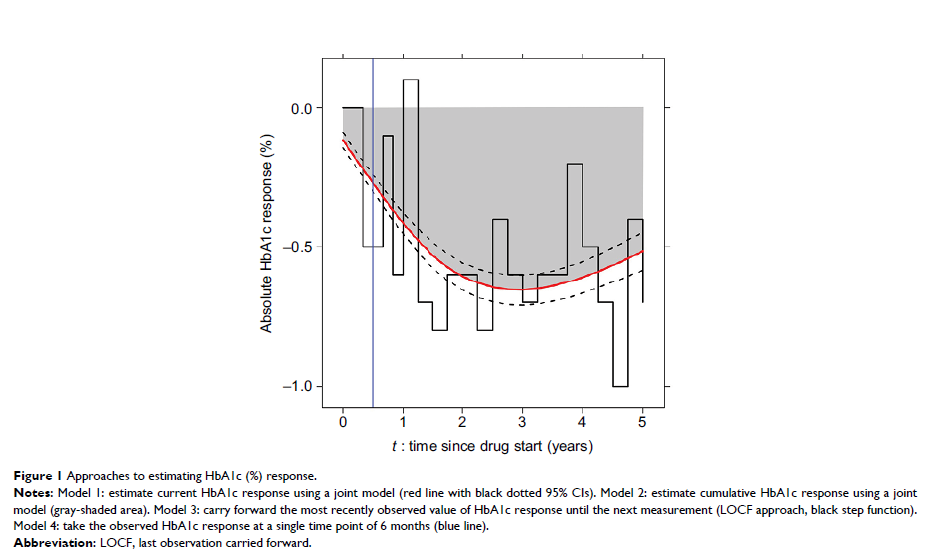
(ADOPT) drug efficacy trial (n=4,351). Joint models were parameterized for 1)
current HbA1c response (change from baseline in HbA1c) and 2) cumulative HbA1c
response (total HbA1c change).
Results: With MFN,
greater HbA1c response did not increase the risk of gastrointestinal events (HR
per 1% absolute greater current response 0.82 [95% CI 0.67, 1.01]; HR per 1%
higher cumulative response 0.90 [95% CI 0.81, 1.00]). With SU, greater current
response was associated with an increased risk of hypoglycemia (HR 1.41 [95% CI
1.04, 1.91]). With TZD, greater response was associated with an increased risk
of edema (current HR 1.45 [95% CI 1.05, 2.01]; cumulative 1.22 [95% CI 1.07,
1.38]) but not fracture.
Conclusion: Joint
modeling provides a useful framework to evaluate the association between
response to a drug and the risk of developing side effects. There may be great
potential for widespread application of joint modeling to evaluate the risks
and benefits of both new and established medications.
Keywords: diabetes
mellitus, type 2, drug-related side effects, HbA1c, hypoglycemia, joint model,
precision medicine, thiazolidinediones, metformin, sulfonylurea compounds,
ADOPT, edema