115195
论文已发表
注册即可获取德孚的最新动态
IF 收录期刊
- 3.6 Breast Cancer (Dove Med Press)
- 4.3 Clin Epidemiol
- 2.6 Cancer Manag Res
- 3.2 Infect Drug Resist
- 4.1 Clin Interv Aging
- 6.1 Drug Des Dev Ther
- 4.1 Int J Chronic Obstr
- 8.7 Int J Nanomed
- 2.5 Int J Women's Health
- 3.2 Neuropsych Dis Treat
- 2.4 OncoTargets Ther
- 2.6 Patient Prefer Adher
- 2.6 Ther Clin Risk Manag
- 3.1 J Pain Res
- 3.5 Diabet Metab Synd Ob
- 4.5 Psychol Res Behav Ma
- 3.4 Nat Sci Sleep
- 2.4 Pharmgenomics Pers Med
- 2.6 Risk Manag Healthc Policy
- 4.6 J Inflamm Res
- 2.3 Int J Gen Med
- 3.9 J Hepatocell Carcinoma
- 3.3 J Asthma Allergy
- 2.5 Clin Cosmet Investig Dermatol
- 3.0 J Multidiscip Healthc

粉防己碱通过体外和体内诱导细胞凋亡来抑制宫颈癌的生长
Authors Zhang H, Xie B, Zhang Z, Sheng X, Zhang S
Received 16 September 2018
Accepted for publication 5 November 2018
Published 20 December 2018 Volume 2019:13 Pages 119—127
DOI https://doi.org/10.2147/DDDT.S187776
Checked for plagiarism Yes
Review by Single-blind
Peer reviewers approved by Dr Cristina Weinberg
Peer reviewer comments 2
Editor who approved publication: Dr Tuo Deng
Introduction and aim: Cervical
cancers are the most common forms of cancer that occur in women globally and
are difficult to be cured in their terminal stages. Tetrandrine (TET), a
monomeric compound isolated from a traditional Chinese medicine, Radix Stephania tetrandrae ,
exhibits anticancer effects on different tumor types. However, the mechanisms
by which TET regulates the proliferation, apoptosis, migration, and invasion in
cervical cancer remain unclear. Thus, this study aimed to investigate the
therapeutic effects of TET on cervical cancer in vitro and in vivo.
Methods: Cell
Counting Kit-8, immunofluorescence, flow cytometry, wound healing, and
transwell migration assays were used to detect cell proliferation, apoptosis,
and migration and invasion, respectively, in vitro. In addition,
immunohistochemical assays were performed to evaluate tumor growth and
apoptosis in vivo. Moreover, Western blotting was used to examine active
caspase 3, matrix metalloproteinase (MMP)2, and MMP9 protein levels
in vitro and in vivo.
Results: The
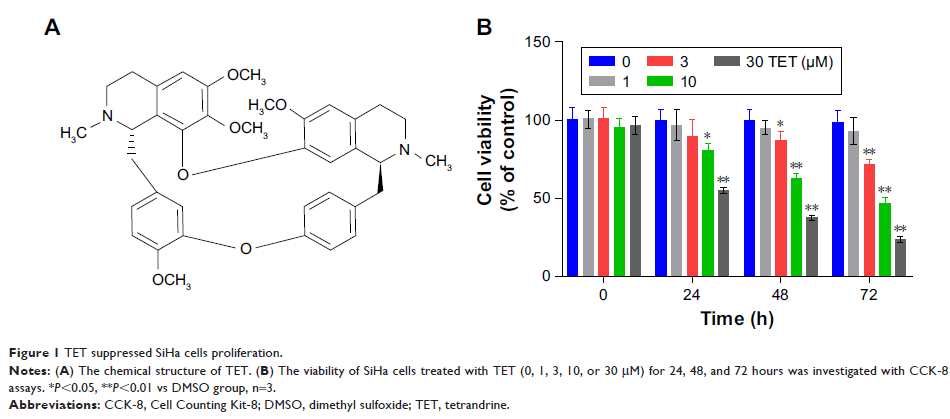
results revealed that TET significantly inhibited SiHa cell proliferation
in vitro and suppressed tumor growth in vivo. Meanwhile, TET was
revealed to induce cervical cancer cell apoptosis by upregulating active
caspase 3 in vitro and in vivo. Furthermore, the migration and
invasion of SiHa cells were inhibited by TET accompanied with MMP2 and MMP9
downregulation.
Conclusion: We have
shown that TET inhibited cervical tumor growth and migration in vitro and
in vivo for the first time. The accumulating evidence suggests that TET
could be a potential therapeutic agent for the treatment of cervical cancer.
Keywords: tetrandrine,
cervical cancer, proliferation, apoptosis, migration