115195
论文已发表
注册即可获取德孚的最新动态
IF 收录期刊
- 3.6 Breast Cancer (Dove Med Press)
- 4.3 Clin Epidemiol
- 2.6 Cancer Manag Res
- 3.2 Infect Drug Resist
- 4.1 Clin Interv Aging
- 6.1 Drug Des Dev Ther
- 4.1 Int J Chronic Obstr
- 8.7 Int J Nanomed
- 2.5 Int J Women's Health
- 3.2 Neuropsych Dis Treat
- 2.4 OncoTargets Ther
- 2.6 Patient Prefer Adher
- 2.6 Ther Clin Risk Manag
- 3.1 J Pain Res
- 3.5 Diabet Metab Synd Ob
- 4.5 Psychol Res Behav Ma
- 3.4 Nat Sci Sleep
- 2.4 Pharmgenomics Pers Med
- 2.6 Risk Manag Healthc Policy
- 4.6 J Inflamm Res
- 2.3 Int J Gen Med
- 3.9 J Hepatocell Carcinoma
- 3.3 J Asthma Allergy
- 2.5 Clin Cosmet Investig Dermatol
- 3.0 J Multidiscip Healthc

RASSF1A 启动子甲基化与肾细胞癌的发展、进展和不良癌症特异性存活相关:试验序贯分析
Authors Zhuang Q, Chen Z, Shen J, Fan M, Xue D, Lu H, Xu R, He X
Received 8 August 2018
Accepted for publication 1 November 2018
Published 20 December 2018 Volume 2019:12 Pages 119—134
DOI https://doi.org/10.2147/OTT.S183142
Checked for plagiarism Yes
Review by Single-blind
Peer reviewers approved by Dr Amy Norman
Peer reviewer comments 3
Editor who approved publication: Dr Leo Jen-Liang Su
Background: This
meta-analysis evaluated the clinicopathologic and prognostic significance
of RASSF1A promoter
methylation in renal cell carcinoma (RCC).
Materials and methods: The ORs or HRs
and their 95% CIs were calculated. Trial sequential analysis was conducted.
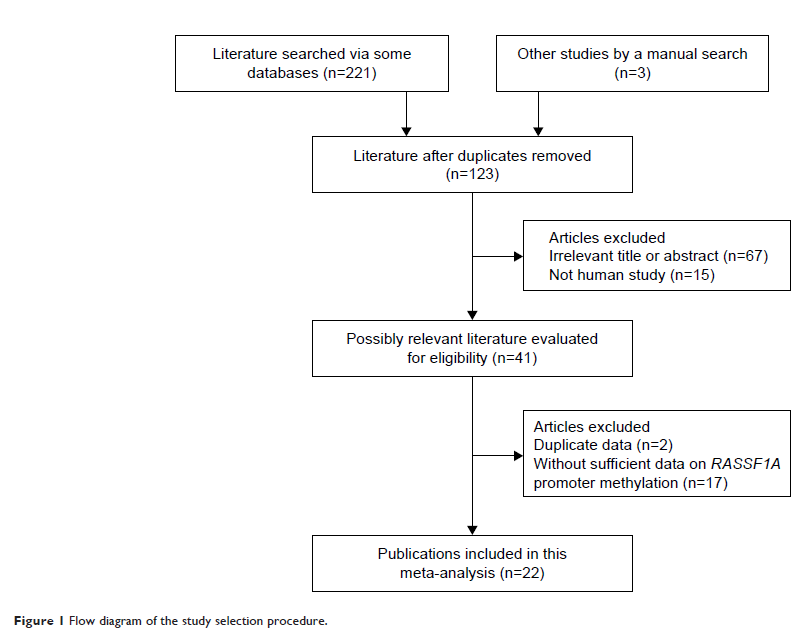
Results: Twenty-two
articles that included 1,421 patients with RCC and 724 controls were
identified. RASSF1A promoter methylation correlated with RCC
in tissue, blood, and urine samples. On multivariate analysis, RASSF1A promoter
methylation was associated with tumor grade (grade 3–4 vs 1–2: OR=3.59),
clinical stage (stage 3–4 vs 1–2: OR=2.15), T classification (pT2–4 vs pT1:
OR=2.66), histologic subtypes (papillary vs clear cell: OR=2.91), and
cancer-specific survival (HR=1.78), but it was not linked to age, gender, lymph
node status, distant metastasis, or overall survival. The Cancer Genome Atlas
data also showed that RASSF1A methylation was significantly more likely
to be seen in papillary vs clear-cell RCC (OR=23.19).
Conclusion: RASSF1A promoter
methylation may be associated with the development and progression of RCC, as
well as poor cancer-specific survival. Methylation was more frequent in
papillary vs clear-cell RCC. More studies are needed to confirm these findings
in blood or urine samples.
Keywords: RAS
association domain family protein 1A, methylation, survival, clinical features