115195
论文已发表
注册即可获取德孚的最新动态
IF 收录期刊
- 3.6 Breast Cancer (Dove Med Press)
- 4.3 Clin Epidemiol
- 2.6 Cancer Manag Res
- 3.2 Infect Drug Resist
- 4.1 Clin Interv Aging
- 6.1 Drug Des Dev Ther
- 4.1 Int J Chronic Obstr
- 8.7 Int J Nanomed
- 2.5 Int J Women's Health
- 3.2 Neuropsych Dis Treat
- 2.4 OncoTargets Ther
- 2.6 Patient Prefer Adher
- 2.6 Ther Clin Risk Manag
- 3.1 J Pain Res
- 3.5 Diabet Metab Synd Ob
- 4.5 Psychol Res Behav Ma
- 3.4 Nat Sci Sleep
- 2.4 Pharmgenomics Pers Med
- 2.6 Risk Manag Healthc Policy
- 4.6 J Inflamm Res
- 2.3 Int J Gen Med
- 3.9 J Hepatocell Carcinoma
- 3.3 J Asthma Allergy
- 2.5 Clin Cosmet Investig Dermatol
- 3.0 J Multidiscip Healthc

负载多柔比星和吲哚菁绿且带有 PEG 化磷脂涂层的超顺磁性氧化铁纳米粒子用于核磁共振和荧光成像及胶质瘤化疗
Authors Shen C, Wang X, Zheng Z, Gao C, Chen X, Zhao S, Dai Z
Received 12 May 2018
Accepted for publication 1 October 2018
Published 20 December 2018 Volume 2019:14 Pages 101—117
DOI https://doi.org/10.2147/IJN.S173954
Checked for plagiarism Yes
Review by Single-blind
Peer reviewers approved by Dr Cristina Weinberg
Peer reviewer comments 3
Editor who approved publication: Dr Lei Yang
Background: Glioma represents the most common
malignant brain tumor. Outcomes of surgical resection are often unsatisfactory
due to low sensitivity or resolution of imaging methods. Moreover, the use of
traditional chemotherapeutics, such as doxorubicin (DOX), is limited due to
their low blood–brain barrier (BBB) permeability. Recently, the development of
nanotechnology could overcome these obstacles.
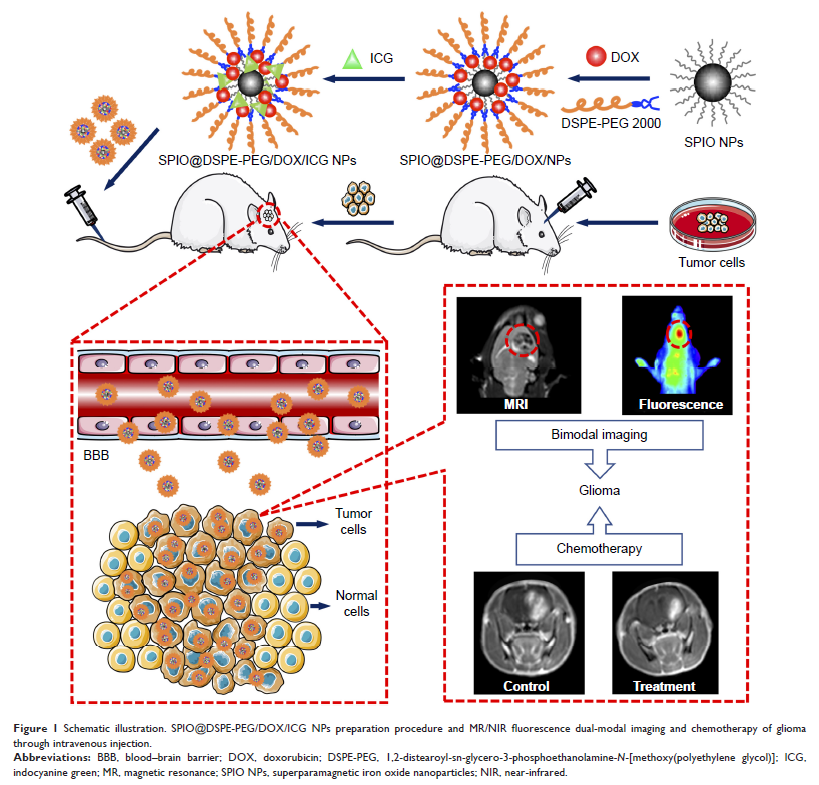
Materials and methods: Hydrophobic superparamagnetic iron oxide nanoparticles (SPIO NPs)
were prepared with the use of thermal decomposition method. They were coated
with 1,2-distearoyl-sn-glycero-3-phosphoethanolamine-N-[methoxy(polyethylene
glycol)-2000] (DSPE-PEG 2000) and DOX using a thin-film hydration method
followed by loading of indocyanine green (ICG) into the phospholipid layers.
Details regarding the characteristics of NPs were determined. The in vitro
biocompatibility and antitumor efficacy were established with the use of MTT
assay. In vivo fluorescence and magnetic resonance (MR) imaging were used
to evaluate BBB penetration and accumulation of NPs at the tumor site.
Antitumor efficacy was evaluated using measures of tumor size, median survival
times, body weights, and H&E staining.
Results: The
multifunctional NPs generated had an average diameter of 22.9 nm, a zeta
potential of -38.19 mV, and were capable of providing a sustained release of
DOX. In vitro experiments demonstrated that the SPIO@DSPE-PEG/DOX/ICG NPs
effectively enhanced cellular uptake of DOX as compared with that of free DOX.
In vivo fluorescence and MR imaging revealed that the NPs not only
effectively crossed the BBB but selectively accumulated at the tumor site.
Meanwhile, among all groups studied, C6 glioma-bearing rats treated with the
NPs exhibited the maximal degree of therapeutic efficacy, including smallest
tumor volume, lowest body weight loss, and longest survival times, with no
obvious side effects.
Conclusion: These
results suggest that the SPIO@DSPE-PEG/DOX/ICG NPs can not only function as a
nanoprobe for MR and fluorescence bimodal imaging, but also as a vehicle to
deliver chemotherapeutic drugs to the tumor site, to achieve the theranostic
treatment of glioma.
Keywords: SPIO
NPs, BBB, MR imaging, fluorescence imaging, chemotherapy