115195
论文已发表
注册即可获取德孚的最新动态
IF 收录期刊
- 3.6 Breast Cancer (Dove Med Press)
- 4.3 Clin Epidemiol
- 2.6 Cancer Manag Res
- 3.2 Infect Drug Resist
- 4.1 Clin Interv Aging
- 6.1 Drug Des Dev Ther
- 4.1 Int J Chronic Obstr
- 8.7 Int J Nanomed
- 2.5 Int J Women's Health
- 3.2 Neuropsych Dis Treat
- 2.4 OncoTargets Ther
- 2.6 Patient Prefer Adher
- 2.6 Ther Clin Risk Manag
- 3.1 J Pain Res
- 3.5 Diabet Metab Synd Ob
- 4.5 Psychol Res Behav Ma
- 3.4 Nat Sci Sleep
- 2.4 Pharmgenomics Pers Med
- 2.6 Risk Manag Healthc Policy
- 4.6 J Inflamm Res
- 2.3 Int J Gen Med
- 3.9 J Hepatocell Carcinoma
- 3.3 J Asthma Allergy
- 2.5 Clin Cosmet Investig Dermatol
- 3.0 J Multidiscip Healthc

辐射诱发的皮肤反应:机制和治疗
Authors Wei J, Meng L, Hou X, Qu C, Wang B, Xin Y, Jiang X
Received 25 September 2018
Accepted for publication 19 November 2018
Published 21 December 2018 Volume 2019:11 Pages 167—177
DOI https://doi.org/10.2147/CMAR.S188655
Checked for plagiarism Yes
Review by Single-blind
Peer reviewers approved by Dr Colin Mak
Peer reviewer comments 2
Editor who approved publication: Dr Antonella D'Anneo
Abstract: Radiotherapy
(RT) is a major treatment for malignant tumors. The latest data show that >70%
of patients with malignant tumors need RT at different periods. Skin changes
can be experienced by up to 95% of patients who underwent RT. Inflammation and
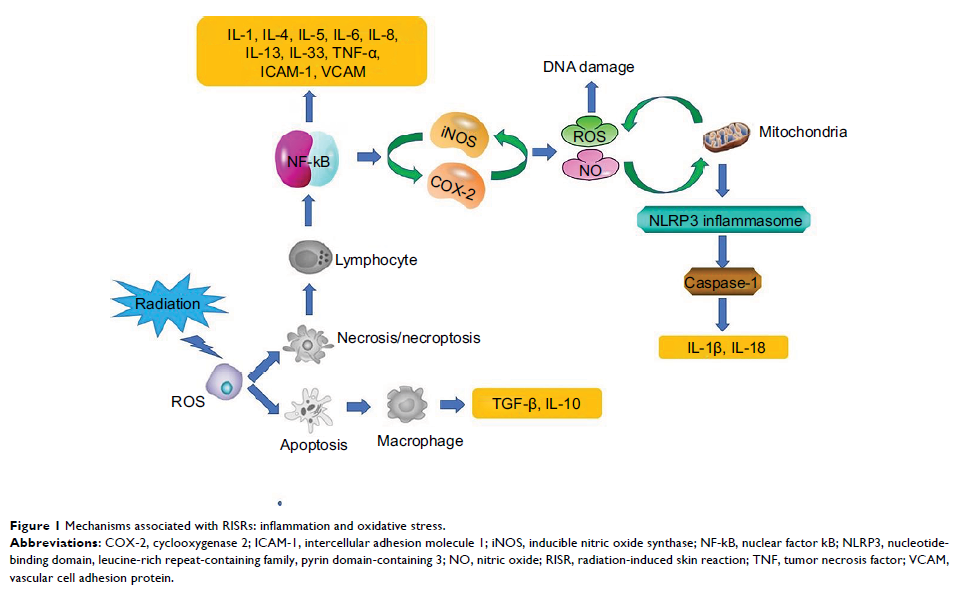
oxidative stress (OS) have been shown to be generally associated with
radiation-induced skin reactions (RISRs). Inflammatory response and OS interact
and promote each other during RISRs. Severe skin reactions often have a great
impact on the progress of RT. The treatment of RISRs is particularly critical
because advanced RT technology can also lead to skin reactions. RISRs are
classified into acute and chronic reactions. The treatment methods for acute
RISRs include steroid treatment, creams, ointments, and hydrocolloid dressings,
depending on the reaction grading. Chronic RISRs includes chronic ulcerations,
telangiectasias, and fibrosis of the skin, and advanced treatments such as
mesenchymal stem cells, hyperbaric oxygen therapy, superoxide dismutase, and
low-intensity laser therapy can be considered. Here, we review and summarize
the important mechanisms that cause RISRs as well as the standard and advanced
treatments for RISRs.
Keywords: radiation-induced
skin reactions, inflammatory response, oxidative stress, treatment