115195
论文已发表
注册即可获取德孚的最新动态
IF 收录期刊
- 3.6 Breast Cancer (Dove Med Press)
- 4.3 Clin Epidemiol
- 2.6 Cancer Manag Res
- 3.2 Infect Drug Resist
- 4.1 Clin Interv Aging
- 6.1 Drug Des Dev Ther
- 4.1 Int J Chronic Obstr
- 8.7 Int J Nanomed
- 2.5 Int J Women's Health
- 3.2 Neuropsych Dis Treat
- 2.4 OncoTargets Ther
- 2.6 Patient Prefer Adher
- 2.6 Ther Clin Risk Manag
- 3.1 J Pain Res
- 3.5 Diabet Metab Synd Ob
- 4.5 Psychol Res Behav Ma
- 3.4 Nat Sci Sleep
- 2.4 Pharmgenomics Pers Med
- 2.6 Risk Manag Healthc Policy
- 4.6 J Inflamm Res
- 2.3 Int J Gen Med
- 3.9 J Hepatocell Carcinoma
- 3.3 J Asthma Allergy
- 2.5 Clin Cosmet Investig Dermatol
- 3.0 J Multidiscip Healthc

CD14 rs2569190 C> T 多态性之间的关联与缺血性脑卒中易感性的关系:基于 5,277 名受试者所做的综合分析
Authors Wu YQ, Cheng SY, Xu XC, Li WC
Received 25 August 2018
Accepted for publication 17 November 2018
Published 21 December 2018 Volume 2019:15 Pages 47—55
DOI https://doi.org/10.2147/NDT.S185313
Checked for plagiarism Yes
Review by Single-blind
Peer reviewers approved by Dr Amy Norman
Peer reviewer comments 2
Editor who approved publication: Dr Yu-Ping Ning
Introduction: Previous
epidemiological studies have suggested that CD14 rs2569190
C>T polymorphism plays an important role in ischemic stroke (IS) risk, but
the results were inconsistent. Therefore, we conducted a meta-analysis to
determine the association between CD14 rs2569190 C>T polymorphism and IS
susceptibility.
Methods: Online
databases were searched from inception up to July 1, 2018, for studies
concerning CD14 rs2569190
C>T polymorphism and its association with IS susceptibility. ORs and
corresponding 95% CIs were calculated in the genetic models of each
polymorphism locus with Stata Version 14.0. Furthermore, heterogeneity,
meta-regression, accumulative analyses, sensitivity analyses, and publication
bias were examined.
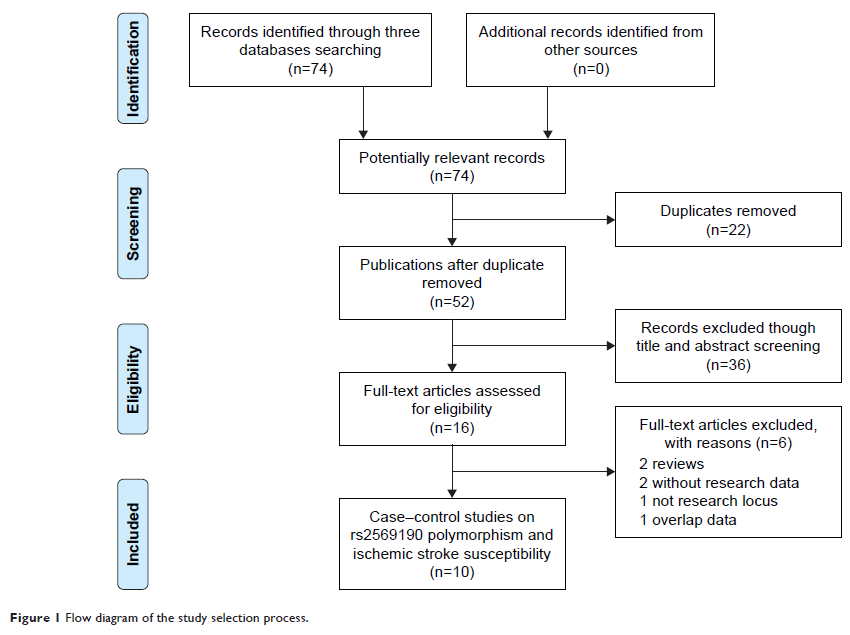
Results: Overall, 10
observed studies involving 5,277 subjects were included in this meta-analysis
on CD14 rs2569190
C>T polymorphism. Generally, no significant associations were found
between CD14 rs2569190
C>T polymorphism and IS risk (allele contrast of T vs C: OR =1.03, 95% CI
=0.96–1.12, P =0.41, I 2=27.8%; co-dominant models of CT vs CC: OR
=1.01, 95% CI =0.81–1.25, P =0.95, I 2=51.9%; co-dominant models of TT vs CC: OR
=1.04, 95% CI =0.89–1.22, P =0.62, I 2=25.1%; dominant model of CT + TT vs CC: OR
=1.02, 95% CI =0.84–1.25, P =0.82, I 2=51.4%; recessive model of TT vs CC + CT: OR
=1.07, 95% CI =0.95–1.22, P =0.28, I 2=0%), similar to the results in the subgroup
analysis.
Conclusion: The current
evidence indicated that CD14 rs2569190 C>T polymorphism was not a
critical risk factor for IS development.
Keywords: CD14, ischemic
stroke, polymorphism