115195
论文已发表
注册即可获取德孚的最新动态
IF 收录期刊
- 3.6 Breast Cancer (Dove Med Press)
- 4.3 Clin Epidemiol
- 2.6 Cancer Manag Res
- 3.2 Infect Drug Resist
- 4.1 Clin Interv Aging
- 6.1 Drug Des Dev Ther
- 4.1 Int J Chronic Obstr
- 8.7 Int J Nanomed
- 2.5 Int J Women's Health
- 3.2 Neuropsych Dis Treat
- 2.4 OncoTargets Ther
- 2.6 Patient Prefer Adher
- 2.6 Ther Clin Risk Manag
- 3.1 J Pain Res
- 3.5 Diabet Metab Synd Ob
- 4.5 Psychol Res Behav Ma
- 3.4 Nat Sci Sleep
- 2.4 Pharmgenomics Pers Med
- 2.6 Risk Manag Healthc Policy
- 4.6 J Inflamm Res
- 2.3 Int J Gen Med
- 3.9 J Hepatocell Carcinoma
- 3.3 J Asthma Allergy
- 2.5 Clin Cosmet Investig Dermatol
- 3.0 J Multidiscip Healthc

嵌合抗原受体修饰的T细胞(CAR-T)治疗实体瘤的关键因素
Authors Yan LL, Liu BN
Received 10 October 2018
Accepted for publication 26 November 2018
Published 24 December 2018 Volume 2019:12 Pages 193—204
DOI https://doi.org/10.2147/OTT.S190336
Checked for plagiarism Yes
Review by Single-blind
Peer reviewers approved by Dr Amy Norman
Peer reviewer comments 2
Editor who approved publication: Dr Sanjeev Srivastava
Abstract: The
success of chimeric antigen receptor-modified T-cell (CAR-T) therapy for B-cell
lymphocyte malignancies targeting CD19 places it in a rapidly growing field in
cancer immunotherapy for both hematological and solid tumors. However, the two
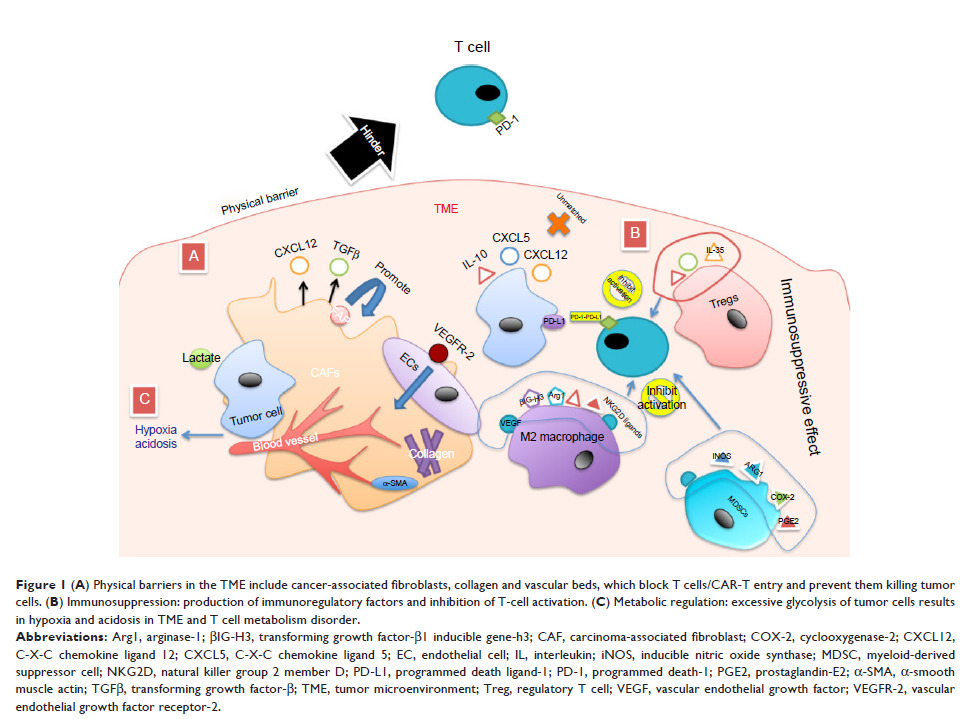
types of tumor are quite different in the following respects. Solid tumors are
characterized by complex vasculatures and matrix barriers that significantly
affect T-cell functions and migration. Moreover, various immunosuppressive
molecules expressed in the tumor microenvironment can impede T-cell activation,
and the high metabolic rate of tumors competitively suppresses the metabolism
of immune cells. All these factors will exert their influences on the
development of a cancer, which is a dynamic balance between the host’s immune
system and the tumor. At present, solid tumors are treated primarily by
surgical resection combined with radiotherapy and chemotherapy, a treatment
process that is painful and not always effective. With advantages over
traditional treatments, the recently developed CAR-T immunotherapy has been
applied and has shown highly promising results. Nevertheless, the complexity of
solid tumors presents a great challenge to this technique. This review focuses
on elucidating the factors influencing the anti-tumor effects of CAR-T in the
specific tumor environment, and hence exploring feasible approaches to overcome
them.
Keywords: chimeric
antigen receptor-modified T cell, immunotherapy, solid tumor, tumor
environment, anti-tumor effects