115195
论文已发表
注册即可获取德孚的最新动态
IF 收录期刊
- 3.6 Breast Cancer (Dove Med Press)
- 4.3 Clin Epidemiol
- 2.6 Cancer Manag Res
- 3.2 Infect Drug Resist
- 4.1 Clin Interv Aging
- 6.1 Drug Des Dev Ther
- 4.1 Int J Chronic Obstr
- 8.7 Int J Nanomed
- 2.5 Int J Women's Health
- 3.2 Neuropsych Dis Treat
- 2.4 OncoTargets Ther
- 2.6 Patient Prefer Adher
- 2.6 Ther Clin Risk Manag
- 3.1 J Pain Res
- 3.5 Diabet Metab Synd Ob
- 4.5 Psychol Res Behav Ma
- 3.4 Nat Sci Sleep
- 2.4 Pharmgenomics Pers Med
- 2.6 Risk Manag Healthc Policy
- 4.6 J Inflamm Res
- 2.3 Int J Gen Med
- 3.9 J Hepatocell Carcinoma
- 3.3 J Asthma Allergy
- 2.5 Clin Cosmet Investig Dermatol
- 3.0 J Multidiscip Healthc

对于初诊时即出现远处转移的壶腹癌患者,原发性肿瘤切除术的潜在治疗价值:一个基于人口的研究
Authors Wang J, Bo X, Lu P, Suo T, Ni X, Liu H, Pan H, Shen S, Li M, Zhang D, Wang Y, Liu HB
Received 2 August 2018
Accepted for publication 22 October 2018
Published 24 December 2018 Volume 2019:11 Pages 217—228
DOI https://doi.org/10.2147/CMAR.S182312
Checked for plagiarism Yes
Review by Single-blind
Peer reviewers approved by Dr Colin Mak
Peer reviewer comments 3
Editor who approved publication: Dr Luzhe Sun
Objective: To evaluate
the therapeutic value of primary tumor resection (PTR) in metastatic ampullary
cancer at the initial presentation.
Patients and methods: Patients
with metastatic ampullary cancer were identified from Surveillance,
Epidemiology and End Results database. Propensity score matching (PSM) was
performed to balance the characteristics of our cohort. Kaplan–Meier analyses,
log-rank tests and multivariate Cox regression models were employed to evaluate
the therapeutic value of PTR.
Results: A total
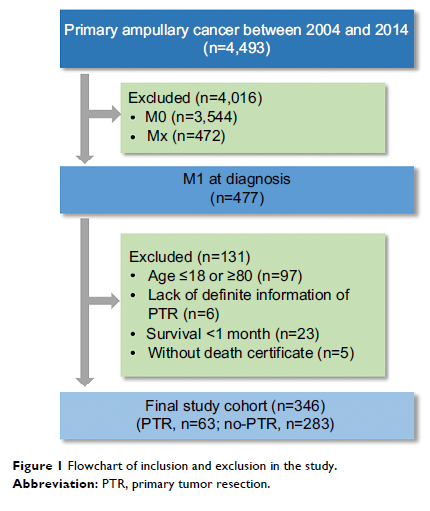
of 346 patients with metastatic ampullary cancer were identified from 2004 to
2014 and 90 patients were screened by PSM. PTR was associated with favorable
overall survival (OS) and cancer-specific survival (CSS) after PSM (PTR vs
no-PTR: 16.0, 95% CI: 9.0–22.0 vs 8.0, 95% CI: 5.0–11.0 for median OS; 22.0,
95% CI: 13.0–33.0 vs 9.0, 95% CI: 5.0–11.0 for median CSS; both log-rank P <0.001).
Patients receiving PTR plus chemotherapy showed better survival compared with
those receiving only chemotherapy (median OS: 18, 95% CI: 13–27 vs 9.0, 95% CI:
8.0–11.0; median CSS: 23.0, 95% CI: 14.0–36.0 vs 9.0, 95% CI: 8.0–13.0; both
log-rank P <0.001).
Conclusion: PTR might
bring a survival benefit to ampullary cancer patients with distant metastasis
at the initial presentation and might provide a more favorable prognosis when
combined with chemotherapy.
Keywords: ampullary
cancer, PSM, primary tumor resection, chemotherapy