115195
论文已发表
注册即可获取德孚的最新动态
IF 收录期刊
- 3.6 Breast Cancer (Dove Med Press)
- 4.3 Clin Epidemiol
- 2.6 Cancer Manag Res
- 3.2 Infect Drug Resist
- 4.1 Clin Interv Aging
- 6.1 Drug Des Dev Ther
- 4.1 Int J Chronic Obstr
- 8.7 Int J Nanomed
- 2.5 Int J Women's Health
- 3.2 Neuropsych Dis Treat
- 2.4 OncoTargets Ther
- 2.6 Patient Prefer Adher
- 2.6 Ther Clin Risk Manag
- 3.1 J Pain Res
- 3.5 Diabet Metab Synd Ob
- 4.5 Psychol Res Behav Ma
- 3.4 Nat Sci Sleep
- 2.4 Pharmgenomics Pers Med
- 2.6 Risk Manag Healthc Policy
- 4.6 J Inflamm Res
- 2.3 Int J Gen Med
- 3.9 J Hepatocell Carcinoma
- 3.3 J Asthma Allergy
- 2.5 Clin Cosmet Investig Dermatol
- 3.0 J Multidiscip Healthc

生物还原前药 3-(2-硝基苯基)丙酸 - 紫杉醇纳米颗粒(NPPA-PTX NPs)对 MDA-MB-231 细胞的抗肿瘤活性:体内和体外
Authors Duan X, Yao X, Zhang S, Xu M, Hao Y, Li Z, Zheng X, Liu M, Li Z, Li H, Wang J, Feng Z, Zhang X
Received 5 September 2018
Accepted for publication 27 November 2018
Published 24 December 2018 Volume 2019:14 Pages 195—204
DOI https://doi.org/10.2147/IJN.S186556
Checked for plagiarism Yes
Review by Single-blind
Peer reviewers approved by Dr Alexander Kharlamov
Peer reviewer comments 3
Editor who approved publication: Dr Linlin Sun
Background: 3-(2-Nitrophenyl)
propionic acid-paclitaxel (NPPA-PTX) is a paclitaxel (PTX) bioreductive prodrug
synthesized by our lab. We hypothesize that NPPA-PTX can self-assemble to form
nanoparticles (NPs).
Materials and methods: In the
present research, the theoretical partition coefficient (XlogP) and Hansen
solubility parameters of NPPA-PTX were calculated. NPPA-PTX nanoparticles
prepared by NPPA-PTX and DSPE-PEG (NPPA-PTX:DSPE-PEG =1:0.1, w/w) (NPPA-PTX@PEG
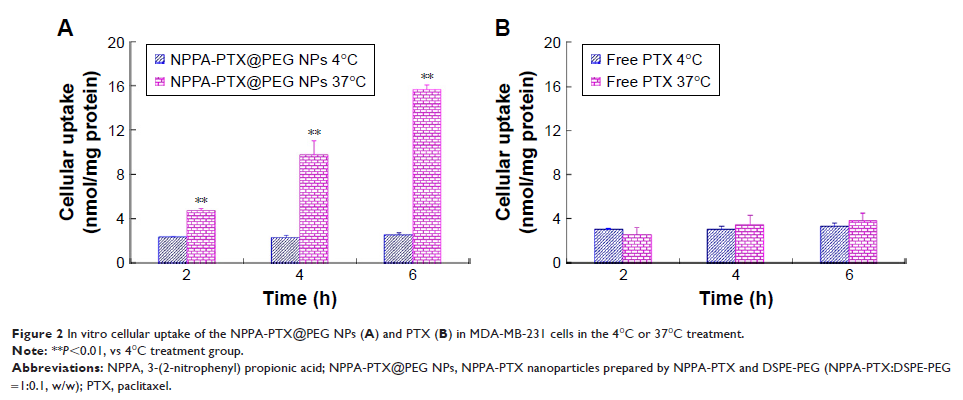
NPs) were prepared and characterized. The cellular uptake, in vitro antitumor
activity, in vivo targeting effect, tumor distribution, in vivo antitumor
activity, and safety of NPPA-PTX@PEG NPs were investigated.
Results: Our
results indicate that NPPA-PTX can self-assemble to form NPPA-PTX@PEG NPs. Both
the cellular uptake and safety of NPPA-PTX@PEG NPs were higher than those of
Taxol. NPPA-PTX@PEG NPs could target tumor tissues by a passive targeting
effect. In tumor tissues, NPPA-PTX@PEG NPs could completely transform into
active PTX. The in vivo antitumor activity of NPPA-PTX@PEG NPs was confirmed in
MDA-MB-231 tumor-bearing nude mice.
Conclusion: The
bioreductive prodrug NPPA-PTX could self-assemble to form NPs. The safety and
antitumor activity of NPPA-PTX@PEG were confirmed in our in vitro and in vivo
experiments. The NPPA-PTX@PEG NPs developed in this study could offer a new way
of preparing bioreductive prodrug, self-assembled NPs suitable for antitumor
therapy.
Keywords: bioreductive
prodrug, 3-(2-nitrophenyl) propionic acid-paclitaxel, nanoparticles, antitumor
activity, in vitro, in vivo