115195
论文已发表
注册即可获取德孚的最新动态
IF 收录期刊
- 3.6 Breast Cancer (Dove Med Press)
- 4.3 Clin Epidemiol
- 2.6 Cancer Manag Res
- 3.2 Infect Drug Resist
- 4.1 Clin Interv Aging
- 6.1 Drug Des Dev Ther
- 4.1 Int J Chronic Obstr
- 8.7 Int J Nanomed
- 2.5 Int J Women's Health
- 3.2 Neuropsych Dis Treat
- 2.4 OncoTargets Ther
- 2.6 Patient Prefer Adher
- 2.6 Ther Clin Risk Manag
- 3.1 J Pain Res
- 3.5 Diabet Metab Synd Ob
- 4.5 Psychol Res Behav Ma
- 3.4 Nat Sci Sleep
- 2.4 Pharmgenomics Pers Med
- 2.6 Risk Manag Healthc Policy
- 4.6 J Inflamm Res
- 2.3 Int J Gen Med
- 3.9 J Hepatocell Carcinoma
- 3.3 J Asthma Allergy
- 2.5 Clin Cosmet Investig Dermatol
- 3.0 J Multidiscip Healthc

Xyloketal 衍生物 C53N 可预防小鼠轻度创伤性脑损伤
Authors Liang F, Su F, Wang X, Long S, Zheng Y, He X, Pang J, Pei Z
Received 22 June 2018
Accepted for publication 26 October 2018
Published 27 December 2018 Volume 2019:13 Pages 173—182
DOI https://doi.org/10.2147/DDDT.S177951
Checked for plagiarism Yes
Review by Single-blind
Peer reviewers approved by Dr Cristina Weinberg
Peer reviewer comments 3
Editor who approved publication: Dr Georgios Panos
Purpose: Mild
traumatic brain injury (mTBI), the most common type of TBI, can result in
prolonged cognitive impairment, mood disorders, and behavioral problems.
Reducing oxidative stress and inflammation can rescue the neurons from
mTBI-induced cell death. Xyloketal B, a natural product from mangrove fungus,
has shown good antioxidative and neuroprotective effects in several disease
models. Here, we investigated the potential protection afforded by a xyloketal
derivative, C53N, in a closed-skull mTBI model.
Materials and methods: Skulls of
mice were thinned to 20–30 µm thickness, following which they were subjected to
a slight compression injury to induce mTBI. One hour after TBI, mice were
intraperitoneally injected with C53N, which was solubilized in 0.5% dimethyl
sulfoxide in saline. In vivo two-photon laser scanning microscopy was used to
image cell death in injured parenchyma in each mouse over a 12-hour period (at
1, 3, 6, and 12 hours). Water content and oxidation index, together with
pathological analysis of glial reactivity, were assessed at 24 hours to
determine the effect of C53N on mTBI.
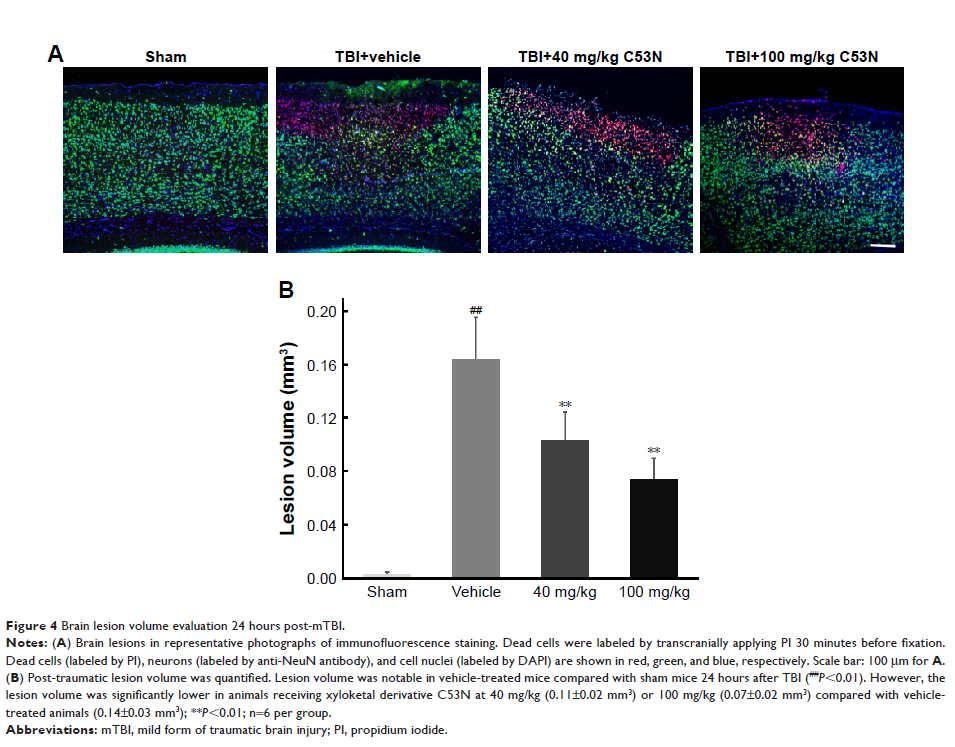
Results: Cell death,
oxidative stress, and glial reactivity increased in mTBI mice compared with
sham-injured mice. Treatment with 40 or 100 mg/kg C53N 1 hour after mTBI significantly
attenuated oxidative stress and glial reactivity and reduced parenchymal cell
death at the acute phase after mTBI.
Conclusion: The
present study highlights the therapeutic potential of the xyloketal derivative
C53N for pharmacological intervention in mTBI.
Keywords: xyloketal
derivative, mTBI, in vivo imaging, antioxidant activity, neuroprotective
activity