115195
论文已发表
注册即可获取德孚的最新动态
IF 收录期刊
- 3.6 Breast Cancer (Dove Med Press)
- 4.3 Clin Epidemiol
- 2.6 Cancer Manag Res
- 3.2 Infect Drug Resist
- 4.1 Clin Interv Aging
- 6.1 Drug Des Dev Ther
- 4.1 Int J Chronic Obstr
- 8.7 Int J Nanomed
- 2.5 Int J Women's Health
- 3.2 Neuropsych Dis Treat
- 2.4 OncoTargets Ther
- 2.6 Patient Prefer Adher
- 2.6 Ther Clin Risk Manag
- 3.1 J Pain Res
- 3.5 Diabet Metab Synd Ob
- 4.5 Psychol Res Behav Ma
- 3.4 Nat Sci Sleep
- 2.4 Pharmgenomics Pers Med
- 2.6 Risk Manag Healthc Policy
- 4.6 J Inflamm Res
- 2.3 Int J Gen Med
- 3.9 J Hepatocell Carcinoma
- 3.3 J Asthma Allergy
- 2.5 Clin Cosmet Investig Dermatol
- 3.0 J Multidiscip Healthc

多柔比星脂质体与左心耳射频导管消融联合应用可减少导电消融后的恢复
Authors Zhuge Y, Ni HE, Wang YJ, He MY, Wang JS, Gao F, Wang F
Received 3 September 2018
Accepted for publication 3 December 2018
Published 27 December 2018 Volume 2019:14 Pages 231—241
DOI https://doi.org/10.2147/IJN.S186267
Checked for plagiarism Yes
Review by Single-blind
Peer reviewers approved by Dr Alexander Kharlamov
Peer reviewer comments 2
Editor who approved publication: Dr Mian Wang
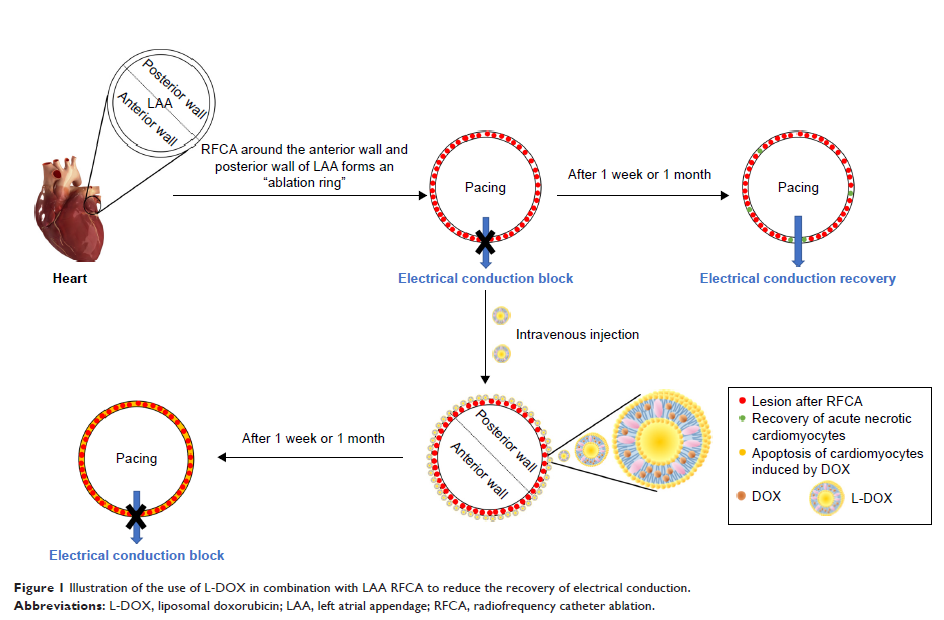
Aims: To
determine whether use of radiofrequency catheter ablation (RFCA) combined with
intravenously administered liposomal doxorubicin (L-DOX) facilitates a
reduction in the recovery of post-ablation electrical conduction.
Methods: Circumferential
ablation was performed on the epicardial surface of the left atrial appendage
(LAA) in New Zealand White rabbits, and L-DOX was then administered
intravenously. Fluorescence spectrophotometry was used to assess reagent
bio-distribution, while Western blots and immunohistochemistry were used to
assess the localization of the apoptotic markers Bcl-2, Bax, and cleaved CASP3
in the LAA. Liver, kidney, and cardiac functions were also measured to evaluate
the safety of this approach.
Results: At 1 week
and 1 month after RFCA, a pacing electrocardiogram could not be detected in
most of the rabbits that had received the combined RFCA and L-DOX therapy.
L-DOX began to target the LAA on the second day after RFCA. L-DOX treatment
increased the apoptosis of cardiomyocytes in the regions peripheral to the
necrotic area induced by RFCA. Doxorubicin had some effect on liver and kidney
function, but these effects were reversible and did not affect survival.
Conclusion: The present
results provide evidence that L-DOX treatment can reduce the recovery of
electrical conduction after RFCA therapy owing to L-DOX-induced apoptosis of
cardiomyocytes in the ablated area and the proximal transition zone of the LAA.
Keywords: doxorubicin,
liposome, radiofrequency catheter ablation, atrial fibrillation, recovered
electrical conduction