115195
论文已发表
注册即可获取德孚的最新动态
IF 收录期刊
- 3.6 Breast Cancer (Dove Med Press)
- 4.3 Clin Epidemiol
- 2.6 Cancer Manag Res
- 3.2 Infect Drug Resist
- 4.1 Clin Interv Aging
- 6.1 Drug Des Dev Ther
- 4.1 Int J Chronic Obstr
- 8.7 Int J Nanomed
- 2.5 Int J Women's Health
- 3.2 Neuropsych Dis Treat
- 2.4 OncoTargets Ther
- 2.6 Patient Prefer Adher
- 2.6 Ther Clin Risk Manag
- 3.1 J Pain Res
- 3.5 Diabet Metab Synd Ob
- 4.5 Psychol Res Behav Ma
- 3.4 Nat Sci Sleep
- 2.4 Pharmgenomics Pers Med
- 2.6 Risk Manag Healthc Policy
- 4.6 J Inflamm Res
- 2.3 Int J Gen Med
- 3.9 J Hepatocell Carcinoma
- 3.3 J Asthma Allergy
- 2.5 Clin Cosmet Investig Dermatol
- 3.0 J Multidiscip Healthc

NIMA 相关激酶 2 过度表达与癌症患者的生存率低有关:一个系统评价和荟萃分析
Authors Yao Y, Su J, Zhao L, Luo N, Long L, Zhu X
Received 21 September 2018
Accepted for publication 19 November 2018
Published 3 January 2019 Volume 2019:11 Pages 455—465
DOI https://doi.org/10.2147/CMAR.S188347
Checked for plagiarism Yes
Review by Single-blind
Peer reviewers approved by Dr Justinn Cochran
Peer reviewer comments 2
Editor who approved publication: Dr Antonella D'Anneo
Objective: NIMA-related
kinase 2 (NEK2) has been reported to be overexpressed in various types of
cancer and correlated with poor prognosis. The role(s) of NEK2 in cancer,
however, is still uncertain. The aim of this study was to evaluate the
prognostic value of NEK2 in human tumors.
Methods: A
comprehensive literature search was performed for PubMed, Embase, Web of
Science, and CNKI databases, and eligible studies were included based on the
inclusion and exclusion criteria. A meta-analysis of the included studies was
then carried out.
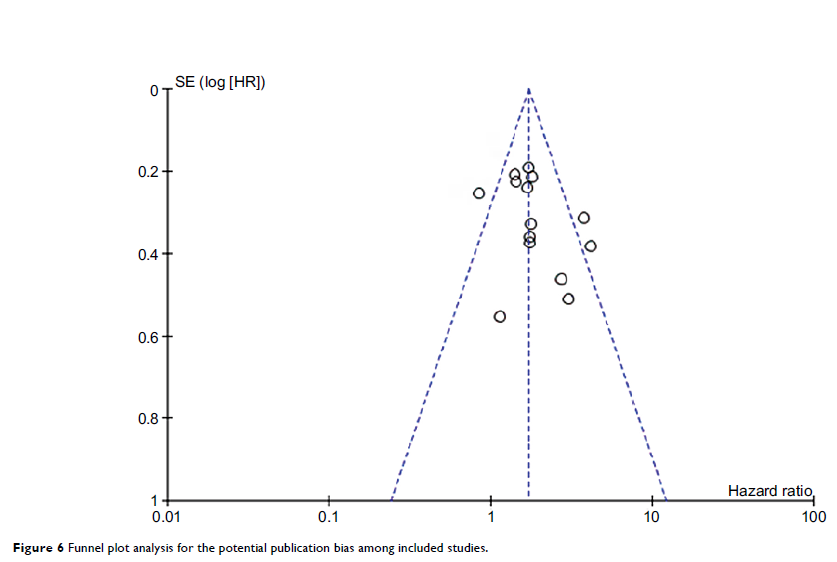
Results: Fifteen
studies with 3,280 cancer patients were included in the present meta-analysis.
All publications were of moderate to high quality, and had no significant
heterogeneity (I 2=46%, P =0.03) or
publication bias was discovered. The results showed that a high NEK2 level was
associated with shorter overall survival (OS) in patients with various types of
cancers (pooled HR=1.72, 95% CI 1.49–2.00, P <0.00001).
However, the disease-free survival (DFS) had no significant association with
NEK2 level (HR=1.13, 95% CI: 0.29–4.38, P =0.85). In the subgroup analyses, high NEK2 level was
correlated with an increased risk of poor OS in patients with hepatocellular
carcinoma (HR=1.62, 95% CI: 1.25–2.10, P =0.02) and lung cancer (HR=2.18, 95% CI:
1.40–3.38, P =0.0005).
However, other factors, including sample size, follow-up period, HR estimation
method, and country, also affect the association between NEK2 expression and
OS. Analysis of clinicopathological parameters further showed that increased
NEK2 level was correlated with younger age, male gender, better tumor differentiation,
and lower number of tumor nodules.
Conclusion: The
results of this study indicated that increased expression of NEK2 was
associated with unfavorable survival of cancer patients and that NEK2 could be
used as a prognostic predictor for cancers.
Keywords: NEK2,
prognosis, cancer, diagnosis, meta-analysis, clinical characteristics