115195
论文已发表
注册即可获取德孚的最新动态
IF 收录期刊
- 3.6 Breast Cancer (Dove Med Press)
- 4.3 Clin Epidemiol
- 2.6 Cancer Manag Res
- 3.2 Infect Drug Resist
- 4.1 Clin Interv Aging
- 6.1 Drug Des Dev Ther
- 4.1 Int J Chronic Obstr
- 8.7 Int J Nanomed
- 2.5 Int J Women's Health
- 3.2 Neuropsych Dis Treat
- 2.4 OncoTargets Ther
- 2.6 Patient Prefer Adher
- 2.6 Ther Clin Risk Manag
- 3.1 J Pain Res
- 3.5 Diabet Metab Synd Ob
- 4.5 Psychol Res Behav Ma
- 3.4 Nat Sci Sleep
- 2.4 Pharmgenomics Pers Med
- 2.6 Risk Manag Healthc Policy
- 4.6 J Inflamm Res
- 2.3 Int J Gen Med
- 3.9 J Hepatocell Carcinoma
- 3.3 J Asthma Allergy
- 2.5 Clin Cosmet Investig Dermatol
- 3.0 J Multidiscip Healthc

接受放射性碘治疗的分化型甲状腺癌患者的正念减压:一项随机对照试验
Authors Liu T, Zhang W, Xiao S, Xu L, Wen Q, Bai L, Ma Q, Ji B
Received 9 August 2018
Accepted for publication 21 November 2018
Published 4 January 2019 Volume 2019:11 Pages 467—474
DOI https://doi.org/10.2147/CMAR.S183299
Checked for plagiarism Yes
Review by Single-blind
Peer reviewers approved by Dr Colin Mak
Peer reviewer comments 2
Editor who approved publication: Dr Ahmet Emre Eskazan
Objective: The aim
of this study was to evaluate the efficacy of mindfulness-based stress
reduction (MBSR) on health-related quality of life (QoL), depression, and
anxiety in patients with differentiated thyroid cancer (DTC) receiving
radioactive iodine therapy (RIT).
Patients and methods: A
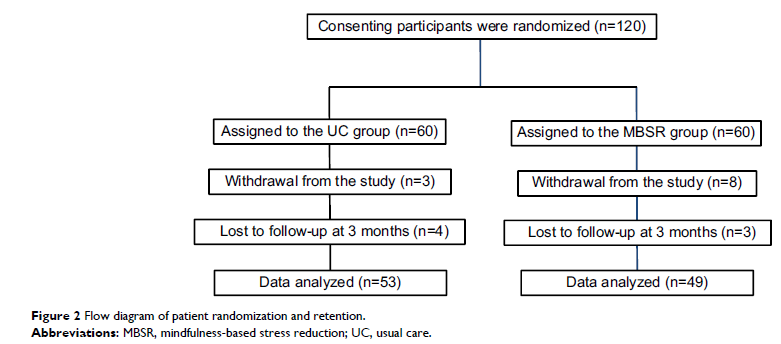
randomized controlled trial of MBSR with 120 DTC patients was performed. They
were randomly assigned into the MBSR intervention group and usual care (UC)
group. An 8-week MBSR program was administered to the MBSR group starting 8
weeks before RIT. Health-related QoL, depression, and anxiety were measured
immediately before the start of MBSR (T1), immediately after RIT
hospitalization was concluded (1 week after concluding the last MBSR session,
T2), and 3 months after RIT hospitalization (T3), using the QoL Questionnaire
Core 30 Items (QLQ-C30), Self-rating Depression Scale (SDS), and Self-rating
Anxiety Scale (SAS).
Results: Fifty-three
patients in the UC group and 49 patients in the MBSR group completed the study
and were analyzed. Both the UC and MBSR groups reported low QoL and high SDS
and SAS scores immediately after RIT hospitalization. Patients randomly
assigned to the MBSR group showed significantly greater improvements in
emotional function (P =0.012, d =–0.03 for T2 and d =1.17 for T3),
fatigue (P =0.037, d =1.00 for T2
and d =–0.69
for T3), global QoL (P =0.015, d =1.61 for T2 and d =1.56 for T3),
depression (P =0.027, d =–1.19 for T2
and d =–0.83
for T3), and anxiety (P =0.043, d =–1.00 for T2 and d =–0.86 for T3).
Conclusion: An 8-week
MBSR program significantly improved a wide range of scales in health-related
QoL and mitigated depression and anxiety among DTC patients receiving RIT.
Keywords: mindfulness-based
stress reduction, differentiated thyroid cancer, radioactive iodine therapy,
quality of life, anxiety, depression