115195
论文已发表
注册即可获取德孚的最新动态
IF 收录期刊
- 3.6 Breast Cancer (Dove Med Press)
- 4.3 Clin Epidemiol
- 2.6 Cancer Manag Res
- 3.2 Infect Drug Resist
- 4.1 Clin Interv Aging
- 6.1 Drug Des Dev Ther
- 4.1 Int J Chronic Obstr
- 8.7 Int J Nanomed
- 2.5 Int J Women's Health
- 3.2 Neuropsych Dis Treat
- 2.4 OncoTargets Ther
- 2.6 Patient Prefer Adher
- 2.6 Ther Clin Risk Manag
- 3.1 J Pain Res
- 3.5 Diabet Metab Synd Ob
- 4.5 Psychol Res Behav Ma
- 3.4 Nat Sci Sleep
- 2.4 Pharmgenomics Pers Med
- 2.6 Risk Manag Healthc Policy
- 4.6 J Inflamm Res
- 2.3 Int J Gen Med
- 3.9 J Hepatocell Carcinoma
- 3.3 J Asthma Allergy
- 2.5 Clin Cosmet Investig Dermatol
- 3.0 J Multidiscip Healthc

长链非编码 RNA SNHG16 通过海绵 miR-140-5p 诱导肝细胞癌细胞对索拉非尼的耐药性
Authors Ye J, Zhang R, Du X, Chai W, Zhou Q
Received 24 May 2018
Accepted for publication 7 November 2018
Published 4 January 2019 Volume 2019:12 Pages 415—422
DOI https://doi.org/10.2147/OTT.S175176
Checked for plagiarism Yes
Review by Single-blind
Peer reviewers approved by Dr Andrew Yee
Peer reviewer comments 3
Editor who approved publication: Prof. Dr. Geoffrey Pietersz
Background: Sorafenib
is widely used for treatment of hepatocellular carcinoma (HCC), but the
acquired resistance remains a major obstacle for its application. Thus it is of
critical importance to elucidate the molecular mechanisms underlying sorafenib
resistance in HCC. This study aimed to determine the roles of long noncoding
RNA SNHG16 in sorafenib-resistant HCC cells.
Methods: HCC and
matched adjacent normal liver tissue samples were obtained from 103 HCC
patients. Sorafenib-resistant HepG2/SOR cell line was established from its
parental HepG2 cells by exposure to increasing concentrations of sorafenib.
SNHG16 and miR-140-5p expression levels in tissue samples and cells were
detected by RT-qPCR analysis. The sensitivity of cells to sorafenib in vitro
was evaluated by MTT assay, and the sensitivity of HepG2/SOR cells to sorafenib
in vivo was estimated using the nude mouse-based xenograft model. The potential
binding relation between SNHG16 and miR-140-5p was validated by dual luciferase
reporter assay and biotinylated RNA pull-down assay.
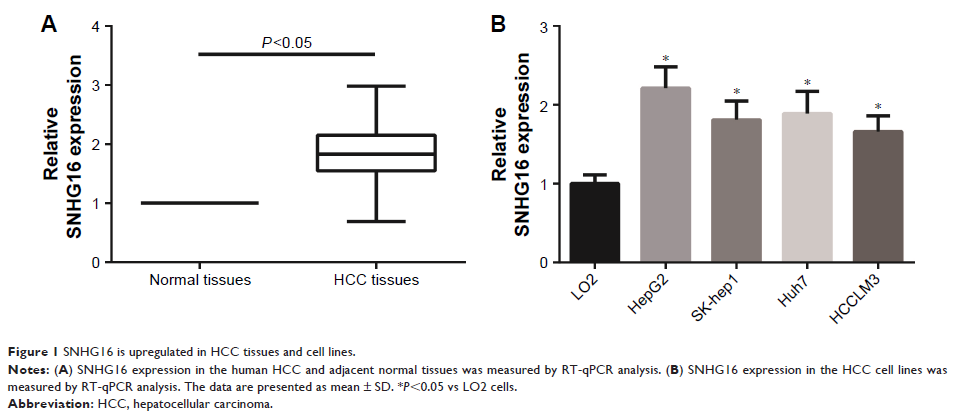
Results: The
results showed that SNHG16 expression was remarkably increased in HCC tissues
and cell lines, and its high expression was closely associated with aggressive
clinicopathological features and poor prognosis of HCC patients. Further
experiments showed that SNHG16 is upregulated in HepG2/SOR cells, whereas
knockdown of SNHG16 increases the sensitivity of HepG2/SOR cells to sorafenib
in vitro and in vivo. Further mechanistic study identified that SNHG16
functions as an endogenous sponge for miR-140-5p in HepG2 cells, and in HCC
tissues, the expression of miR-140-5p is negatively correlated with SNHG16
expression. Moreover, miR-140-5p overexpression also increases the sensitivity
of HepG2/SOR cells to sorafenib, and the effects of SNHG16 knockdown on
sorafenib resistance could be blocked by miR-140-5p inhibitor.
Conclusion: Collectively,
our findings demonstrated that knockdown of SNHG16 attenuated sorafenib
resistance in HCC through sponging miR-140-5p, indicating that SNHG16 might be
as a promising therapeutic target to boost the effectiveness of chemotherapy
for HCC patients.
Keywords: long
noncoding RNA, SNHG16, hepatocellular carcinoma, sorafenib resistance,
miR-140-5p