115195
论文已发表
注册即可获取德孚的最新动态
IF 收录期刊
- 3.6 Breast Cancer (Dove Med Press)
- 4.3 Clin Epidemiol
- 2.6 Cancer Manag Res
- 3.2 Infect Drug Resist
- 4.1 Clin Interv Aging
- 6.1 Drug Des Dev Ther
- 4.1 Int J Chronic Obstr
- 8.7 Int J Nanomed
- 2.5 Int J Women's Health
- 3.2 Neuropsych Dis Treat
- 2.4 OncoTargets Ther
- 2.6 Patient Prefer Adher
- 2.6 Ther Clin Risk Manag
- 3.1 J Pain Res
- 3.5 Diabet Metab Synd Ob
- 4.5 Psychol Res Behav Ma
- 3.4 Nat Sci Sleep
- 2.4 Pharmgenomics Pers Med
- 2.6 Risk Manag Healthc Policy
- 4.6 J Inflamm Res
- 2.3 Int J Gen Med
- 3.9 J Hepatocell Carcinoma
- 3.3 J Asthma Allergy
- 2.5 Clin Cosmet Investig Dermatol
- 3.0 J Multidiscip Healthc

淋巴结分期评分和淋巴结分期的充分性
Authors Chen H, Feng G
Received 6 September 2018
Accepted for publication 14 November 2018
Published 8 January 2019 Volume 2019:12 Pages 449—455
DOI https://doi.org/10.2147/OTT.S186642
Checked for plagiarism Yes
Review by Single-blind
Peer reviewers approved by Dr Andrew Yee
Peer reviewer comments 2
Editor who approved publication: Dr Leo Jen-Liang Su
Aims: The number of
lymph nodes (LNs) excised in patients with pathologic N0 is limited, and it is
very likely that there will be recessive node disease after surgery, so they
are at risk of understaging. The purpose of the present study is to develop a
nodal staging score (NSS) in a mathematical way to assess the likelihood that a
pathologic N0 gastric cancer (GCa) patient has, indeed, no occult nodal disease
after surgery.
Patients and methods: A total of
14,033 stage I–III GCa patients were identified from Surveillance, Epidemiology
and End Results database for analysis. A beta-binomial model was fitted to
calculate the probability of missing a nodal disease. This probability is then
used to calculate the NSS.
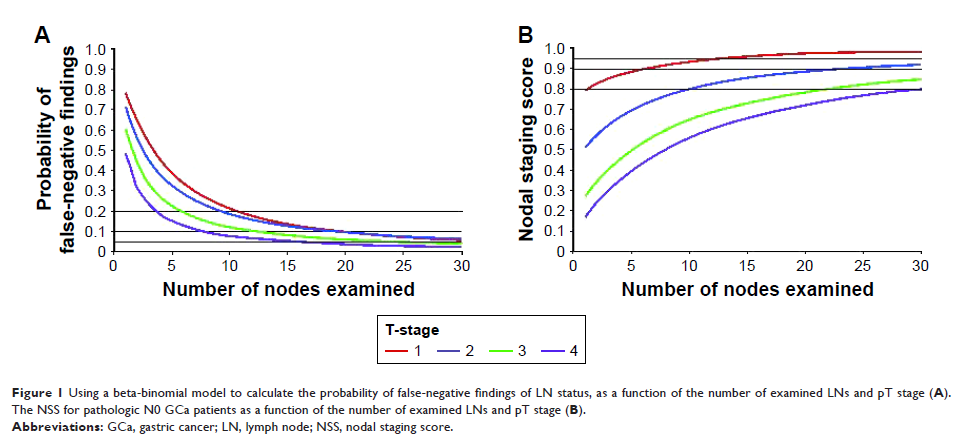
Results: The probability
of missing a nodal disease is decreased with increasing LNs examined across all
pT stages. Seven and 24 LNs removed and examined was enough for an NSS of 90%
in pT1 and pT2 patients, respectively, ensuring a high confidence of correct
nodal negative classification. Twenty-three and 31 LNs examined in pT3 and pT4
patients could also maintain the NSS at 80%, respectively. NSS had a
significant impact on patients’ survival across all pT stages (all P s <0.0001).
Conclusion: The
probability that GCa patients are free of true nodal disease could be provided
by NSS-based prediction, which is conducive to postoperative decision and
survival surveillance. In addition, NSS can define a subtle standard on how
many LNs examined are enough for adequate staging dependent on pT stages.
However, at least 16 LNs examined is the standard recommendation to date.
Keywords: gastric
cancer, nodal-negative classification, adequate staging, prognosis