115195
论文已发表
注册即可获取德孚的最新动态
IF 收录期刊
- 3.6 Breast Cancer (Dove Med Press)
- 4.3 Clin Epidemiol
- 2.6 Cancer Manag Res
- 3.2 Infect Drug Resist
- 4.1 Clin Interv Aging
- 6.1 Drug Des Dev Ther
- 4.1 Int J Chronic Obstr
- 8.7 Int J Nanomed
- 2.5 Int J Women's Health
- 3.2 Neuropsych Dis Treat
- 2.4 OncoTargets Ther
- 2.6 Patient Prefer Adher
- 2.6 Ther Clin Risk Manag
- 3.1 J Pain Res
- 3.5 Diabet Metab Synd Ob
- 4.5 Psychol Res Behav Ma
- 3.4 Nat Sci Sleep
- 2.4 Pharmgenomics Pers Med
- 2.6 Risk Manag Healthc Policy
- 4.6 J Inflamm Res
- 2.3 Int J Gen Med
- 3.9 J Hepatocell Carcinoma
- 3.3 J Asthma Allergy
- 2.5 Clin Cosmet Investig Dermatol
- 3.0 J Multidiscip Healthc

顺铂为基础化疗一线复发转移性尿路上皮膀胱癌患者在抗程序性细胞死亡配体-1 治疗后的疾病超进展:一份病例报告
Authors Mao S, Zhang J, Guo Y, Zhang Z, Wu Y, Zhang W, Wang L, Jiang Geng, Yan Y, Yao X
Received 17 September 2018
Accepted for publication 19 December 2018
Published 11 January 2019 Volume 2019:13 Pages 291—300
DOI https://doi.org/10.2147/DDDT.S181122
Checked for plagiarism Yes
Review by Single-blind
Peer reviewers approved by Dr Colin Mak
Peer reviewer comments 2
Editor who approved publication: Dr Qiongyu Guo
Background: Immune
checkpoint blockade targeting programmed cell death ligand-1 (PD-L1)/programmed
death-1 (PD-1) signaling was approved recently for locally advanced and
metastatic urothelial bladder carcinoma (UBC). Some patients experience a very
rapid tumor progression, rather than clinical benefit, from anti-PD-L1/PD-1
therapy.
Case presentation: A 58-year-old
male diagnosed with non-muscle-invasive bladder cancer 3 years ago received
transurethral resection of bladder tumor (TURBT) and intravesical chemotherapy.
TURBT was repeated a year later for recurrent and progressive UBC. Following
further disease progression, he received a radical cystectomy (RC),
pathologically staged as T2bN2M0, and adjuvant cisplatin-containing combination
chemotherapy. When his disease progressed to metastatic UBC, he was started on
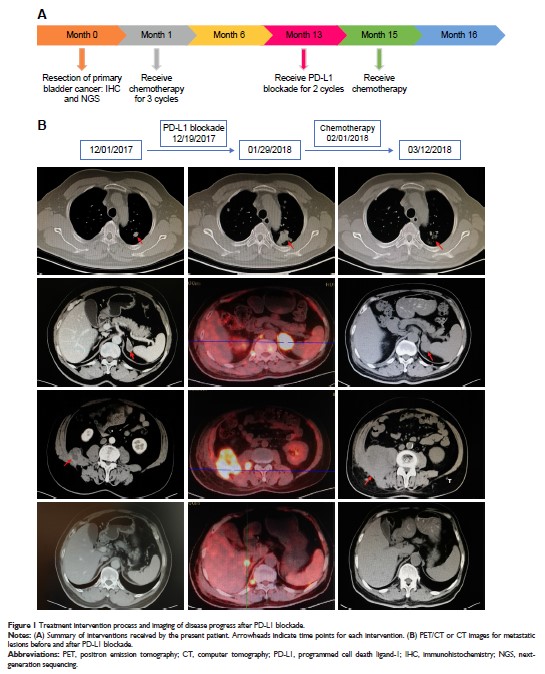
anti-PD-L1 monotherapy and experienced ultrarapid disease progression within 2
months; imaging scans ruled out pseudoprogression. We observed a fourfold
increase in tumor growth rate, defined as the ratio of post- to pretreatment
rates. Next-generation sequencing of formalin-fixed paraffin-embedded RC
tissues showed MDM2 amplification without MDM4 amplification, EGFR aberrations, or DNMT3A alterations.
Immunohistochemistry showed grade 2+ PD-L1 labeling intensity of the RC
tissues, with 15%–25% and 5%–10% PD-LI immunopositive tumor cells and
tumor-infiltrating immune cells, respectively.
Conclusion: Even in
cases with PD-L1-positive tumors, MDM2 gene amplification may result in
failure of anti-PD-L1 immunotherapy and rapid tumor growth. Therefore, genomic
profiling may identify patients at risk for hyperprogression before
immunotherapy.
Keywords: urothelial
bladder carcinoma, programmed cell death ligand-1, immune checkpoint blockade,
hyperprogression, MDM2