115195
论文已发表
注册即可获取德孚的最新动态
IF 收录期刊
- 3.6 Breast Cancer (Dove Med Press)
- 4.3 Clin Epidemiol
- 2.6 Cancer Manag Res
- 3.2 Infect Drug Resist
- 4.1 Clin Interv Aging
- 6.1 Drug Des Dev Ther
- 4.1 Int J Chronic Obstr
- 8.7 Int J Nanomed
- 2.5 Int J Women's Health
- 3.2 Neuropsych Dis Treat
- 2.4 OncoTargets Ther
- 2.6 Patient Prefer Adher
- 2.6 Ther Clin Risk Manag
- 3.1 J Pain Res
- 3.5 Diabet Metab Synd Ob
- 4.5 Psychol Res Behav Ma
- 3.4 Nat Sci Sleep
- 2.4 Pharmgenomics Pers Med
- 2.6 Risk Manag Healthc Policy
- 4.6 J Inflamm Res
- 2.3 Int J Gen Med
- 3.9 J Hepatocell Carcinoma
- 3.3 J Asthma Allergy
- 2.5 Clin Cosmet Investig Dermatol
- 3.0 J Multidiscip Healthc

后路减压脊柱稳定术治疗颈椎转移性脊髓压迫症患者的临床疗效及危险因素
Authors Lei M, Yu J, Yan S, An X, Liu Y
Received 19 August 2018
Accepted for publication 15 November 2018
Published 11 January 2019 Volume 2019:15 Pages 119—127
DOI https://doi.org/10.2147/TCRM.S184497
Checked for plagiarism Yes
Review by Single-blind
Peer reviewers approved by Dr Andrew Yee
Peer reviewer comments 2
Editor who approved publication: Professor Deyun Wang
Purpose: The aim of this
study was to investigate the clinical results of surgery for cervical spine
metastasis and identify clinical risk factors affecting postoperative survival
and neurological outcome.
Patients and methods: A
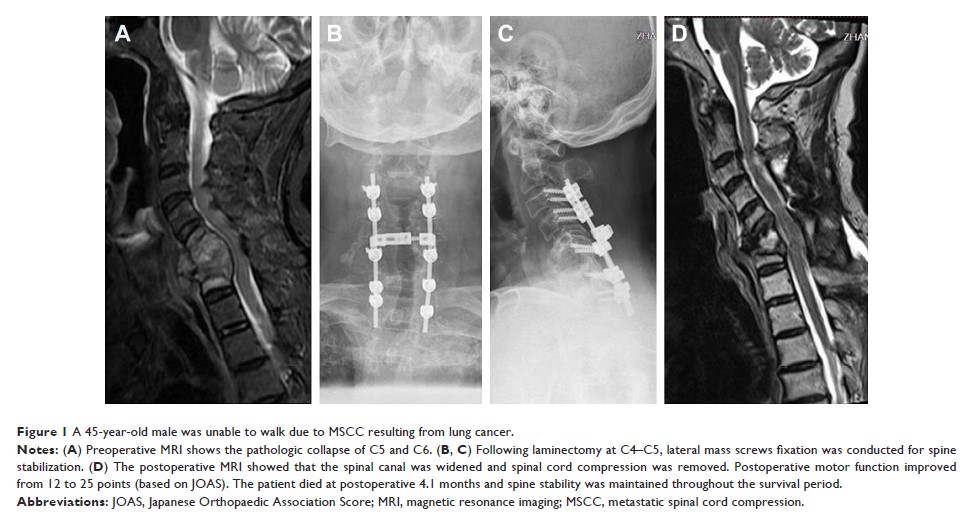
retrospective analysis of medical records was performed on 19 patients who
had undergone decompressive surgery and spine stabilization due to metastatic
spinal cord compression in the cervical spine. All patients had severe pain
before surgery. Worst pain, average pain, and pain interference were evaluated
using the visual analog scale (range, 0–10) for each patient at baseline and
following surgery. Neurological recovery was assessed using the Japanese
Orthopaedic Association Score (JOAS). In addition, associations between ten
characteristics and postoperative survival and neurological outcomes were
analyzed in the study.
Results: The mean
worst pain score in a 24-hour period was 8.6 before the operation. At 1 day, 1,
3, 6, and 12 months after the operation, the mean worst pain scores decreased
to 5.6, 4.5, 3.8, 2.6, and 2.4 (all P <0.001 vs baseline), respectively. Similar
decreases in average pain and pain interference were also observed. The median
JOAS in a 24-hour period was 11.0 before the operation. At 1 day, 1, 3, 6, and
12 months after the operation, the median JOAS increased to 12.0 (P =0.469), 13.0 (P =0.010), 14.0 (P <0.001), 15.0 (P <0.001), and
14.0 (P <0.001),
respectively. According to the multivariate analysis, postoperative survival
was significantly associated with the type of primary tumor (P =0.033),
preoperative ambulatory status (P =0.004), extra-spinal bone metastasis (P =0.021), 125I seed brachytherapy (P =0.014), and complication
status (P =0.009).
Better neurological outcome was found to be correlated with higher JOAS (P =0.013).
Surgery-related complications occurred in 26.3% of patients.
Conclusion: Posterior
decompression and spine stabilization for painful cervical spine metastasis
resulting from spinal cord compression were found to be effective for
neurological recovery and pain control with a tolerable rate of complications.
Keywords: cervical
spine metastasis, surgery, survival prognosis, neurological outcome, visual
analog scale, Japanese Orthopaedic Association Score