115195
论文已发表
注册即可获取德孚的最新动态
IF 收录期刊
- 3.6 Breast Cancer (Dove Med Press)
- 4.3 Clin Epidemiol
- 2.6 Cancer Manag Res
- 3.2 Infect Drug Resist
- 4.1 Clin Interv Aging
- 6.1 Drug Des Dev Ther
- 4.1 Int J Chronic Obstr
- 8.7 Int J Nanomed
- 2.5 Int J Women's Health
- 3.2 Neuropsych Dis Treat
- 2.4 OncoTargets Ther
- 2.6 Patient Prefer Adher
- 2.6 Ther Clin Risk Manag
- 3.1 J Pain Res
- 3.5 Diabet Metab Synd Ob
- 4.5 Psychol Res Behav Ma
- 3.4 Nat Sci Sleep
- 2.4 Pharmgenomics Pers Med
- 2.6 Risk Manag Healthc Policy
- 4.6 J Inflamm Res
- 2.3 Int J Gen Med
- 3.9 J Hepatocell Carcinoma
- 3.3 J Asthma Allergy
- 2.5 Clin Cosmet Investig Dermatol
- 3.0 J Multidiscip Healthc

异常的 CEACAM19 表达与阴茎癌的转移表型相关
Authors Hu X, Chen M, Li Y, Wang Y, Wen S, Jun F
Received 26 October 2018
Accepted for publication 7 December 2018
Published 14 January 2019 Volume 2019:11 Pages 715—725
DOI https://doi.org/10.2147/CMAR.S192385
Checked for plagiarism Yes
Review by Single-blind
Peer reviewers approved by Dr Andrew Yee
Peer reviewer comments 2
Editor who approved publication: Dr Kenan Onel
Objective: A greater
knowledge of the mechanisms of the pathogenesis of penile cancers may assist in
the development of more tailored targeted therapy. Herein, we aimed to evaluate
the expression of CEACAM19 in penile cancer and to explore its regulatory
mechanisms.
Material and methods: This
retrospective study enrolled 64 penile cancer patients who underwent penectomy
between 2011 and 2015. CEACAM19 expression in tissues was detected by
immunohistochemistry, which was analyzed in association with
clinicopathological parameters. Kaplan–Meier analysis was performed to evaluate
the relationship between CEACAM19 expression and prognosis of patients with
penile cancer. Cell Counting Kit-8 assay and clonogenic assay were used to
evaluate the cell viability and tumorigenic potential of penile cancer cell
line, respectively; wound healing assay and transwell invasion assay were
conducted to evaluate the effect of CEACAM19 depletion on cell migration and
invasion in penile cancer cells; CEACAM19 protein expression was analyzed by
Western blotting. Culture supranatant matrix metalloproteinase 2/9 (MMP2/9) was
detected by ELISA.
Results: CEACAM19 was
differentially expressed in non-cancerous and penile cancer tissues.
Over-expression of CEACAM19 was significantly associated with nodal and distant
metastasis, and predicted unfavorable cancer-specific survival in penile
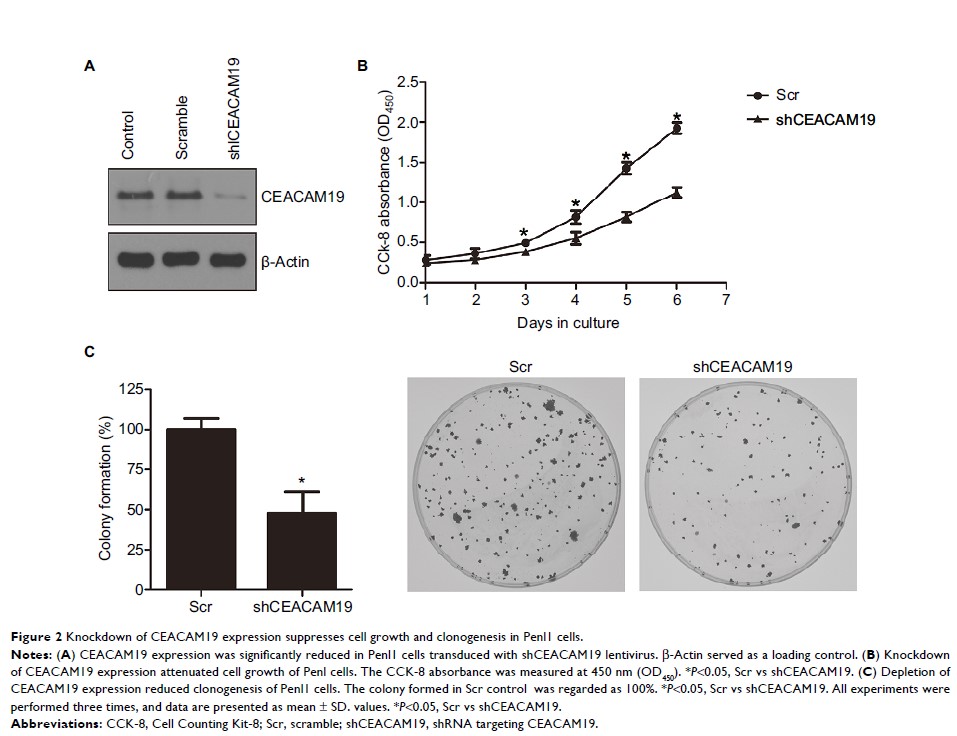
cancer. Depletion of CEACAM19 expression suppressed cell proliferation, reduced
colony formation, and attenuated cell migration and invasion in Penl1 cells.
Furthermore, knockdown of CEACAM19 expression attenuated the levels of
p-Smad2/3 and reduced secretion of MMP2/9 in Penl1 cells. The effects of
CEACAM19 might result from its function in regulating the Smad2/3 activation,
as inhibition on Smad2/3 activation suppressed cell migration and invasion and
reduced MMP2/9 secretion in Penl1 cells.
Conclusion: Over-expression
of CEACAM19 might serve as a potential prognostic biomarker for clinical
management of penile cancer. Strategies targeting CEACAM19-regulated signaling
pathways may have a therapeutic benefit in penile cancer.
Keywords: penile
cancer, CEACAM19, prognosis, metastasis