115195
论文已发表
注册即可获取德孚的最新动态
IF 收录期刊
- 3.6 Breast Cancer (Dove Med Press)
- 4.3 Clin Epidemiol
- 2.6 Cancer Manag Res
- 3.2 Infect Drug Resist
- 4.1 Clin Interv Aging
- 6.1 Drug Des Dev Ther
- 4.1 Int J Chronic Obstr
- 8.7 Int J Nanomed
- 2.5 Int J Women's Health
- 3.2 Neuropsych Dis Treat
- 2.4 OncoTargets Ther
- 2.6 Patient Prefer Adher
- 2.6 Ther Clin Risk Manag
- 3.1 J Pain Res
- 3.5 Diabet Metab Synd Ob
- 4.5 Psychol Res Behav Ma
- 3.4 Nat Sci Sleep
- 2.4 Pharmgenomics Pers Med
- 2.6 Risk Manag Healthc Policy
- 4.6 J Inflamm Res
- 2.3 Int J Gen Med
- 3.9 J Hepatocell Carcinoma
- 3.3 J Asthma Allergy
- 2.5 Clin Cosmet Investig Dermatol
- 3.0 J Multidiscip Healthc

氧化铁纳米颗粒促进间充质干细胞向损伤部位的迁移
Authors Li X, Wei Z, Lv H, Wu L, Cui Y, Yao H, Li J, Zhang H, Yang B, Jiang J
Received 22 August 2018
Accepted for publication 17 December 2018
Published 14 January 2019 Volume 2019:14 Pages 573—589
DOI https://doi.org/10.2147/IJN.S184920
Checked for plagiarism Yes
Review by Single-blind
Peer reviewers approved by Dr Alexander Kharlamov
Peer reviewer comments 2
Editor who approved publication: Dr Lei Yang
Background: Developing
new methods to deliver cells to the injured tissue is a critical factor in
translating cell therapeutics research into clinical use; therefore, there is a
need for improved cell homing capabilities.
Materials and methods: In this
study, we demonstrated the effects of labeling rat bone marrow-derived
mesenchymal stem cells (MSCs) with fabricated polydopamine (PDA)-capped Fe3O4 (Fe3O4@PDA)
superparticles employing preassembled Fe3O4 nanoparticles
as the cores.
Results: We found
that the Fe3O4@PDA composite superparticles exhibited no
adverse effects on MSC characteristics. Moreover, iron
oxide nanoparticles increased the number of MSCs in the S-phase, their
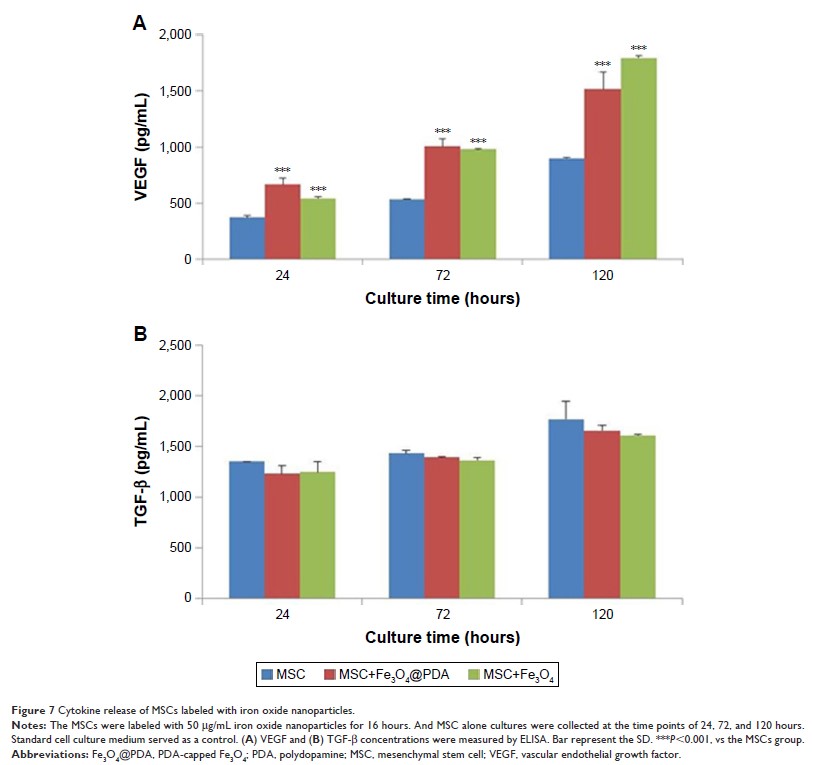
proliferation index and migration ability, and their secretion of vascular
endothelial growth factor relative to unlabeled MSCs. Interestingly,
nanoparticles not only promoted the expression of C-X-C chemokine receptor 4
but also increased the expression of the migration-related proteins c-Met and
C-C motif chemokine receptor 1, which has not been reported previously.
Furthermore, the MSC-loaded nanoparticles exhibited improved homing and
anti-inflammatory abilities in the absence of external magnetic fields
in vivo.
Conclusion: These results
indicated that iron oxide nanoparticles rendered MSCs more favorable for use in
injury treatment with no negative effects on MSC properties, suggesting their
potential clinical efficacy.
Keywords: mesenchymal
stem cells, migration, Fe3O4 nanoparticles, polydopamine