115195
论文已发表
注册即可获取德孚的最新动态
IF 收录期刊
- 3.6 Breast Cancer (Dove Med Press)
- 4.3 Clin Epidemiol
- 2.6 Cancer Manag Res
- 3.2 Infect Drug Resist
- 4.1 Clin Interv Aging
- 6.1 Drug Des Dev Ther
- 4.1 Int J Chronic Obstr
- 8.7 Int J Nanomed
- 2.5 Int J Women's Health
- 3.2 Neuropsych Dis Treat
- 2.4 OncoTargets Ther
- 2.6 Patient Prefer Adher
- 2.6 Ther Clin Risk Manag
- 3.1 J Pain Res
- 3.5 Diabet Metab Synd Ob
- 4.5 Psychol Res Behav Ma
- 3.4 Nat Sci Sleep
- 2.4 Pharmgenomics Pers Med
- 2.6 Risk Manag Healthc Policy
- 4.6 J Inflamm Res
- 2.3 Int J Gen Med
- 3.9 J Hepatocell Carcinoma
- 3.3 J Asthma Allergy
- 2.5 Clin Cosmet Investig Dermatol
- 3.0 J Multidiscip Healthc

较低的维生素 D 水平与痛风患者的抑郁有关
Authors Zhou Q, Shao Y, Gan Z, Fang L
Received 1 November 2018
Accepted for publication 4 December 2018
Published 14 January 2019 Volume 2019:15 Pages 227—231
DOI https://doi.org/10.2147/NDT.S193114
Checked for plagiarism Yes
Review by Single-blind
Peer reviewers approved by Dr Colin Mak
Peer reviewer comments 2
Editor who approved publication: Dr Yu-Ping Ning
Background: Depression is
commonly observed among patients with gout. Low levels of vitamin D have been
associated with depression in non-gout subjects. We examined the association of
vitamin D levels with depression in patients with gout.
Methods: We conducted a
cross-sectional study of 186 gout patients at the Endocrinology Department of
First Affiliated Hospital of Jiaxing University. Levels of serum
25-hydroxyvitamin D (25(OH)D) were determined using a competitive
protein-binding assay. The 17-item Hamilton Depression Scale was used for
screening for depressive symptoms. Diagnosis of depression in gout patients was
made in accordance with Diagnostic and Statistical Manual of Mental Disorders, fifth
edition criteria for depression. Multivariate analysis was
performed using logistic regression models.
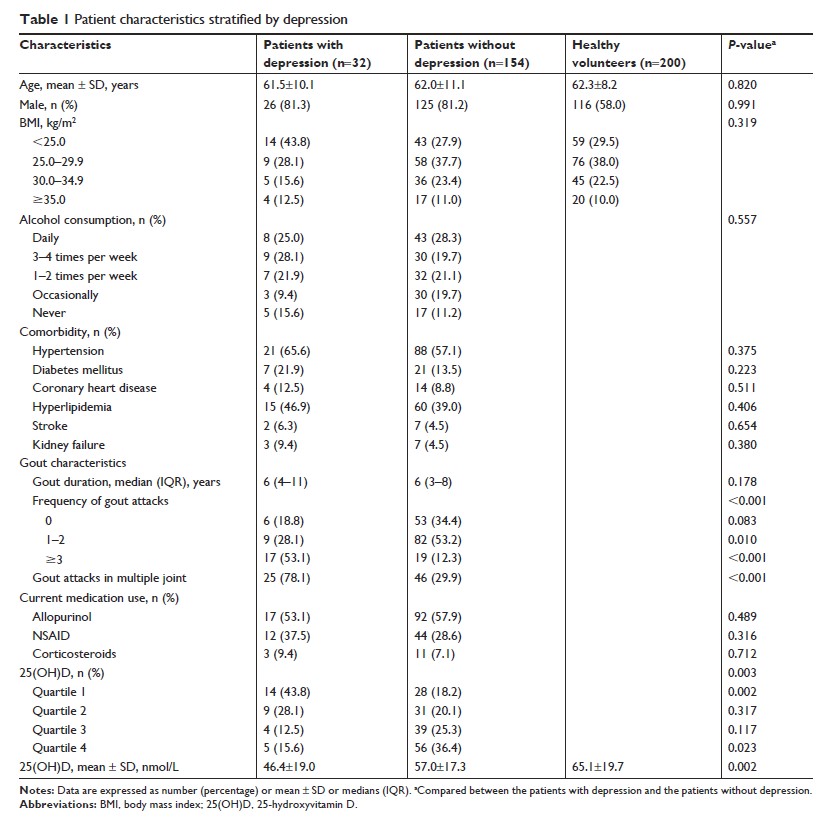
Results: Thirty-two
gout patients (17.2%) were diagnosed as having depression. Patients with
depression showed significantly lower 25(OH)D levels as compared to patients
without depression (46.4±19.0 vs 57.0±17.3 nmol/L, P <0.001).
Significant differences in 25(OH)D quartiles of gout patients were observed
between the patients with depression and the patients without depression (P =0.003). In
multivariate analyses, serum 25(OH)D levels (≤40.0 nmol/L) were independently
associated with depression in patients with gout (OR 3.833, 95% CI
1.406–10.453, P =0.009).
Conclusion: Our study
demonstrates an important association between serum vitamin D levels and
depression in patients with gout.
Keywords: depression,
vitamin, gout