115195
论文已发表
注册即可获取德孚的最新动态
IF 收录期刊
- 3.6 Breast Cancer (Dove Med Press)
- 4.3 Clin Epidemiol
- 2.6 Cancer Manag Res
- 3.2 Infect Drug Resist
- 4.1 Clin Interv Aging
- 6.1 Drug Des Dev Ther
- 4.1 Int J Chronic Obstr
- 8.7 Int J Nanomed
- 2.5 Int J Women's Health
- 3.2 Neuropsych Dis Treat
- 2.4 OncoTargets Ther
- 2.6 Patient Prefer Adher
- 2.6 Ther Clin Risk Manag
- 3.1 J Pain Res
- 3.5 Diabet Metab Synd Ob
- 4.5 Psychol Res Behav Ma
- 3.4 Nat Sci Sleep
- 2.4 Pharmgenomics Pers Med
- 2.6 Risk Manag Healthc Policy
- 4.6 J Inflamm Res
- 2.3 Int J Gen Med
- 3.9 J Hepatocell Carcinoma
- 3.3 J Asthma Allergy
- 2.5 Clin Cosmet Investig Dermatol
- 3.0 J Multidiscip Healthc

血清 BICC1 水平在各种情绪障碍中有显著不同
Authors Chen S, Jiang H, Xu Z, Zhao J, Wang M, Lu Y, Li J, Sun F, Yuan Y
Received 7 October 2018
Accepted for publication 14 December 2018
Published 15 January 2019 Volume 2019:15 Pages 259—265
DOI https://doi.org/10.2147/NDT.S190048
Checked for plagiarism Yes
Review by Single-blind
Peer reviewers approved by Dr Andrew Yee
Peer reviewer comments 3
Editor who approved publication: Dr Yu-Ping Ning
Purpose: Mood
disorders are recurrent chronic disorders with fluctuating mood states and
energy, and misdiagnosis is common when based solely on clinical interviews
because of overlapping symptoms. Because misdiagnosis may lead to inappropriate
treatment and poor prognosis, finding an easily implemented objective tool for
the discrimination of different mood disorders is very necessary and urgent.
However, there has been no accepted objective tool until now. Recently, BICC1 has been
identified as a candidate gene relating to major depressive disorder (MDD).
Therefore, the aim of this study is to evaluate the ability of serum BICC1 to
discriminate between various mood disorders, including MDD and the manic and
depressive phases of bipolar disorder, namely bipolar mania (BM) and bipolar
depression (BD).
Patients and methods: Serum BICC1
levels in drug-free patients with MDD (n=30), BM (n=30), and BD (n=13), and
well-matched healthy controls (HC, n=30) were measured with ELISA kits. Pearson
correlation analyses were used to analyze the correlations between serum BICC1
levels and clinical information. Receiver operating characteristic (ROC) curve
analysis was used to analyze the differential discriminative potential of BICC1
for different mood disorders.
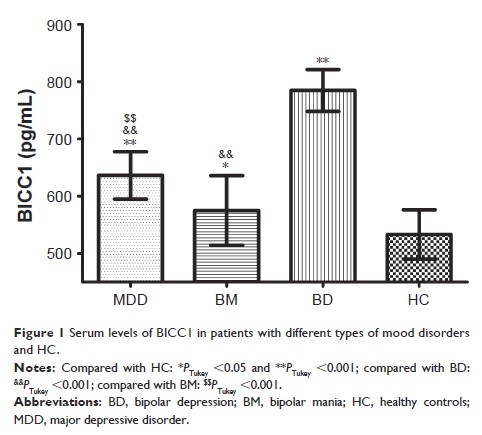
Results: One-way ANOVA
indicated that serum BICC1 levels were significantly increased in all patient
groups compared with the HC group and significantly different between each pair
of patient groups. Correlation analyses found no relationship between serum
BICC1 levels and any clinical variables in any study group. ROC curve analysis
showed that serum BICC1 could discriminate among all three mood disorders from
each other accurately with fair-to-excellent discriminatory capacity (area
under the ROC curve from 0.787 to 1.0).
Conclusion: The findings of
this preliminary study indicated significant differences in serum BICC1 levels
in patients with different mood disorders. This study provides preliminary
evidence that serum BICC1 may be regarded as a promising, objective,
easy-to-use tool for diagnosing different mood disorders.
Keywords: biomarker,
mood disorder, diagnosis, differential diagnosis, objective tool, BICC1