115195
论文已发表
注册即可获取德孚的最新动态
IF 收录期刊
- 3.6 Breast Cancer (Dove Med Press)
- 4.3 Clin Epidemiol
- 2.6 Cancer Manag Res
- 3.2 Infect Drug Resist
- 4.1 Clin Interv Aging
- 6.1 Drug Des Dev Ther
- 4.1 Int J Chronic Obstr
- 8.7 Int J Nanomed
- 2.5 Int J Women's Health
- 3.2 Neuropsych Dis Treat
- 2.4 OncoTargets Ther
- 2.6 Patient Prefer Adher
- 2.6 Ther Clin Risk Manag
- 3.1 J Pain Res
- 3.5 Diabet Metab Synd Ob
- 4.5 Psychol Res Behav Ma
- 3.4 Nat Sci Sleep
- 2.4 Pharmgenomics Pers Med
- 2.6 Risk Manag Healthc Policy
- 4.6 J Inflamm Res
- 2.3 Int J Gen Med
- 3.9 J Hepatocell Carcinoma
- 3.3 J Asthma Allergy
- 2.5 Clin Cosmet Investig Dermatol
- 3.0 J Multidiscip Healthc

PUF60 通过下调 PTEN 表达加速乳腺癌的进展
Authors Sun D, Lei W, Hou X, Li H, Ni W
Received 14 July 2018
Accepted for publication 19 November 2018
Published 17 January 2019 Volume 2019:11 Pages 821—830
DOI https://doi.org/10.2147/CMAR.S180242
Checked for plagiarism Yes
Review by Single-blind
Peer reviewers approved by Dr Amy Norman
Peer reviewer comments 2
Editor who approved publication: Dr Antonella D'Anneo
Background: PUF60 is
a splicing variant of far upstream element binding protein 1-interacting
repressor, which is abnormally expressed in a variety of tumors and is closely
involved in their progression. However, whether PUF60 participates in the
occurrence and development of breast cancer remains unknown. Therefore, the
objective of the current study is to explore the effects and mechanism of PUF60
in the progression of breast cancer.
Methods: PUF60
expression patterns in breast cancer tissues and cells were determined by
RT-PCR and Western blotting. The relationship between PUF60 expression and
patients’ clinical features and outcome was evaluated to assess the potential
of PUF60 as a marker for progression and prognosis prediction. CCK-8, flow
cytometry, transwell and in vivo tumor formation assays were used to detect
cell proliferation, apoptosis, migration, invasion and tumorigenesis. The
effects of PUF60 on the activation of PTEN/PI3K/AKT were also evaluated by
Western blotting and immunofluorescence assays.
Results: The
expression of PUF60 was elevated in breast cancer tissue samples and cell
lines, and its high expression was closely associated with the high incidence
of lymph node metastasis and advanced TNM stage. Besides, upregulation of PUF60
with lentivirus infection significantly increased the growth, migration, and
invasion and repressed the apoptosis of breast cancer HCC1937 and MDA-MB-231
cells, while silencing of PUF60 with shRNA showed the opposite results.
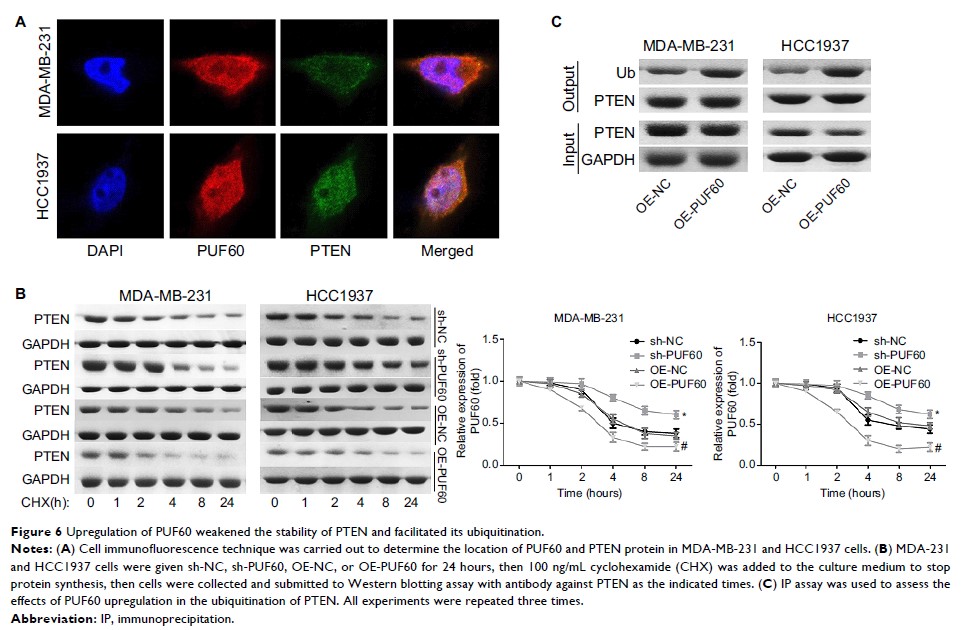
Moreover, PUF60 upregulation promoted the expression of p-AKT, PI3K, and mTOR,
while decreased PTEN expression through inhibiting its stability and enhancing
its ubiquitination. Furthermore, upregulation of PUF60 promoted the
tumorigenesis in vivo, whereas this effect was impaired when PTEN expression
was upregulated in MDA-MB-231 and HCC1937 cells.
Conclusion: This
study demonstrates that PUF60 is highly expressed in breast cancer;
upregulation of PUF60 accelerates the progression of breast cancer through PTEN
inhibition.
Keywords: PUF60,
PTEN, PI3K/AKT, breast cancer, proliferation, tumorigenesis