115195
论文已发表
注册即可获取德孚的最新动态
IF 收录期刊
- 3.6 Breast Cancer (Dove Med Press)
- 4.3 Clin Epidemiol
- 2.6 Cancer Manag Res
- 3.2 Infect Drug Resist
- 4.1 Clin Interv Aging
- 6.1 Drug Des Dev Ther
- 4.1 Int J Chronic Obstr
- 8.7 Int J Nanomed
- 2.5 Int J Women's Health
- 3.2 Neuropsych Dis Treat
- 2.4 OncoTargets Ther
- 2.6 Patient Prefer Adher
- 2.6 Ther Clin Risk Manag
- 3.1 J Pain Res
- 3.5 Diabet Metab Synd Ob
- 4.5 Psychol Res Behav Ma
- 3.4 Nat Sci Sleep
- 2.4 Pharmgenomics Pers Med
- 2.6 Risk Manag Healthc Policy
- 4.6 J Inflamm Res
- 2.3 Int J Gen Med
- 3.9 J Hepatocell Carcinoma
- 3.3 J Asthma Allergy
- 2.5 Clin Cosmet Investig Dermatol
- 3.0 J Multidiscip Healthc

在中国,开放式、腹腔镜式或机器人辅助根治性前列腺切除术后与健康相关的生活质量状况
Authors Huang W, Zhang Y, Shen BH, Wang S, Meng HZ, Jin XD
Received 5 October 2018
Accepted for publication 17 December 2018
Published 18 January 2019 Volume 2019:11 Pages 899—907
DOI https://doi.org/10.2147/CMAR.S189893
Checked for plagiarism Yes
Review by Single-blind
Peer reviewers approved by Dr Andrew Yee
Peer reviewer comments 2
Editor who approved publication: Dr Kenan Onel
Purpose: To
compare the outcomes of health-related quality of life (HRQOL) in patients
undergoing open (ORP), laparoscopic (LRP), or robot-assisted (RARP) radical
prostatectomy.
Patients and methods: We
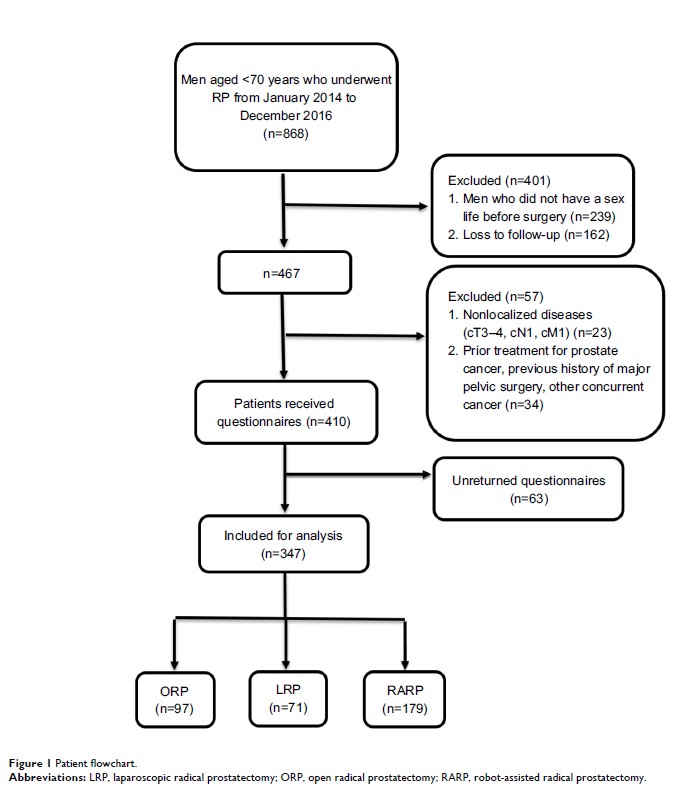
retrospectively analyzed 347 men with clinically localized prostate cancer
treated with ORP (n=97), LRP (n=71), or RARP (n=179) by high-volume surgeons in
our institution between January 2014 and December 2016. The primary endpoint
was HRQOL including urinary incontinence and erectile dysfunction.
Results: One year
after surgery, 15.9% of men reported moderate to severe urinary incontinence
(ORP 16.5%, LRP 15.4%, and RARP 15.7%), with only 4.6% using pads. There were
no statistically significant differences in the ratios of no pad usage and
urinary incontinence bother after 12 months postoperatively among the three
groups. However, 67.7% of the men reported moderate to severe erectile
dysfunction (ORP 66%, LRP 66.1%, and RARP 69.3%) 12 months after surgery. There
was no statistically significant difference in the international index of
erectile function-5 (IIEF-5) postoperatively among the different surgical
groups. In the univariate and multivariate analyses, age at surgery,
preoperative IIEF-5, and neurovascular bundle preservation were the risk
factors for moderate to severe sexual bother. Interestingly, 16.1% of men with
an erection hardness score of grade 3–4 were hesitant to become sexually active
postoperatively.
Conclusion: ORP, LRP,
and RARP have similar early HRQOL outcomes with respect to urinary incontinence
and erectile dysfunction. In contrast to urinary continence, erectile
dysfunction is still a serious concern for patients who undergo radical
prostatectomy.
Keywords: erectile
dysfunction, prostate cancer, radical prostatectomy, urinary incontinence