115195
论文已发表
注册即可获取德孚的最新动态
IF 收录期刊
- 3.6 Breast Cancer (Dove Med Press)
- 4.3 Clin Epidemiol
- 2.6 Cancer Manag Res
- 3.2 Infect Drug Resist
- 4.1 Clin Interv Aging
- 6.1 Drug Des Dev Ther
- 4.1 Int J Chronic Obstr
- 8.7 Int J Nanomed
- 2.5 Int J Women's Health
- 3.2 Neuropsych Dis Treat
- 2.4 OncoTargets Ther
- 2.6 Patient Prefer Adher
- 2.6 Ther Clin Risk Manag
- 3.1 J Pain Res
- 3.5 Diabet Metab Synd Ob
- 4.5 Psychol Res Behav Ma
- 3.4 Nat Sci Sleep
- 2.4 Pharmgenomics Pers Med
- 2.6 Risk Manag Healthc Policy
- 4.6 J Inflamm Res
- 2.3 Int J Gen Med
- 3.9 J Hepatocell Carcinoma
- 3.3 J Asthma Allergy
- 2.5 Clin Cosmet Investig Dermatol
- 3.0 J Multidiscip Healthc

射频消融治疗三叉神经痛的疗效和安全性:一个系统评价和荟萃分析
Authors Wu H, Zhou J, Chen J, Gu Y, Shi L, Ni H
Received 12 June 2018
Accepted for publication 10 December 2018
Published 18 January 2019 Volume 2019:12 Pages 423—441
DOI https://doi.org/10.2147/JPR.S176960
Checked for plagiarism Yes
Review by Single-blind
Peer reviewers approved by Dr Justinn Cochran
Peer reviewer comments 4
Editor who approved publication: Dr Michael Ueberall
Objective: The
objective of this study was to summarize the effectiveness and safety of
trigeminal neuralgia (TN) treatment via different radiofrequency approaches
such as continuous radiofrequency (CRF), pulsed radiofrequency (PRF), and
combined CRF and pulsed radiofrequency (CCPRF) treatments, thus providing
high-quality clinical evidence for TN treatment.
Methods: A series
of databases were searched for relevant articles published between January 1998
and April 2018. The modified Jadad scale was referred to evaluate the
methodological quality of the included studies. Data were extracted
independently, and the outcome and safety of different routes, temperatures,
and guidance used in CRF, PRF, and CCPRF were compared. Meta-analysis and
publication bias were calculated using Review Manager software.
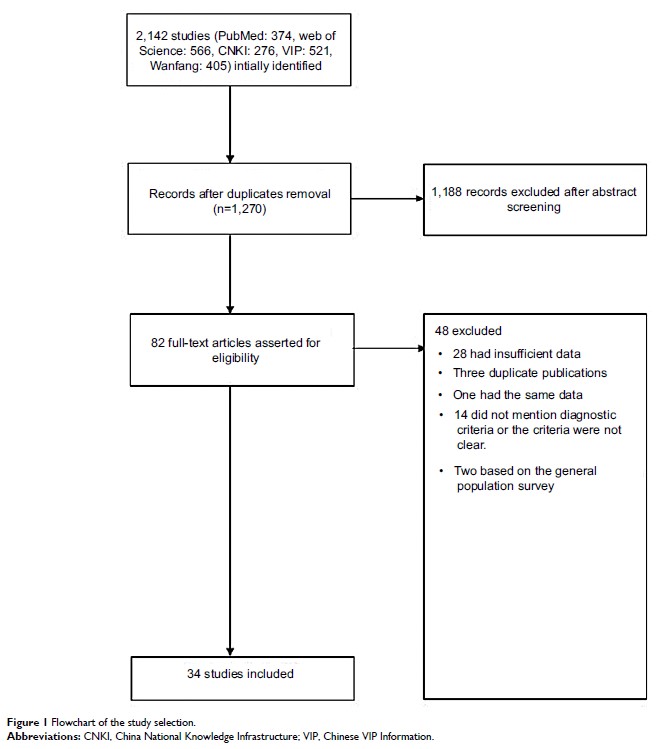
Results: In total,
34 studies involving 3,558 participants were included. With regard to TN
treatment, PRF had no difference in cured rate in comparison with CRF, while
CRF was more effective than CCPRF (P <0.05). The comparison of complication rates
showed that PRF and CCPRF were safer. For puncture guidance via CRF,
three-dimensional-printed template was more accurate in success rate at first
puncture than computed tomography guidance (P <0.05). For puncture route, foramen rotundum (FR)
or pterygopalatine fossa (PPF) route had no significance in efficiency rate via
CRF in comparison with foramen oval (FO) route, but PPF and FR routes were
safer. For CRF treatment, low temperature (68°C–70°C) compared with high
temperature (71°C–75°C) had no effect. Moreover, higher temperature (66°C–80°C)
had a greater effect compared with lower temperature (55°C–65°C) on TN
treatment (P <0.05),
while the safety of which was decreasing.
Conclusion: CCPRF
could achieve a greater effect and safety on TN treatment. FR and FO routes in
TN puncture treatment via CRF are safer. Medium temperature range is better for
CRF therapy, and higher temperature is recommended in PRF, especially for the
elders. Further international multicenter trials are needed to confirm the
evidence.
Keywords: trigeminal
neuralgia, radiofrequency ablation, radiofrequency thermocoagulation,
meta-analysis