115195
论文已发表
注册即可获取德孚的最新动态
IF 收录期刊
- 3.6 Breast Cancer (Dove Med Press)
- 4.3 Clin Epidemiol
- 2.6 Cancer Manag Res
- 3.2 Infect Drug Resist
- 4.1 Clin Interv Aging
- 6.1 Drug Des Dev Ther
- 4.1 Int J Chronic Obstr
- 8.7 Int J Nanomed
- 2.5 Int J Women's Health
- 3.2 Neuropsych Dis Treat
- 2.4 OncoTargets Ther
- 2.6 Patient Prefer Adher
- 2.6 Ther Clin Risk Manag
- 3.1 J Pain Res
- 3.5 Diabet Metab Synd Ob
- 4.5 Psychol Res Behav Ma
- 3.4 Nat Sci Sleep
- 2.4 Pharmgenomics Pers Med
- 2.6 Risk Manag Healthc Policy
- 4.6 J Inflamm Res
- 2.3 Int J Gen Med
- 3.9 J Hepatocell Carcinoma
- 3.3 J Asthma Allergy
- 2.5 Clin Cosmet Investig Dermatol
- 3.0 J Multidiscip Healthc

羟考酮和瑞芬太尼对超声引导下经皮射频消融治疗的肝癌患者的不同影响:一项随机试验
Authors Wu J, Lu Y, Cao X
Received 12 October 2018
Accepted for publication 12 December 2018
Published 18 January 2019 Volume 2019:13 Pages 365—372
DOI https://doi.org/10.2147/DDDT.S188728
Checked for plagiarism Yes
Review by Single-blind
Peer reviewers approved by Dr Palas Chanda
Peer reviewer comments 2
Editor who approved publication: Dr Anastasios Lymperopoulos
Background: Percutaneous
radiofrequency ablation (RFA) is a recently introduced alternative technique
for the treatment of hepatic cancer. Anesthesia is required for RFA of hepatic
cancer to achieve patient comfort and immobilization during this painful
procedure. The purpose of this study was to investigate the analgesic efficacy
and evaluate the safety of a single intravenous injection of oxycodone
hydrochloride for this procedure.
Patients and methods: A total
of 120 American Society of Anesthesiologists class I–II grade patients for
elective ultrasound-guided percutaneous RFA were enrolled in this randomized
controlled trial. Patients were randomized (1:1) to receive either a single
intravenous injection of oxycodone (group O) or continuous infusion of
remifentanil (group R). Both groups received the continuous infusion of
dexmedetomidine for sedation. Visual analog scale (VAS), rescue analgesic, and
side effects were checked during the periprocedural period. In addition,
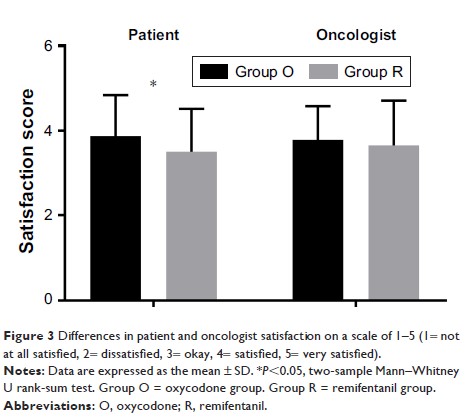
patient and oncologist satisfaction on a scale of 1–5 were determined.
Results: VAS score
in group O was significantly lower than in group R at 1, 2, and 3 hours after
RFA, and patients in group O required analgesics significantly later and less
doses in the first 24 hours after RFA. The occurrence of unwanted body
movements was significantly lower in group O. We found no complications
including allergic reaction, excessive sedation, and chest wall rigidity in all
patients. The patient satisfaction score was significantly higher in group O
than that in group R.
Conclusion: Ultrasound-guided
percutaneous RFA for hepatic cancer can be completed both with continuous
infusion of remifentanil or a single intravenous injection of oxycodone.
However, oxycodone hydrochloride provides better patient experience with higher
satisfactory score and less unwanted body movements, relieves post-procedural
pain better, and is not associated with an increase in adverse effects.
Keywords: analgesia,
oxycodone, hepatic cancer, radiofrequency ablation