115195
论文已发表
注册即可获取德孚的最新动态
IF 收录期刊
- 3.6 Breast Cancer (Dove Med Press)
- 4.3 Clin Epidemiol
- 2.6 Cancer Manag Res
- 3.2 Infect Drug Resist
- 4.1 Clin Interv Aging
- 6.1 Drug Des Dev Ther
- 4.1 Int J Chronic Obstr
- 8.7 Int J Nanomed
- 2.5 Int J Women's Health
- 3.2 Neuropsych Dis Treat
- 2.4 OncoTargets Ther
- 2.6 Patient Prefer Adher
- 2.6 Ther Clin Risk Manag
- 3.1 J Pain Res
- 3.5 Diabet Metab Synd Ob
- 4.5 Psychol Res Behav Ma
- 3.4 Nat Sci Sleep
- 2.4 Pharmgenomics Pers Med
- 2.6 Risk Manag Healthc Policy
- 4.6 J Inflamm Res
- 2.3 Int J Gen Med
- 3.9 J Hepatocell Carcinoma
- 3.3 J Asthma Allergy
- 2.5 Clin Cosmet Investig Dermatol
- 3.0 J Multidiscip Healthc

通过 BMP-2 肽功能化的氧化石墨烯修饰增强丝素蛋白电纺支架的骨再生增强
Authors Wu J, Zheng A, Liu Y, Jiao D, Zeng D, Wang X, Cao L, Jiang X
Received 15 September 2018
Accepted for publication 11 December 2018
Published 18 January 2019 Volume 2019:14 Pages 733—751
DOI https://doi.org/10.2147/IJN.S187664
Checked for plagiarism Yes
Review by Single-blind
Peer reviewers approved by Dr Alexander Kharlamov
Peer reviewer comments 3
Editor who approved publication: Dr Linlin Sun
Introduction: Bone
tissue engineering has become one of the most effective methods to treat bone
defects. Silk fibroin (SF) is a natural protein with no physiological
activities, which has features such as good biocompatibility and easy
processing and causes minimal inflammatory reactions in the body. Scaffolds
prepared by electrospinning SF can be used in bone tissue regeneration and
repair. Graphene oxide (GO) is rich in functional groups, has good
biocompatibility, and promotes osteogenic differentiation of stem cells, while
bone morphogenetic protein-2 (BMP-2) polypeptide has an advantage in promoting
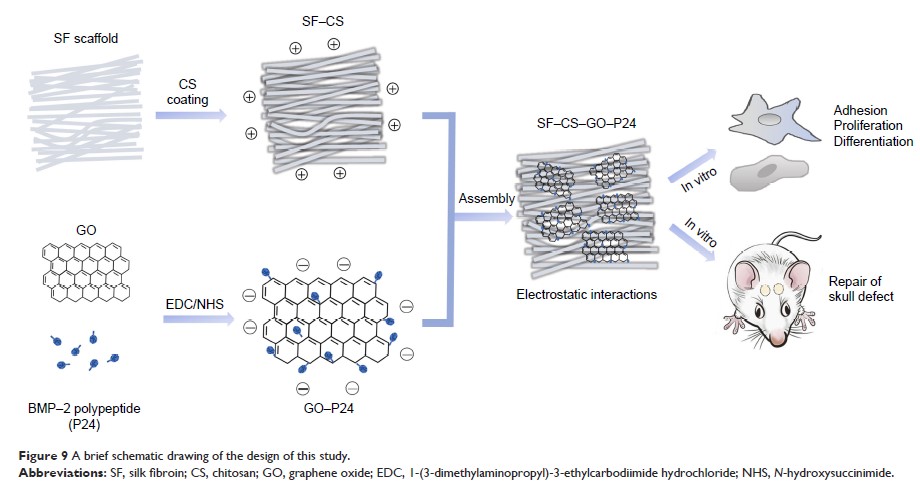
osteogenesis induction. In this study, we attempted to graft BMP-2 polypeptide
onto GO and then bonded the functionalized GO onto SF electrospun scaffolds
through electrostatic interactions. The main purpose of this study was to
further improve the biocompatibility of SF electrospun scaffolds, which could
promote the osteogenic differentiation of bone marrow mesenchymal stem cells
and the repair of bone tissue defects.
Materials and methods: The successful synthesis of GO and functionalized GO was confirmed
by transmission electron microscope, X-ray photoelectron spectroscopy, and
thermogravimetric analysis. Scanning electron microscopy, atomic force
microscopy, mechanical test, and degradation experiment confirmed the
preparation of SF electrospun scaffolds and the immobilization of GO on the
fibers. In vitro experiment was used to verify the biocompatibility of the
composite scaffolds, and in vivo experiment was used to prove the
repairing ability of the composite scaffolds for bone defects.
Results: We
successfully fabricated the composite scaffolds, which enhanced
biocompatibility, not only promoting cell adhesion and proliferation but also
greatly enhancing in vitro osteogenic differentiation of bone marrow
stromal cells using either an osteogenic or non-osteogenic medium. Furthermore,
transplantation of the composite scaffolds significantly promoted in vivo
bone formation in critical-sized calvarial bone defects.
Conclusion: These
findings suggested that the incorporation of BMP-2 polypeptide-functionalized
GO into chitosan-coated SF electrospun scaffolds was a viable strategy for
fabricating excellent scaffolds that enhance the regeneration of bone defects.
Keywords: bone
morphogenetic protein-2, peptide, osteogenic differentiation, bone
regeneration, graphene oxide, silk fibroin, electrospinning scaffold, bone
marrow mesenchymal stem cells