115195
论文已发表
注册即可获取德孚的最新动态
IF 收录期刊
- 3.6 Breast Cancer (Dove Med Press)
- 4.3 Clin Epidemiol
- 2.6 Cancer Manag Res
- 3.2 Infect Drug Resist
- 4.1 Clin Interv Aging
- 6.1 Drug Des Dev Ther
- 4.1 Int J Chronic Obstr
- 8.7 Int J Nanomed
- 2.5 Int J Women's Health
- 3.2 Neuropsych Dis Treat
- 2.4 OncoTargets Ther
- 2.6 Patient Prefer Adher
- 2.6 Ther Clin Risk Manag
- 3.1 J Pain Res
- 3.5 Diabet Metab Synd Ob
- 4.5 Psychol Res Behav Ma
- 3.4 Nat Sci Sleep
- 2.4 Pharmgenomics Pers Med
- 2.6 Risk Manag Healthc Policy
- 4.6 J Inflamm Res
- 2.3 Int J Gen Med
- 3.9 J Hepatocell Carcinoma
- 3.3 J Asthma Allergy
- 2.5 Clin Cosmet Investig Dermatol
- 3.0 J Multidiscip Healthc

使用低频波动幅度改变牙痛患者的内在脑活动 - 使用低频率波动的幅度探测高度近视患者变异的自发脑活动模式 一项静息态功能性磁共振成像研究
Authors Yang J, Li B, Yu QY, Ye L, Zhu PW, Shi WQ, Yuan Q, Min YL, He YL, Shao Y
Received 6 October 2018
Accepted for publication 11 December 2018
Published 18 January 2019 Volume 2019:15 Pages 283—291
DOI https://doi.org/10.2147/NDT.S189962
Checked for plagiarism Yes
Review by Single-blind
Peer reviewers approved by Dr Amy Norman
Peer reviewer comments 2
Editor who approved publication: Dr Yu-Ping Ning
Background: The
results of previous studies have indicated that pain-associated diseases can
result in marked functional and anatomical alterations in the brain. However,
differences in spontaneous brain activity occurring in toothache (TA) patients
remain unclear.
Objective: This
study investigated intrinsic brain activity changes in TA subjects using the
amplitude of low-frequency fluctuation (ALFF) technique.
Methods: A total
of 18 patients with TA (eight males, and 10 females) and 18 healthy controls
(HCs) who were matched for gender, age, and educational status were enrolled.
Resting-state functional MRI was used to examine the participants. Spontaneous
cerebral activity variations were investigated using the ALFF technique. The
mean ALFF values of the TA patients and the HCs were classified using receiver
operating characteristic (ROC) curves. The correlations between ALFF signals of
distinct regions of the cerebrum and the clinical manifestations of the TA
patients were evaluated using Pearson’s correlation analysis.
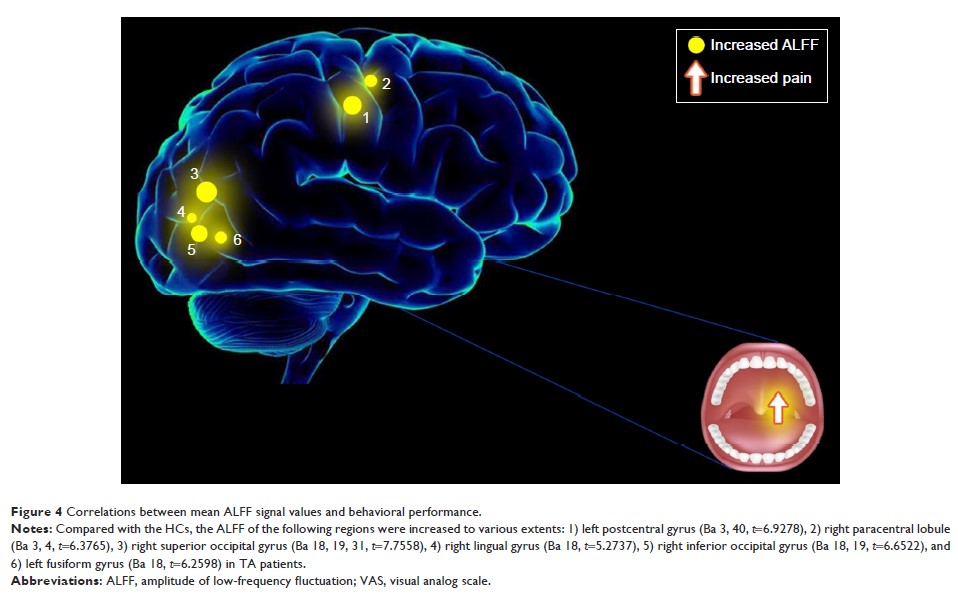
Results: Compared
with HCs, TA patients showed notably higher ALFF in the left postcentral gyrus,
right paracentral lobule, right lingual gyrus, right inferior occipital gyrus,
left fusiform gyrus, and right superior occipital gyrus. ROC curve analysis of
each brain region showed that the accuracy area under the curve was excellent.
In the TA group, the visual analog scale of the left side was positively
correlated with the ALFF signal values of the right paracentral lobule (r =0.639, P =0.025).
Conclusion: Multiple
brain regions, including pain- and vision-related areas, exhibited aberrant
intrinsic brain activity patterns, which may help to explain the underlying
neural mechanisms in TA.
Keywords: toothache,
functional MRI, ALFF, intrinsic brain activity, pain, resting-state