115195
论文已发表
注册即可获取德孚的最新动态
IF 收录期刊
- 3.6 Breast Cancer (Dove Med Press)
- 4.3 Clin Epidemiol
- 2.6 Cancer Manag Res
- 3.2 Infect Drug Resist
- 4.1 Clin Interv Aging
- 6.1 Drug Des Dev Ther
- 4.1 Int J Chronic Obstr
- 8.7 Int J Nanomed
- 2.5 Int J Women's Health
- 3.2 Neuropsych Dis Treat
- 2.4 OncoTargets Ther
- 2.6 Patient Prefer Adher
- 2.6 Ther Clin Risk Manag
- 3.1 J Pain Res
- 3.5 Diabet Metab Synd Ob
- 4.5 Psychol Res Behav Ma
- 3.4 Nat Sci Sleep
- 2.4 Pharmgenomics Pers Med
- 2.6 Risk Manag Healthc Policy
- 4.6 J Inflamm Res
- 2.3 Int J Gen Med
- 3.9 J Hepatocell Carcinoma
- 3.3 J Asthma Allergy
- 2.5 Clin Cosmet Investig Dermatol
- 3.0 J Multidiscip Healthc

阿戈美拉汀刺激下的褪黑素受体可防止由 Aβ 诱导的 PC12 细胞 tau 蛋白磷酸化和氧化损伤
Authors Yao K, Zhao Y, Zu H
Received 5 August 2018
Accepted for publication 21 December 2018
Published 21 January 2019 Volume 2019:13 Pages 387—396
DOI https://doi.org/10.2147/DDDT.S182684
Checked for plagiarism Yes
Review by Single-blind
Peer reviewers approved by Dr Cristina Weinberg
Peer reviewer comments 2
Editor who approved publication: Prof. Dr. Cristiana Tanase
Purpose: As a
novel antidepressant drug, agomelatine has good therapeutic effect on the mood
disorder and insomnia in Alzheimer’s disease (AD). Recent studies have shown
the neuroprotective function of agomelatine, including anti-oxidative and
anti-apoptosis effect. However, it remains unclear whether agomelatine exerts
neuroprotection in AD. Thus, the neuroprotective effect of agomelatine against
amyloid beta 25–35 (Aβ25–35)-induced
toxicity in PC12 cells was evaluated in this study.
Methods: The concentration
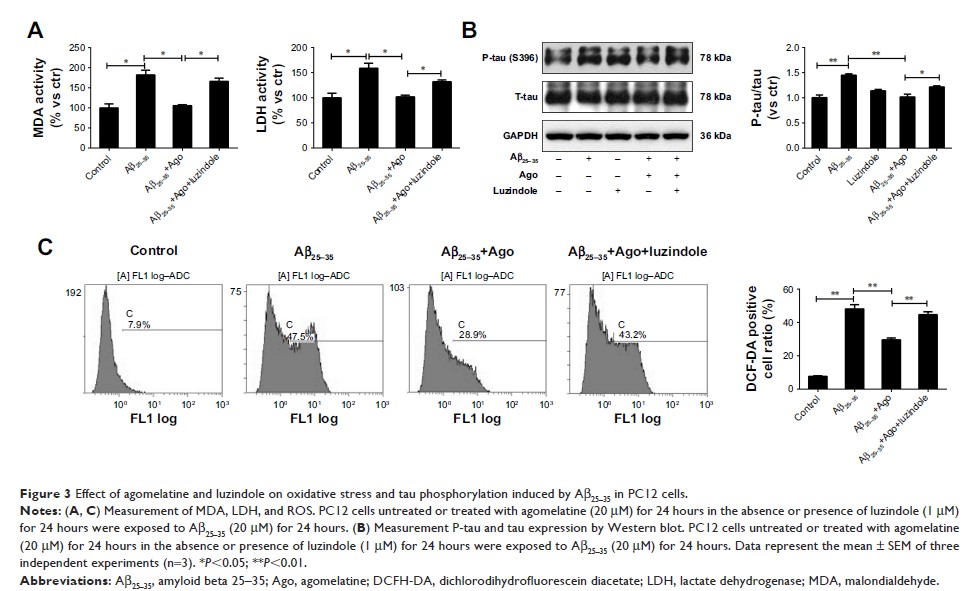
of malondialdehyde (MDA), LDH, and ROS was investigated to evaluate oxidative
damage. The expression of P-tau, tau, PTEN, P-Akt, Akt, P-GSK3β, and GSK3β
proteins was assessed by Western blotting. Our results demonstrated that Aβ25–35 significantly
increased the content of MDA, LDH, and ROS. Meanwhile, Aβ25–35 upregulated
the expression of P-tau and PTEN as well as downregulated P-Akt and P-GSK3β
expression. These effects could be blocked by agomelatine pretreatment.
Furthermore, luzindole, the melatonin receptor (MT) antagonist, could reverse
the neuroprotective effect of agomelatine.
Conclusion: The
results demonstrated that antidepressant agomelatine might prevent the tau
protein phosphorylation and oxidative damage induced by Aβ25–35 in PC12
cells by activating MT-PTEN/Akt/GSK3β signaling. This study provided a novel
therapeutic target for AD in the future.
Keywords: agomelatine,
Alzheimer’s disease, oxidative stress, tau hyperphosphorylation