115195
论文已发表
注册即可获取德孚的最新动态
IF 收录期刊
- 3.6 Breast Cancer (Dove Med Press)
- 4.3 Clin Epidemiol
- 2.6 Cancer Manag Res
- 3.2 Infect Drug Resist
- 4.1 Clin Interv Aging
- 6.1 Drug Des Dev Ther
- 4.1 Int J Chronic Obstr
- 8.7 Int J Nanomed
- 2.5 Int J Women's Health
- 3.2 Neuropsych Dis Treat
- 2.4 OncoTargets Ther
- 2.6 Patient Prefer Adher
- 2.6 Ther Clin Risk Manag
- 3.1 J Pain Res
- 3.5 Diabet Metab Synd Ob
- 4.5 Psychol Res Behav Ma
- 3.4 Nat Sci Sleep
- 2.4 Pharmgenomics Pers Med
- 2.6 Risk Manag Healthc Policy
- 4.6 J Inflamm Res
- 2.3 Int J Gen Med
- 3.9 J Hepatocell Carcinoma
- 3.3 J Asthma Allergy
- 2.5 Clin Cosmet Investig Dermatol
- 3.0 J Multidiscip Healthc

中国汉族先天性无痛无汗症患者的 NTRK1 临床特征异质性及突变分析
Authors Li N, Guo S, Wang Q, Duan G, Sun J, Liu Y, Zhang J, Wang C, Zhu C, Liu J, Zhang X
Received 24 September 2018
Accepted for publication 27 November 2018
Published 22 January 2019 Volume 2019:12 Pages 453—465
DOI https://doi.org/10.2147/JPR.S188566
Checked for plagiarism Yes
Review by Single-blind
Peer reviewers approved by Dr Colin Mak
Peer reviewer comments 3
Editor who approved publication: Dr Katherine Hanlon
Purpose: Congenital
insensitivity to pain with anhidrosis (CIPA) is a rare inherited disorder whose
core clinical features consist of no response to noxious stimuli and inability
to sweat under any conditions. Our goal was to characterize the details of
phenotypic and genotypic features in Chinese CIPA patients.
Patients and methods: Personal
data and clinical information were investigated by interview and physical
examination. DNA was extracted from blood samples of patients and their
available familial members and subjected to genetic analysis.
Results: A total
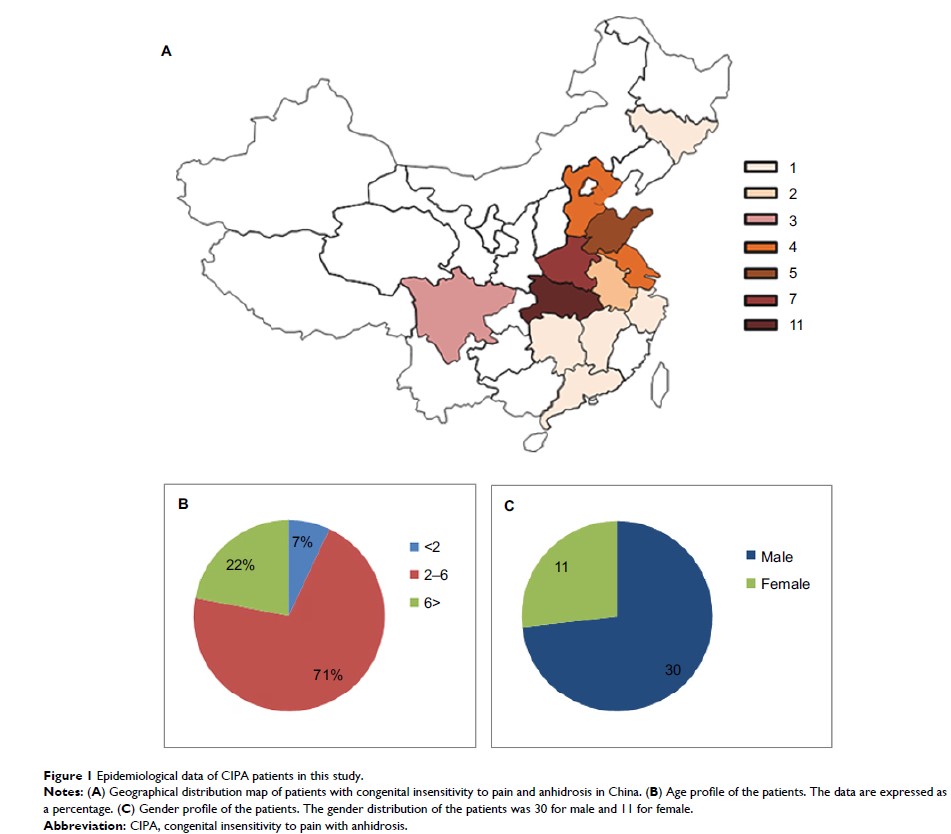
of 41 Han Chinese CIPA patients from 35 unrelated families were recruited. The
distribution of patients was mainly in the central and southern regions of
China, with a male to female ratio of 3:1 and a mortality rate of 7.3%.
Heterogeneity of clinical features, including pain insensitivity, temperature
sensation, and complications, were cataloged. Interestingly, some patients had
“visceral pain” sensation, and there was a significant difference in
temperature perception and thermal pain between individuals. The incidence of
bone and joint fractures was 49%. The characteristics of 19 mutations of NTRK1 in 41
patients, with five novel mutations, were identified. More than 63% of patients
had the splice mutation, c.851–33 T>A, which strongly suggests that it may
be a common pathogenic site in Han Chinese patients.
Conclusion: Current
findings expand our knowledge about the spectrum of phenotypic features and the
racial characteristics of NTRK1 mutations of CIPA patients in the Han
Chinese population.
Keywords: congenital
insensitivity to pain with anhidrosis, HASN IV, phenotype, NTRK1, mutation,
Chinese