115195
论文已发表
注册即可获取德孚的最新动态
IF 收录期刊
- 3.6 Breast Cancer (Dove Med Press)
- 4.3 Clin Epidemiol
- 2.6 Cancer Manag Res
- 3.2 Infect Drug Resist
- 4.1 Clin Interv Aging
- 6.1 Drug Des Dev Ther
- 4.1 Int J Chronic Obstr
- 8.7 Int J Nanomed
- 2.5 Int J Women's Health
- 3.2 Neuropsych Dis Treat
- 2.4 OncoTargets Ther
- 2.6 Patient Prefer Adher
- 2.6 Ther Clin Risk Manag
- 3.1 J Pain Res
- 3.5 Diabet Metab Synd Ob
- 4.5 Psychol Res Behav Ma
- 3.4 Nat Sci Sleep
- 2.4 Pharmgenomics Pers Med
- 2.6 Risk Manag Healthc Policy
- 4.6 J Inflamm Res
- 2.3 Int J Gen Med
- 3.9 J Hepatocell Carcinoma
- 3.3 J Asthma Allergy
- 2.5 Clin Cosmet Investig Dermatol
- 3.0 J Multidiscip Healthc

MicroRNA-339 通过靶向 ZNF689 抑制人肝细胞癌的增殖和侵袭
Authors Zeng H, Zheng J, Wen S, Luo J, Shao G, Zhang Y
Received 4 September 2018
Accepted for publication 28 December 2018
Published 22 January 2019 Volume 2019:13 Pages 435—445
DOI https://doi.org/10.2147/DDDT.S186352
Checked for plagiarism Yes
Review by Single-blind
Peer reviewers approved by Dr Cristina Weinberg
Peer reviewer comments 2
Editor who approved publication: Dr Sukesh Voruganti
Background: Hepatocellular
carcinoma (HCC) is the second leading cause of cancer mortality worldwide,
however, the prognosis for HCC remains unsatisfactory. This study aimed to
explore the role of miR-339-5p in HCC.
Methods: We first
used quantitative real-time PCR to examine the level of miR-339-5p in HCC
tissues. Then we further adopted Western blotting assay, CCK8, cell invasion
assays, apoptosis detection assay, and luciferase assay to analyze how it
mediate the development of HCC.
Results: We found
that miR-339 is significantly decreased in primary HCC tissues. Overexpression
of miR-339 in HCC cells remarkably suppressed proliferation and invasion and
induced apoptosis. However, silencing miR-339 in HCC cells promoted proliferation
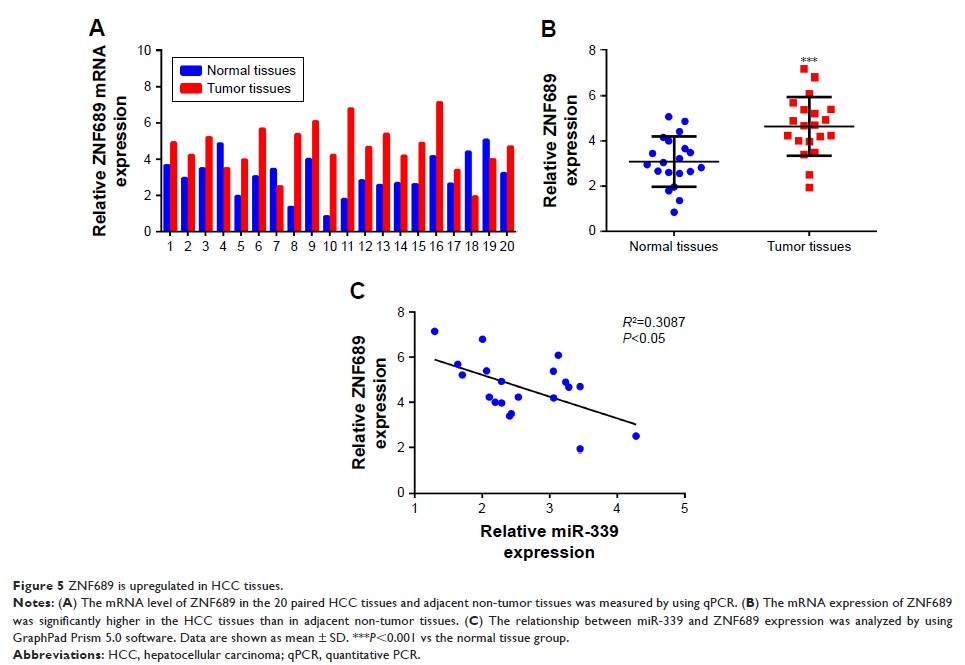
and invasion, and reduced apoptosis. Moreover, we demonstrated that ZNF689 is a
target of miR-339 and there is a negative correlation between miR-339 and
ZNF689 expression in the HCC tissues. Overexpression of ZNF689 in
miR-339-overexpressing HCC cells partially antagonized the inhibitory effects
of miR-339.
Conclusion: Our study
revealed that miR-339 inhibits HCC growth through targeting oncoprotein ZNF689
and restoration of miR-339 might be feasible therapeutic strategy for HCC
treatment.
Keywords: miR-339-5p,
HCC, ZNF689, treatment, proliferation