115195
论文已发表
注册即可获取德孚的最新动态
IF 收录期刊
- 3.6 Breast Cancer (Dove Med Press)
- 4.3 Clin Epidemiol
- 2.6 Cancer Manag Res
- 3.2 Infect Drug Resist
- 4.1 Clin Interv Aging
- 6.1 Drug Des Dev Ther
- 4.1 Int J Chronic Obstr
- 8.7 Int J Nanomed
- 2.5 Int J Women's Health
- 3.2 Neuropsych Dis Treat
- 2.4 OncoTargets Ther
- 2.6 Patient Prefer Adher
- 2.6 Ther Clin Risk Manag
- 3.1 J Pain Res
- 3.5 Diabet Metab Synd Ob
- 4.5 Psychol Res Behav Ma
- 3.4 Nat Sci Sleep
- 2.4 Pharmgenomics Pers Med
- 2.6 Risk Manag Healthc Policy
- 4.6 J Inflamm Res
- 2.3 Int J Gen Med
- 3.9 J Hepatocell Carcinoma
- 3.3 J Asthma Allergy
- 2.5 Clin Cosmet Investig Dermatol
- 3.0 J Multidiscip Healthc

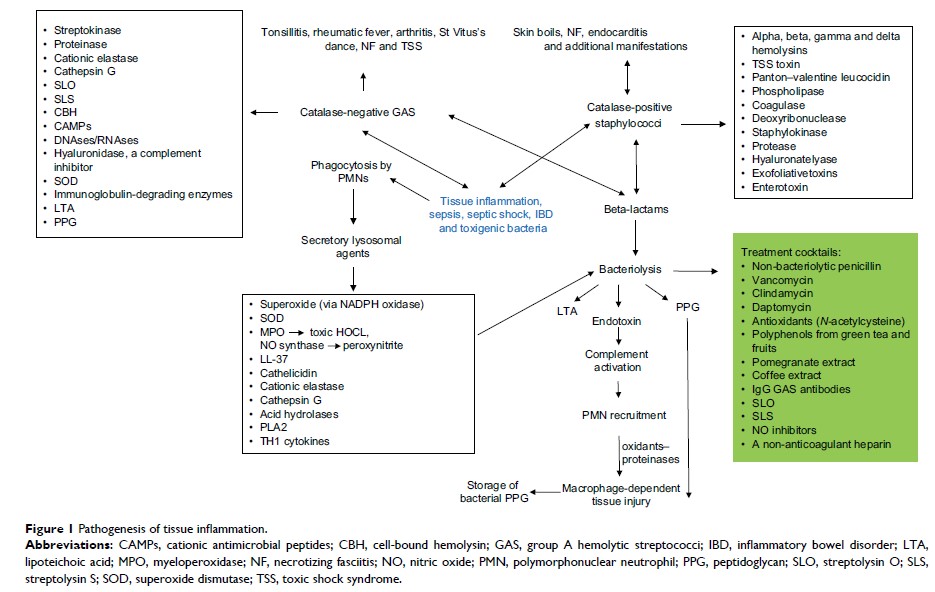
Pro-inflammatory agents released by pathogens, dying host cells, and neutrophils act synergistically to destroy host tissues: a working hypothesis
Authors Ginsburg I, Korem M, Koren E, Varani J
Received 7 October 2018
Accepted for publication 5 December 2018
Published 23 January 2019 Volume 2019:12 Pages 35—47
DOI https://doi.org/10.2147/JIR.S190007
Checked for plagiarism Yes
Review by Single-blind
Peer reviewers approved by Dr Colin Mak
Peer reviewer comments 2
Editor who approved publication: Dr Ning Quan
Abstract: We
postulate that the extensive cell and tissue damage inflicted by many
infectious, inflammatory and post-inflammatory episodes is an enled result of a
synergism among the invading microbial agents, host neutrophils and dead and
dying cells in the nidus. Microbial toxins and other metabolites along with the
plethora of pro-inflammatory agents released from activated neutrophils
massively recruited to the infectious sites and high levels of cationic
histones, other cationic peptides, proteinases and Th1 cytokines released from
activated polymorphonuclear neutrophils (PMNs) and from necrotized tissues may act
in concert (synergism) to bring about cell killing and tissue destruction.
Multiple, diverse interactions among the many potential pro-inflammatory
moieties have been described in these complex lesions. Such infections are
often seen in the skin and aerodigestive tract where the tissue is exposed to
the environment, but can occur in any tissue. Commonly, the tissue-destructive
infections are caused by group A streptococci, pneumococci, Staphylococcus aureus ,
meningococci, Escherichia coli and Shigella , although
many other microbial species are seen on occasion. All these microbial agents
are characterized by their ability to recruit large numbers of PMNs. Given the
complex nature of the disease process, it is proposed that, to treat these
multifactorial disorders, a “cocktail” of anti-inflammatory agents combined
with non-bacteriolytic antibiotics and measures to counteract the critical
toxic role of cationic moieties might prove more effective than a strategy
based on attacking the bacteria alone.
Keywords: synergism,
tissue damage, bacterial toxin, bacteriolysis, cationic proteins, sepsis