115195
论文已发表
注册即可获取德孚的最新动态
IF 收录期刊
- 3.6 Breast Cancer (Dove Med Press)
- 4.3 Clin Epidemiol
- 2.6 Cancer Manag Res
- 3.2 Infect Drug Resist
- 4.1 Clin Interv Aging
- 6.1 Drug Des Dev Ther
- 4.1 Int J Chronic Obstr
- 8.7 Int J Nanomed
- 2.5 Int J Women's Health
- 3.2 Neuropsych Dis Treat
- 2.4 OncoTargets Ther
- 2.6 Patient Prefer Adher
- 2.6 Ther Clin Risk Manag
- 3.1 J Pain Res
- 3.5 Diabet Metab Synd Ob
- 4.5 Psychol Res Behav Ma
- 3.4 Nat Sci Sleep
- 2.4 Pharmgenomics Pers Med
- 2.6 Risk Manag Healthc Policy
- 4.6 J Inflamm Res
- 2.3 Int J Gen Med
- 3.9 J Hepatocell Carcinoma
- 3.3 J Asthma Allergy
- 2.5 Clin Cosmet Investig Dermatol
- 3.0 J Multidiscip Healthc

ALOX5AP 基因多态性与缺血性卒中风险之间缺少关联:来自荟萃分析的证据
Authors Zheng J, Ning G, Xu W, Wen X, Ma X
Received 5 August 2018
Accepted for publication 3 October 2018
Published 25 January 2019 Volume 2019:15 Pages 357—367
DOI https://doi.org/10.2147/NDT.S182674
Checked for plagiarism Yes
Review by Single-blind
Peer reviewers approved by Dr Colin Mak
Peer reviewer comments 2
Editor who approved publication: Dr Yu-Ping Ning
Background: In recent
years, there has been substantial research evaluating the relationship between
arachidonate 5-lipoxygenase-activating protein (ALOX5AP )
polymorphisms and ischemic stroke (IS). The objective of this study was to
systematically review and analyze the existing evidence.
Methods: A
comprehensive search of major electronic databases for studies published
between 1990 and 2018 was carried out. Data were synthesized as OR and 95% CI
using fixed-effects and random-effects models.
Results: A total
of 30 studies were available for analysis. The aggregate sample size across all
studies was 32,782 (16,294 cases and 16,488 controls). We found no association
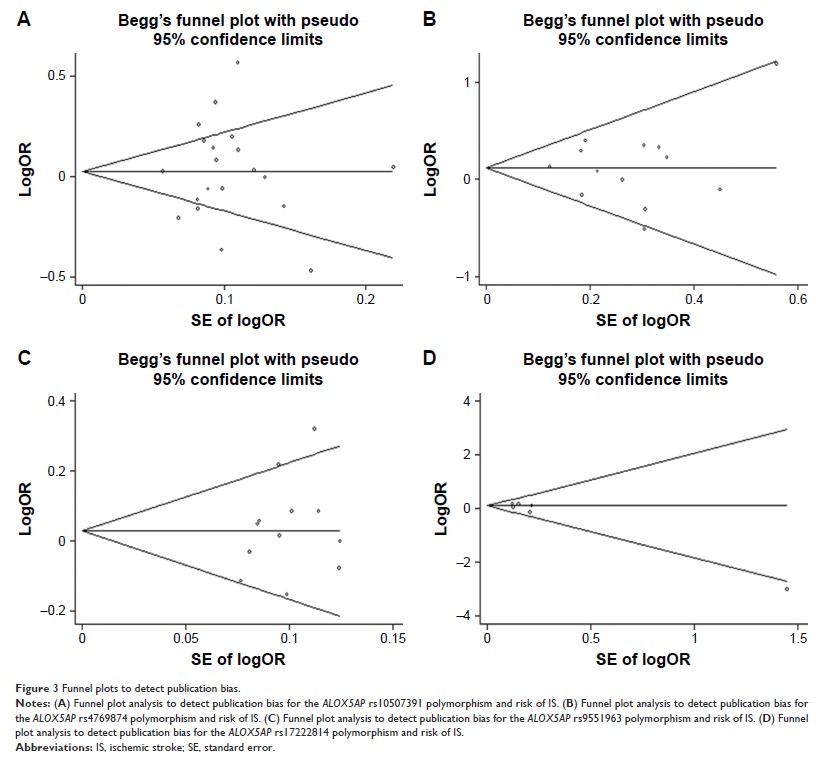
of the ALOX5AP rs10507391
(OR=1.03 for A allele vs T allele; 95% CI: 0.93–1.14; P =0.557), rs4769874
(OR=1.13 for A allele vs G allele; 95% CI: 1.00–1.28; P =0.050), rs9551963
(OR=1.03 for A allele vs C allele; 95% CI: 0.96–1.11; P =0.372),
rs17222814 (OR=1.09 for A allele vs G allele; 95% CI: 0.96–1.24; P =0.195),
rs17222919 (OR=0.89 for G allele vs T allele; 95% CI: 0.75–1.06; P =0.175), and
rs4073259 (OR=1.20 for A allele vs G allele; 95% CI: 1.00–1.45; P =0.056)
polymorphisms with IS risk. Haplotype analysis also did not yield significant
findings for the HapA (rs17222814G–rs10507391T–rs4769874G–rs9551963A; OR=1.20;
95% CI: 0.91–1.56; P =0.192) and HapB (rs17216473A–rs10507391A–rs9315050A–rs17222842G;
OR=1.11; 95% CI: 0.90–1.38; P =0.339) haplotypes.
Conclusion: Current
evidence does not support an association of rs10507391, rs4769874, rs9551963,
rs17222814, rs17222919, rs4073259, and HapA and HapB with IS risk.
Keywords: ischemic
stroke, ALOX5AP, genetic polymorphism, haplotype