115195
论文已发表
注册即可获取德孚的最新动态
IF 收录期刊
- 3.6 Breast Cancer (Dove Med Press)
- 4.3 Clin Epidemiol
- 2.6 Cancer Manag Res
- 3.2 Infect Drug Resist
- 4.1 Clin Interv Aging
- 6.1 Drug Des Dev Ther
- 4.1 Int J Chronic Obstr
- 8.7 Int J Nanomed
- 2.5 Int J Women's Health
- 3.2 Neuropsych Dis Treat
- 2.4 OncoTargets Ther
- 2.6 Patient Prefer Adher
- 2.6 Ther Clin Risk Manag
- 3.1 J Pain Res
- 3.5 Diabet Metab Synd Ob
- 4.5 Psychol Res Behav Ma
- 3.4 Nat Sci Sleep
- 2.4 Pharmgenomics Pers Med
- 2.6 Risk Manag Healthc Policy
- 4.6 J Inflamm Res
- 2.3 Int J Gen Med
- 3.9 J Hepatocell Carcinoma
- 3.3 J Asthma Allergy
- 2.5 Clin Cosmet Investig Dermatol
- 3.0 J Multidiscip Healthc

小儿腮腺粘液表皮样癌的肿瘤学转归
Authors Fang Q, Liu F, Seng D
Received 30 October 2018
Accepted for publication 31 December 2018
Published 29 January 2019 Volume 2019:11 Pages 1081—1085
DOI https://doi.org/10.2147/CMAR.S192788
Checked for plagiarism Yes
Review by Single-blind
Peer reviewers approved by Dr Andrew Yee
Peer reviewer comments 2
Editor who approved publication: Dr Kenan Onel
Background: The goal
of this study was to investigate the long-term oncologic outcome of parotid
mucoepidermoid carcinoma (MEC) in pediatric patients.
Patients and methods: Patients
<19 years old who were diagnosed with MEC from January 1990 to December
2017 were retrospectively enrolled in this study. The main analyzed
indexes included intraparotid node (IPN) metastasis,
neutrophil-tolymphocyte ratio (NLR), loco-regional control (LRC), and
disease-specific survival (DSS) rates.
Results: A total
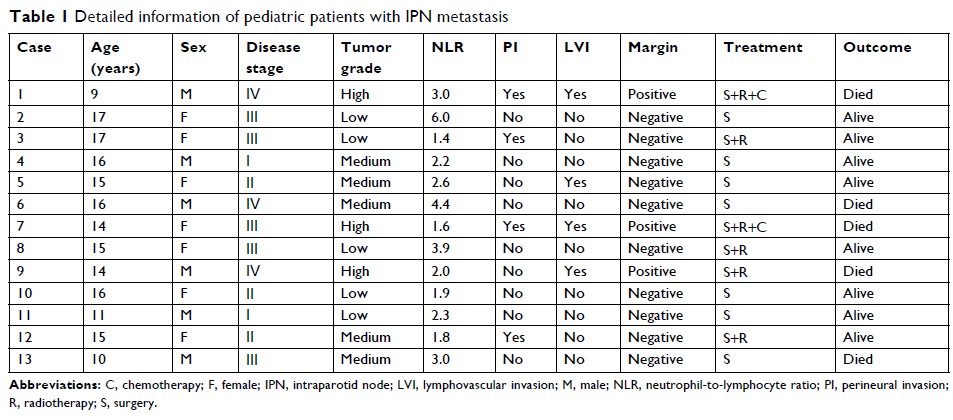
of 73 patients were enrolled. IPN metastasis occurred in 13 (17.8%) patients;
the mean value of the NLR was 2.48 (range: 1.3–6.1). Loco-regional recurrence
occurred in 12 patients, and 7 patients died of the disease. The 10-year LRC
and DSS rates were 83% and 88%, respectively. IPN metastasis remained
significantly related to recurrence in both univariate and Cox model analyses;
a high NLR was significantly associated with recurrence in the univariate
analysis but not in the Cox model. IPN metastasis remained significantly related
to disease-related death in both the univariate and Cox model analyses; a high
NLR was not associated with the DSS in univariate analysis.
Conclusion: The
long-term survival rate was relatively favorable in pediatric MEC. IPN
metastasis was an independent risk factor for loco-regional recurrence and DSS.
The role of the NLR in predicting survival in parotid cancer requires more
research.
Keywords: pediatric
cancer, salivary cancer, parotid cancer, mucoepidermoid carcinoma