115195
论文已发表
注册即可获取德孚的最新动态
IF 收录期刊
- 3.6 Breast Cancer (Dove Med Press)
- 4.3 Clin Epidemiol
- 2.6 Cancer Manag Res
- 3.2 Infect Drug Resist
- 4.1 Clin Interv Aging
- 6.1 Drug Des Dev Ther
- 4.1 Int J Chronic Obstr
- 8.7 Int J Nanomed
- 2.5 Int J Women's Health
- 3.2 Neuropsych Dis Treat
- 2.4 OncoTargets Ther
- 2.6 Patient Prefer Adher
- 2.6 Ther Clin Risk Manag
- 3.1 J Pain Res
- 3.5 Diabet Metab Synd Ob
- 4.5 Psychol Res Behav Ma
- 3.4 Nat Sci Sleep
- 2.4 Pharmgenomics Pers Med
- 2.6 Risk Manag Healthc Policy
- 4.6 J Inflamm Res
- 2.3 Int J Gen Med
- 3.9 J Hepatocell Carcinoma
- 3.3 J Asthma Allergy
- 2.5 Clin Cosmet Investig Dermatol
- 3.0 J Multidiscip Healthc

本文章已被撤回:STAT3 和 VEGFR2 通路的联合抑制对非小细胞肺癌细胞放射敏感性的影响
Authors Hu C, Zhuang W, Qiao Y, Liu B, Liu L, Hui K, Jiang X
Received 5 September 2018
Accepted for publication 17 December 2018
Published 29 January 2019 Volume 2019:12 Pages 933—944
DOI https://doi.org/10.2147/OTT.S186559
Checked for plagiarism Yes
Review by Single-blind
Peer reviewers approved by Dr Andrew Yee
Peer reviewer comments 3
Editor who approved publication: Dr Arseniy Yuzhalin
***本文章已被撤回***
Purpose: The goals
of this study were to determine the effects of combined inhibition of STAT3 and
vascular endothelial growth factor receptor 2 (VEGFR2) pathways on the
radiosensitivity of non-small-cell lung cancer (NSCLC) cells, and to assess the
underlying mechanisms.
Methods: The
expressions of VEGFR2, STAT3, related signaling molecules, hypoxia-inducible
factor 1-alpha (HIF-1α), and cyclin D1 were determined by Western blotting.
Radiosensitivity was assessed using the colony-forming assay, and cell cycle
and cell death were analyzed by flow cytometry. A nude mouse xenograft tumor
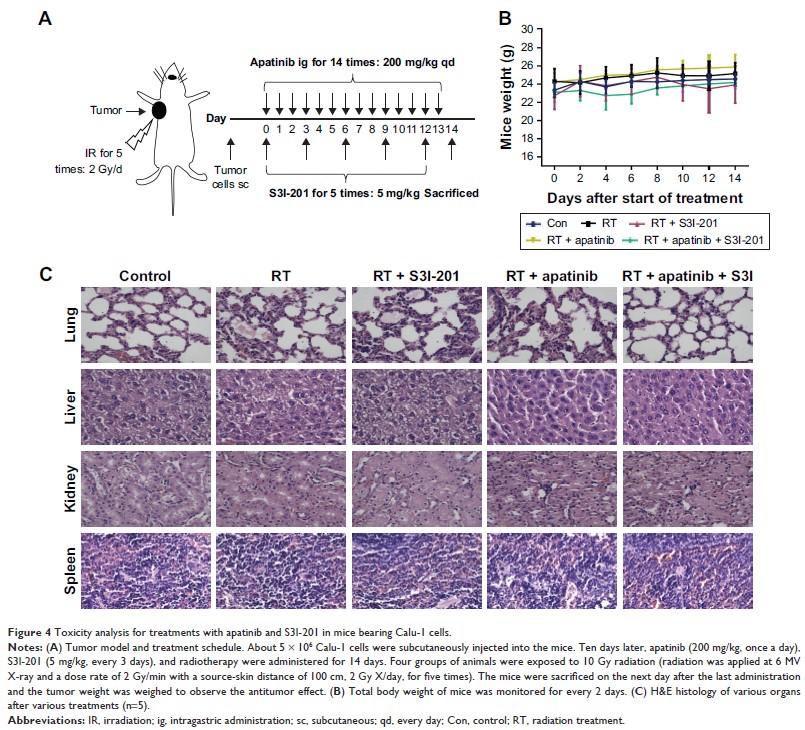
model of Calu-1 cells was established. The hepatorenal toxicity of the
above-mentioned treatment on tumor-bearing mice was observed by H&E
staining. The expression of STAT3, VEGFR2, HIF-1α, and cyclin D1 of the
transplanted tumor tissues was detected by immunohistochemistry. Apoptosis of
tumor tissues was evaluated by TUNEL staining.
Results: In vitro,
we selected two cell lines with high expression levels of STAT3, including
Calu-1 cells that exhibit high VEGFR2 expression and A549 cells that exhibit
low VEGFR2 expression. When apatinib treatment was combined with S3I-201, the
expression of VEGFR2, STAT3, and their downstream signaling molecules was
significantly decreased (P <0.01). There was an increase in cell death and
G2/M phase arrest after treatments, with the most significant changes occurring
upon dual inhibition of STAT3 and VEGFR2 (P <0.01). In vivo, combined treatment of
radiotherapy and dual inhibition of VEGFR2 and STAT3 was well tolerated and did
not deliver additional toxicity. Compared with the control group and the
radiation treatment (RT) + apatinib or RT + S3I-201 duplex group, the
expression level of STAT3, p-STAT3, VEGFR2, HIF-1α, and cyclin D1 in the triple
group (RT + apatinib + S3I-201) was the lowest, and the proportion of apoptotic
cells was the highest (P <0.05).
Conclusion: The
combined inhibition of VEGFR2 and STAT3 is effective in enhancing
radiosensitizing effects in NSCLC cells.
Keywords: STAT3,
VEGFR2, non-small-cell lung cancer, radiosensitivity