115195
论文已发表
注册即可获取德孚的最新动态
IF 收录期刊
- 3.6 Breast Cancer (Dove Med Press)
- 4.3 Clin Epidemiol
- 2.6 Cancer Manag Res
- 3.2 Infect Drug Resist
- 4.1 Clin Interv Aging
- 6.1 Drug Des Dev Ther
- 4.1 Int J Chronic Obstr
- 8.7 Int J Nanomed
- 2.5 Int J Women's Health
- 3.2 Neuropsych Dis Treat
- 2.4 OncoTargets Ther
- 2.6 Patient Prefer Adher
- 2.6 Ther Clin Risk Manag
- 3.1 J Pain Res
- 3.5 Diabet Metab Synd Ob
- 4.5 Psychol Res Behav Ma
- 3.4 Nat Sci Sleep
- 2.4 Pharmgenomics Pers Med
- 2.6 Risk Manag Healthc Policy
- 4.6 J Inflamm Res
- 2.3 Int J Gen Med
- 3.9 J Hepatocell Carcinoma
- 3.3 J Asthma Allergy
- 2.5 Clin Cosmet Investig Dermatol
- 3.0 J Multidiscip Healthc

溶藻弧菌对头孢他啶耐药的代谢机制
Authors Liu SR, Peng XX, Li H
Received 10 July 2018
Accepted for publication 4 January 2019
Published 13 February 2019 Volume 2019:12 Pages 417—429
DOI https://doi.org/10.2147/IDR.S179639
Checked for plagiarism Yes
Review by Single-blind
Peer reviewers approved by Dr Colin Mak
Peer reviewer comments 4
Editor who approved publication: Dr Eric Nulens
Background: Microbial
metabolism confounds antibiotic efficacy. However, information regarding effect
of metabolism on cephalosporin antibiotics-mediated killing and Vibrio spp is
largely absence, although the drugs are widely used in clinic and the bacteria
are pathogens to both human and aquaculture animals.
Purpose: This
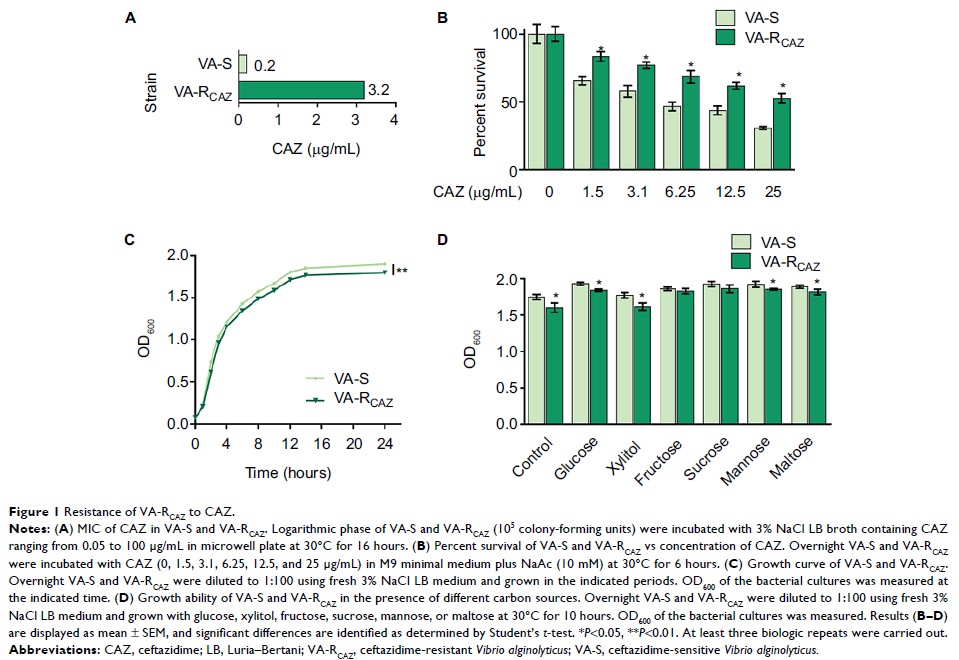
study explores the metabolome of cephalosporin antibiotic-resistant Vibrio alginolyticus and
analyzes the role of bacterial metabolism in drug and multidrug-resistance.
Results: The
metabolomes of isogenic ceftazidime-resistant V. alginolyticus (VA-RCAZ) and
ceftazidime-sensitive V. alginolyticus (VA-S) were analyzed using gas
chromatography -mass spectrometry. The metabolome of VA-RCAZ is
characterized by inefficient respiration, an inefficient pyruvate cycle (P
cycle), increased biosynthesis of fatty acids and decreased membrane proton
motive force. This hypothesis was confirmed by the fact that furfural and
malonate, inhibitors of pyruvate dehydrogenase and succinate dehydrogenase (P
cycle enzymes), respectively, increased resistance of VA-RCAZ to
antibiotics, while exposure to triclosan, to inhibit biosynthesis of fatty
acids, decreased resistance.
Conclusion: These
results contribute to our understanding of mechanisms of bacterial
antibiotic-resistance and may lead to more effective approaches to treat,
manage or prevent infections caused by antibiotic-resistant pathogens including
those of the Vibrio species.
Keywords: antibiotic
resistance, cephalosporin, central carbon metabolism, pyruvate cycle,
biosynthesis of fatty acids, metabolomics