115195
论文已发表
注册即可获取德孚的最新动态
IF 收录期刊
- 3.6 Breast Cancer (Dove Med Press)
- 4.3 Clin Epidemiol
- 2.6 Cancer Manag Res
- 3.2 Infect Drug Resist
- 4.1 Clin Interv Aging
- 6.1 Drug Des Dev Ther
- 4.1 Int J Chronic Obstr
- 8.7 Int J Nanomed
- 2.5 Int J Women's Health
- 3.2 Neuropsych Dis Treat
- 2.4 OncoTargets Ther
- 2.6 Patient Prefer Adher
- 2.6 Ther Clin Risk Manag
- 3.1 J Pain Res
- 3.5 Diabet Metab Synd Ob
- 4.5 Psychol Res Behav Ma
- 3.4 Nat Sci Sleep
- 2.4 Pharmgenomics Pers Med
- 2.6 Risk Manag Healthc Policy
- 4.6 J Inflamm Res
- 2.3 Int J Gen Med
- 3.9 J Hepatocell Carcinoma
- 3.3 J Asthma Allergy
- 2.5 Clin Cosmet Investig Dermatol
- 3.0 J Multidiscip Healthc

Dicerandrol B: 天然咕吨酬二聚体通过内质网应激和线粒体损伤诱导宫颈癌海拉细胞凋亡
Authors Gao DD, Guo ZM, Wang JB, Hu GF, Su YQ, Chen LJ, Lv QW, Yu HM, Qin JC, Xu W
Received 17 October 2018
Accepted for publication 3 January 2019
Published 13 February 2019 Volume 2019:12 Pages 1185—1193
DOI https://doi.org/10.2147/OTT.S191204
Checked for plagiarism Yes
Review by Single-blind
Peer reviewers approved by Dr Cristina Weinberg
Peer reviewer comments 3
Editor who approved publication: Dr Sanjay Singh
Background: Dicerandrol
B is a natural antitumor agent that can be isolated from the endophytic
fungus, Phomopsis sp. The present
study investigated the effects of dicerandrol B on human cervical cancer HeLa
cells.
Materials and methods: In this
study, dicerandrol B was identified by electrospray ionization mass
spectrometry and nuclear magnetic resonance spectroscopy. We used MTT to detect
the cell viability. Flow cytometry was used to analyze the apoptosis and cell
cycle. Western blot was used to examine the expression of related proteins.
Results: Dicerandrol
B was isolated from the endophytic fungus Phomopsis sp.
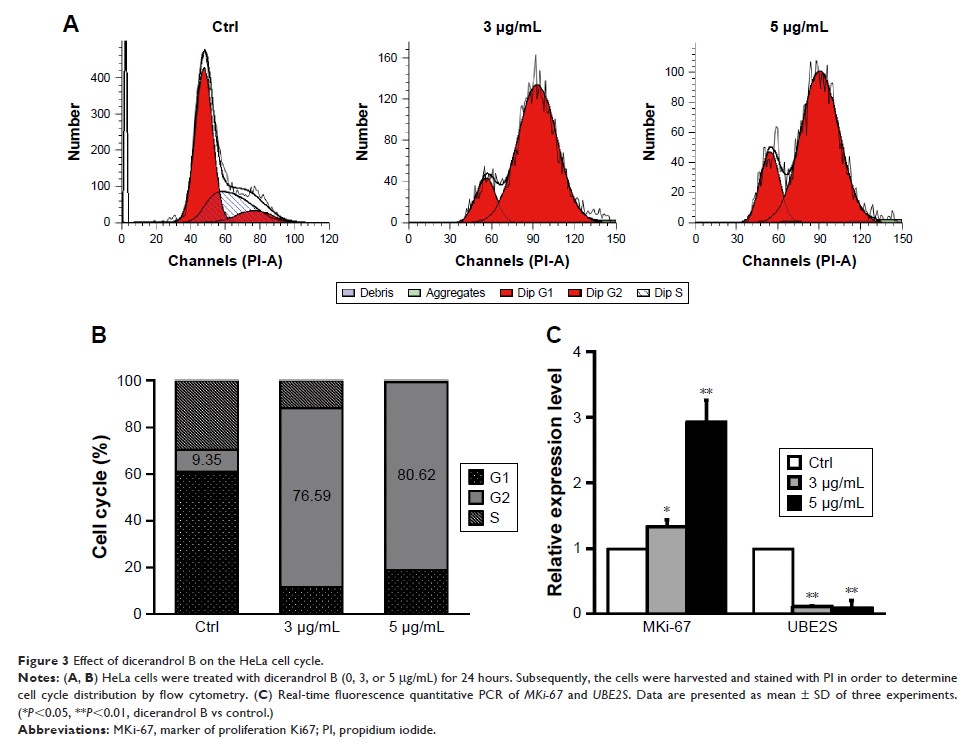
The MTT assay and flow cytometry showed that dicerandrol B significantly
inhibited HeLa cell viability and induced G2/M cell cycle arrest. Western blot
analysis demonstrated that dicerandrol B increased the levels of GRP78,
ubiquitin, cleaved PARP, and Bax protein, decreased the levels of PARP and
Bcl-2 protein, and caused an increase in the Bax/Bcl-2 ratio in HeLa cells.
Dicerandrol B increased the production of ROS in HeLa cells, which was
attenuated by the antioxidant N -acetyl-l-cysteine.
Conclusion: These
findings suggest that dicerandrol B induces apoptosis in human HeLa cells,
possibly through the endoplasmic reticulum stress and mitochondrial apoptotic
pathways. This suggests that dicerandrol B possesses strong anticancer activity
in cervical cancer and provides insight into the underlying mechanisms.
Keywords: apoptosis,
cervical cancer, endoplasmic reticulum stress, mitochondrial damage