115195
论文已发表
注册即可获取德孚的最新动态
IF 收录期刊
- 3.6 Breast Cancer (Dove Med Press)
- 4.3 Clin Epidemiol
- 2.6 Cancer Manag Res
- 3.2 Infect Drug Resist
- 4.1 Clin Interv Aging
- 6.1 Drug Des Dev Ther
- 4.1 Int J Chronic Obstr
- 8.7 Int J Nanomed
- 2.5 Int J Women's Health
- 3.2 Neuropsych Dis Treat
- 2.4 OncoTargets Ther
- 2.6 Patient Prefer Adher
- 2.6 Ther Clin Risk Manag
- 3.1 J Pain Res
- 3.5 Diabet Metab Synd Ob
- 4.5 Psychol Res Behav Ma
- 3.4 Nat Sci Sleep
- 2.4 Pharmgenomics Pers Med
- 2.6 Risk Manag Healthc Policy
- 4.6 J Inflamm Res
- 2.3 Int J Gen Med
- 3.9 J Hepatocell Carcinoma
- 3.3 J Asthma Allergy
- 2.5 Clin Cosmet Investig Dermatol
- 3.0 J Multidiscip Healthc

肝细胞癌和动脉分流术患者使用药物洗脱珠进行经动脉化疗栓塞的安全性和有效性评估:一个单中心体验
Authors Xiao YD, Ma C, Zhang ZS, Liu J
Received 8 November 2018
Accepted for publication 19 January 2019
Published 15 February 2019 Volume 2019:11 Pages 1551—1557
DOI https://doi.org/10.2147/CMAR.S193948
Checked for plagiarism Yes
Review by Single-blind
Peer reviewers approved by Dr Andrew Yee
Peer reviewer comments 2
Editor who approved publication: Dr Antonella D'Anneo
Objective: To
evaluate the feasibility and safety of transarterial chemoembolization with
drug-eluting beads (DEB-TACE) in patients with hepatocellular carcinoma (HCC)
and arterioportal shunts (APSs).
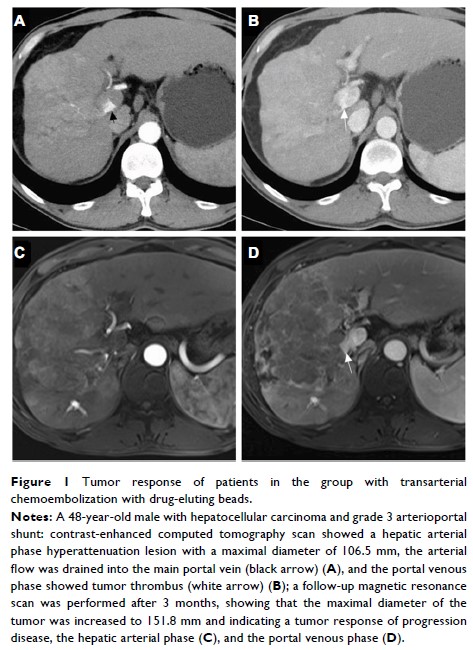
Materials and methods: Fifty-eight
patients with unresectable HCC and APSs who were treated with DEB-TACE (n=26)
or polyvinyl alcohol (PVA) plus TACE (PVA-TACE, n=32) were included in this
retrospective study. The tumor response was evaluated by the modified Response
Evaluation Criteria in Solid Tumors. Toxicity was graded by the Common
Terminology Criteria for Adverse Events version 5.0 (CTCAE v5.0) and compared between
the two groups. Survival curves were calculated by the Kaplan–Meier method and
compared by the log-rank test between the two groups. The influence of
potential prognostic factors on survival in the DEB-TACE group was analyzed via
a multivariate Cox regression model.
Results: The
disease control rate was better in the DEB-TACE group than in the PVA-TACE
group. The median survival times were 346 and 274 days in the DEB-TACE group
and PVA-TACE group, respectively. There was no significant difference in survival
rates between the two groups (P =0.081). Patients treated with DEB-TACE were
significantly less likely to have fever (P =0.048) or a low-grade (grade 1–2) increase in
transaminases (P =0.046)
than the patients treated with PVA-TACE. The potential predictive prognostic
factors in the DEB-TACE group were tumor response, APS grading, and serum
bilirubin.
Conclusion: DEB-TACE
may be feasible and safe in HCC patients with APS. Survival in the DEB-TACE
group was associated with tumor response, APS grading, and serum bilirubin
levels.
Keywords: carcinoma,
hepatocellular, chemoembolization, therapeutic, microspheres, arteriovenous
fistula