115195
论文已发表
注册即可获取德孚的最新动态
IF 收录期刊
- 3.6 Breast Cancer (Dove Med Press)
- 4.3 Clin Epidemiol
- 2.6 Cancer Manag Res
- 3.2 Infect Drug Resist
- 4.1 Clin Interv Aging
- 6.1 Drug Des Dev Ther
- 4.1 Int J Chronic Obstr
- 8.7 Int J Nanomed
- 2.5 Int J Women's Health
- 3.2 Neuropsych Dis Treat
- 2.4 OncoTargets Ther
- 2.6 Patient Prefer Adher
- 2.6 Ther Clin Risk Manag
- 3.1 J Pain Res
- 3.5 Diabet Metab Synd Ob
- 4.5 Psychol Res Behav Ma
- 3.4 Nat Sci Sleep
- 2.4 Pharmgenomics Pers Med
- 2.6 Risk Manag Healthc Policy
- 4.6 J Inflamm Res
- 2.3 Int J Gen Med
- 3.9 J Hepatocell Carcinoma
- 3.3 J Asthma Allergy
- 2.5 Clin Cosmet Investig Dermatol
- 3.0 J Multidiscip Healthc

在双介孔二氧化硅纳米球中多个金纳米颗粒的限制生长,用于改进计算机断层扫描成像和光热治疗
Authors Qin L, Niu D, Jiang Y, He J, Jia X, Zhao W, Li P, Li YS
Received 16 August 2018
Accepted for publication 17 December 2018
Published 25 February 2019 Volume 2019:14 Pages 1519—1532
DOI https://doi.org/10.2147/IJN.S184192
Checked for plagiarism Yes
Review by Single-blind
Peer reviewers approved by Dr Andrew Yee
Peer reviewer comments 3
Editor who approved publication: Dr Lei Yang
Introduction: In this
work, we have developed a novel “confined-growth” strategy to synthesize
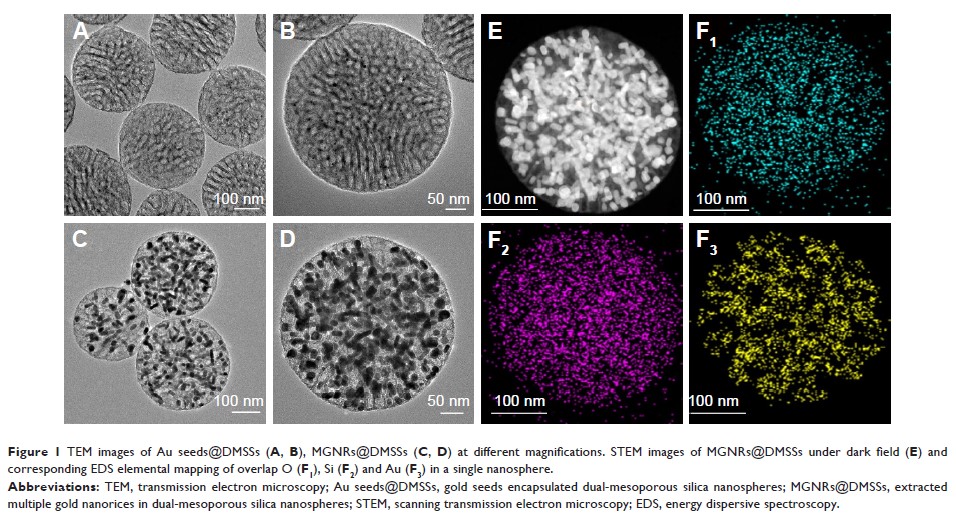
PEGylated multiple gold nanorices-encapsulated dual-mesoporous silica
nanospheres (designated as PEGylated MGNRs@DMSSs) containing both small
mesopores (2.5 nm) in the shell and large mesopores (21.7 nm) in the core based
on a well-established, seed-mediated growth method. The photothermal effect and
CT imaging ability were also studied.
Methods: The
nanoparticles were characterized by Fourier transform infrared (FT-IR) spectra,
N2 absorption isotherms, Field-emission scanning electron microscopy (FE-SEM),
Transmission electron microscopy (TEM), Inductively coupled plasma atomic
emission spectroscopy (ICP-AES) and Confocal microscopy.
Results: The
longitudinally-localized surface (LSPR) absorption properties of MGNRs@DMSSs
can be easily tuned by altering the amount of HAuCl4 in the
gold growth solution. Additionally, the resultant PEGylated MGNRs@DMSSs have
monodispersed, spherical morphology and good colloidal stability in an aqueous
solution. More importantly, when exposed to NIR irradiation, the PEGylated
MGNRs@DMSSs exhibit both higher temperature increments and better photothermal
effects than that of single PEGylated gold nanorods at nearly an equivalent
LSPR absorption. In addition, as CT contrast agents, the PEGylated MGNRs@DMSSs
display a better CT imaging performance, in comparison with single PEGylated
gold nanorods at the same Au concentration.
Conclusion: Taken
together, results indicate the potential for MGNRs@DMSSs used in CT
imaging-guided photothermal therapy. Such a simple “confined-growth” strategy
within a porous matrix offers a promising platform to design and prepare novel
metal(s) oxide@silica nanocomposites for use in further cancer bio-imaging and
therapy.
Keywords: gold
nanorices, dual-mesoporous silica, confined growth, imaging, photothermal
effect