115195
论文已发表
注册即可获取德孚的最新动态
IF 收录期刊
- 3.6 Breast Cancer (Dove Med Press)
- 4.3 Clin Epidemiol
- 2.6 Cancer Manag Res
- 3.2 Infect Drug Resist
- 4.1 Clin Interv Aging
- 6.1 Drug Des Dev Ther
- 4.1 Int J Chronic Obstr
- 8.7 Int J Nanomed
- 2.5 Int J Women's Health
- 3.2 Neuropsych Dis Treat
- 2.4 OncoTargets Ther
- 2.6 Patient Prefer Adher
- 2.6 Ther Clin Risk Manag
- 3.1 J Pain Res
- 3.5 Diabet Metab Synd Ob
- 4.5 Psychol Res Behav Ma
- 3.4 Nat Sci Sleep
- 2.4 Pharmgenomics Pers Med
- 2.6 Risk Manag Healthc Policy
- 4.6 J Inflamm Res
- 2.3 Int J Gen Med
- 3.9 J Hepatocell Carcinoma
- 3.3 J Asthma Allergy
- 2.5 Clin Cosmet Investig Dermatol
- 3.0 J Multidiscip Healthc

预先加载米托蒽醌的水反应性磷脂 - 无定形碳酸钙混合纳米粒子,用于靶向和有效的癌症治疗
Authors Wang C, Han M, Liu X, Chen S, Hu F, Sun J, Yuan H
Received 9 November 2018
Accepted for publication 12 January 2019
Published 25 February 2019 Volume 2019:14 Pages 1503—1517
DOI https://doi.org/10.2147/IJN.S193976
Checked for plagiarism Yes
Review by Single-blind
Peer reviewers approved by Dr Govarthanan Muthusamy
Peer reviewer comments 2
Editor who approved publication: Dr Linlin Sun
Background: The
application of mitoxantrone (MIT) in cancer therapy has been severely limited
by its inherent drawbacks. In addition, effective cancer therapy calls for drug
release systems capable of enforcing drug release within cancer cells in
response to infinite stimulant with enhanced drug penetration capability.
Methods: MIT-preloaded
phospholipid-amorphous calcium carbonate hybrid nanoparticles (PL/ACC-MIT) that
surface modified with PL shell (containing shielding polymer polyethylene
glycol and targeting moiety folic acid) were prepared by a facile
solvent-diffusion method.
Results: It has
been proven that the resulting PL/ACC-MIT nanoparticles demonstrated
satisfactory stability against various aqueous environments with minimal drug
leakage and exerted strong targeting capability but selective preference to the
folate receptor-overexpressing cell line. In contrast, once exposed to the
enzyme-abundant and acidic environments of cancer cells, the PL/ACC-MIT
nanoparticles can readily decompose to facilitate quick drug release and
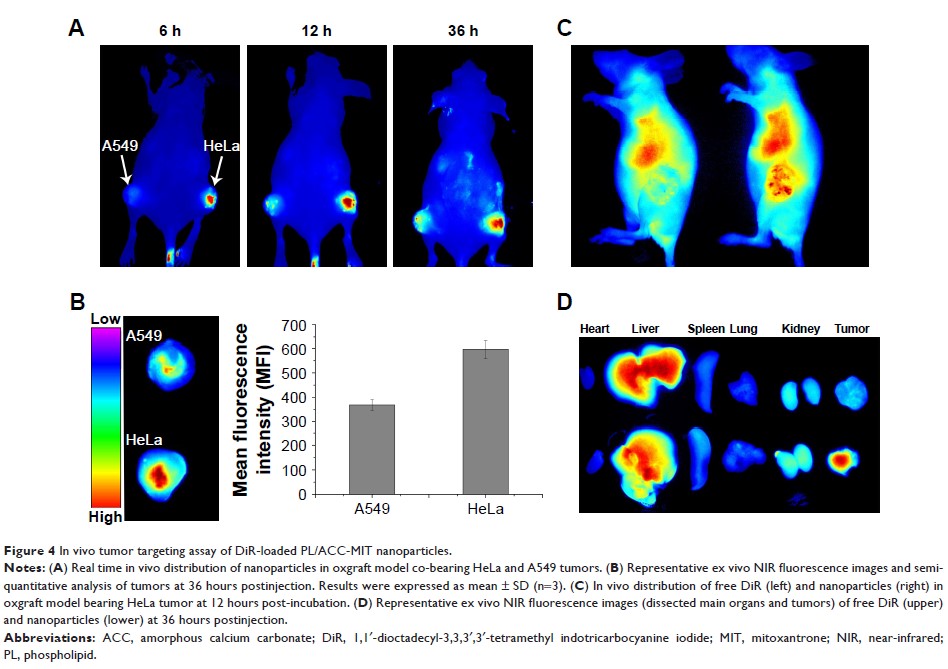
enhanced drug penetration to yield preferable antitumor effect both in vitro
and in vivo.
Conclusion: In this
study, MIT-preloaded water-responsive hybrid nanoparticles with increased
stability, targetability, controlled drug release, and enhanced drug
penetration were successfully developed, which might be a candidate for
targeted and effective cancer therapy.
Keywords: mitoxantrone,
water responsive, hybrid nanoparticles, amorphous calcium carbonate, cancer
therapy